




NPS photo. LocationThe President's House Site is located at the corner of 6th and Market Streets. This is an outdoor exhibit, and can be entered from either Market Street or 6th Street. Hours and FeesOpen daily from 7 am–10 pm, year round. Admission is FREE. TicketingNo tickets are required to visit the President's House Site. It is an outdoor exhibit that visitors explore at their own pace. AccessibilityThe President's House Site is wheelchair accessible. The videos are open captioned. Learn more about the accessibility services offered throughout the park on our website. New ExhibitsThis will be a self-guided exhibit. 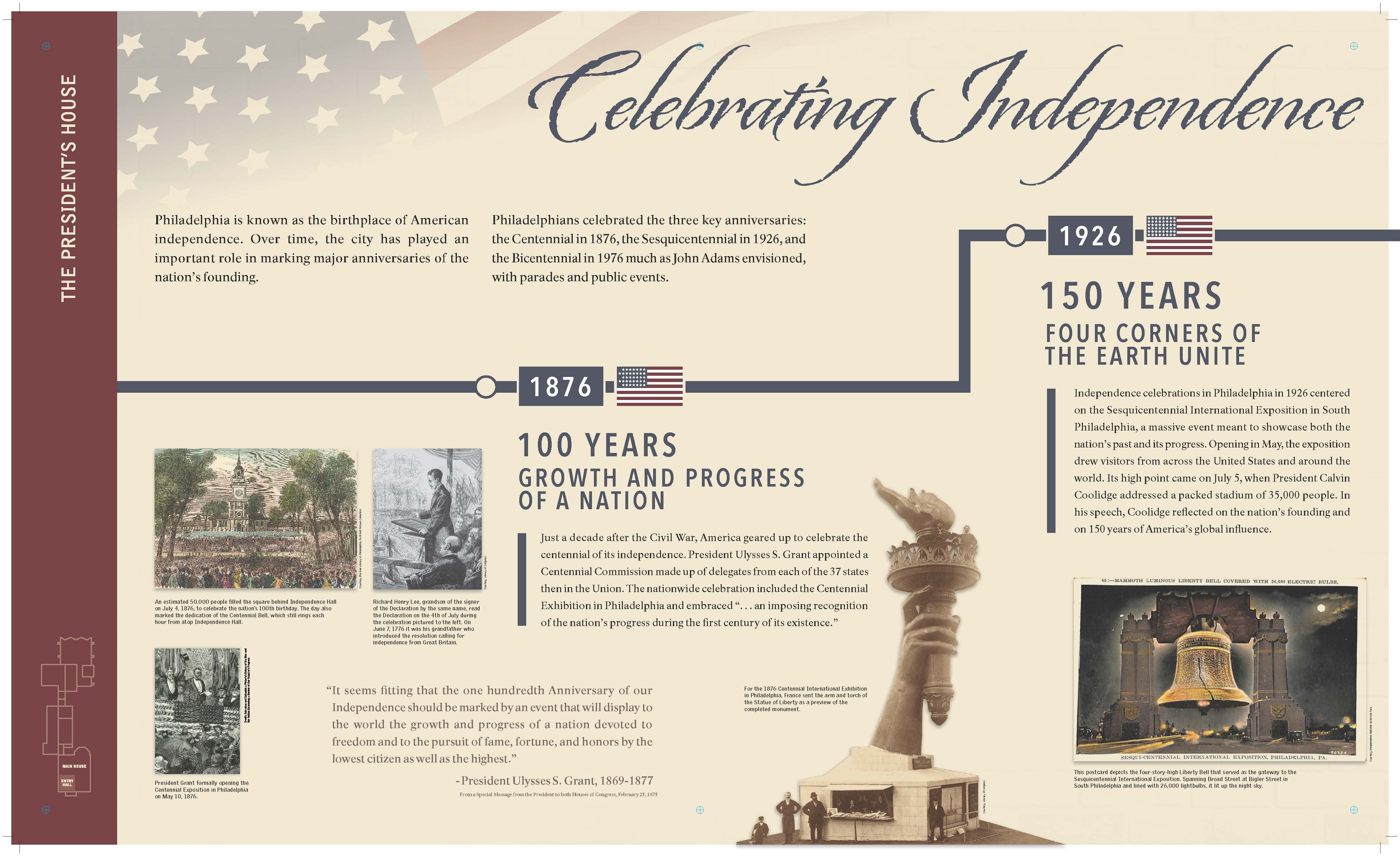 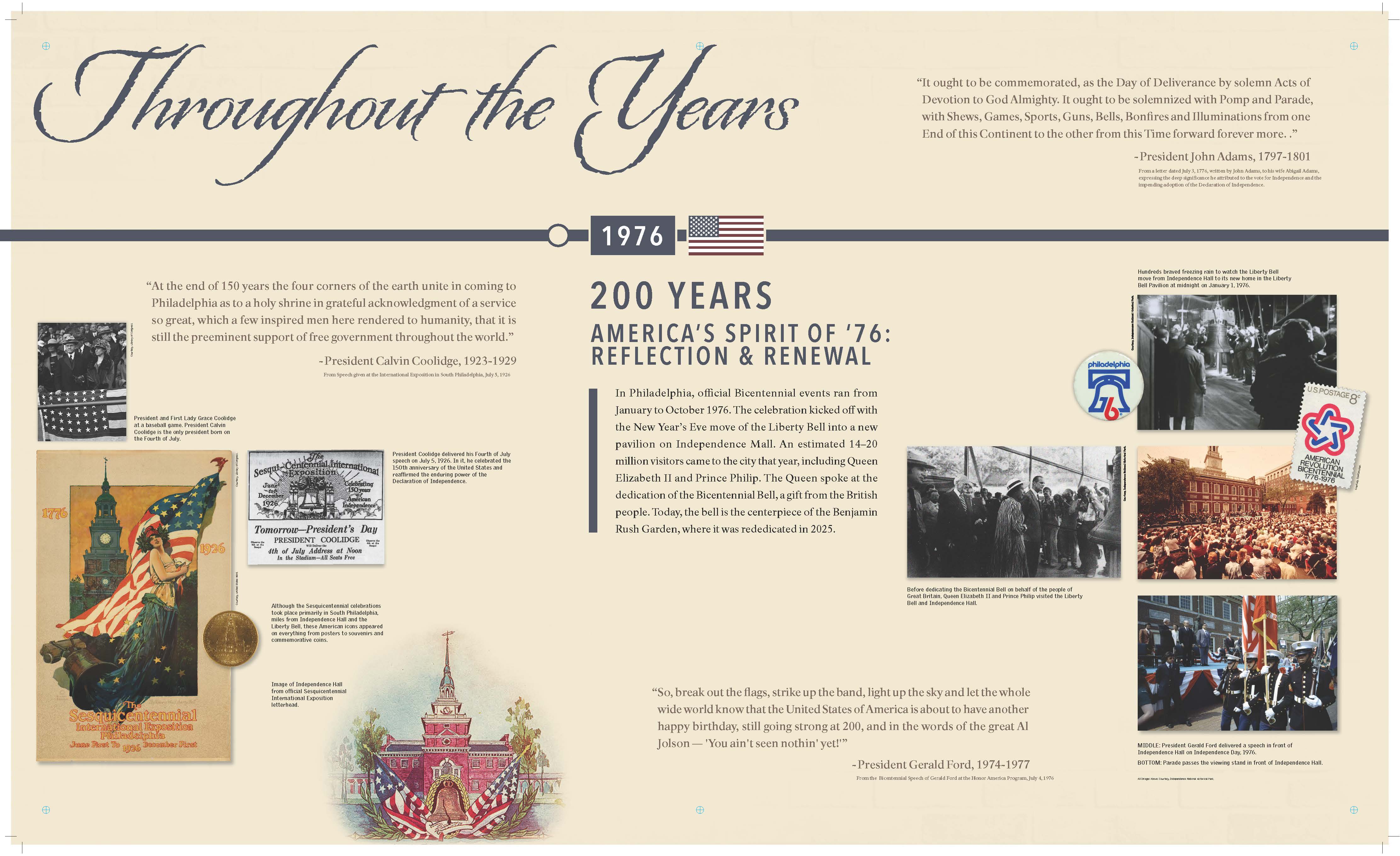
Alt Text for Exhibit Panel: Celebrating Independence Throughout the YearsCelebrating Independence Throughout the YearsPhiladelphia is known as the birthplace of American independence. Over time, the city has played an important role in marking major anniversaries of the nation’s founding. Philadelphians celebrated the three key anniversaries: the Centennial in 1876, the Sesquicentennial in 1926, and the Bicentennial in 1976 much as John Adams envisioned, with parades and public events. 1876: 100 YearsGrowth and Progress of a NationJust a decade after the Civil War, America geared up to celebrate the centennial of its independence. President Ulysses S. Grant appointed a Centennial Commission made up of delegates from each of the 37 states then in the Union. The nationwide celebration included the Centennial Exhibition in Philadelphia and embraced “...an imposing recognition of the nation’s progress during the first century of its existence.” Image: illustration of a crowd around Independence Hall. An estimated 50,000 people filled the square behind Independence Hall on July 4, 1876, to celebrate the nation’s 100th birthday. The day also marked the dedication of the Centennial Bell, which still rings each hour from atop Independence Hall. Image: illustration of a man speaking to a crowd from a stage. Richard Henry Lee, grandson of the signer of the Declaration by the same name, read the Declaration on the 4th of July during the celebration pictured to the left. On June 7, 1776 it was his grandfather who introduced the resolution calling for independence from Great Britain. Image: illustration of a man in a tuxedo speaking to a celebrating crowd. President Grant formally opening the Centennial Exposition in Philadelphia on May 10, 1876. “It seems fitting that the one hundredth Anniversary of our Independence should be marked by an event that will display to the world the growth and progress of a nation devoted to freedom and to the pursuit of fame, fortune, and honors by the lowest citizen as well as the highest.” -President Ulysses S. Grant, 1869-1877. From a Special Message from the President to both Houses of Congress, February 25, 1875. Image: photo of several men posing in front of a single arm from the Statue of Liberty. For the 1876 Centennial International Exhibition in Philadelphia, France sent the arm and torch of the Statue of Liberty as a preview of the completed monument. 1926: 150 YearsFour Corners of the Earth UniteIndependence celebrations in Philadelphia in 1926 centered on the Sesquicentennial International Exposition in South Philadelphia, a massive event meant to showcase both the nation’s past and its progress. Opening in May, the exposition drew visitors from across the United States and around the world. Its high point came on July 5, when President Calvin Coolidge addressed a packed stadium of 35,000 people. In his speech, Coolidge reflected on the nation’s founding and on 150 years of America’s global influence. Image: a postcard illustration of a giant, golden version of the Liberty Bell. This postcard depicts the four-story-high Liberty Bell that served as the gateway to the Sesquicentennial International Exposition. Spanning Broad Street at Bigler Street in South Philadelphia and lined with 26,000 lightbulbs, it lit up the night sky. “At the end of 150 years the four corners of the earth unite in coming to Philadelphia as to a holy shrine in grateful acknowledgment of a service so great, which a few inspired men here rendered to humanity, that it is still the preeminent support of free government throughout the world.” -President Calvin Coolidge, 1923-1929. From Speech given at the International Exposition in South Philadelphia, July 5, 1926 Image: photo of a turn-of-the-century crowd standing behind an American flag. President and First Lady Grace Coolidge at a baseball game. President Calvin Coolidge is the only president born on the Fourth of July. Image: Sesquicentennial poster with an illustration of Lady Liberty, the Liberty Bell, and Independence Hall. Although the Sesquicentennial celebrations took place primarily in South Philadelphia, miles from Independence Hall and the Liberty Bell, these American icons appeared on everything from posters to souvenirs and commemorative coins. Image: newspaper advertisement for an address by President Coolidge at the Sesquicentennial International Exposition. President Coolidge delivered his Fourth of July speech on July 5, 1926. In it, he celebrated the 150th anniversary of the United States and reaffirmed the enduring power of the Declaration of Independence. Image: illustration of the Liberty Bell flanked by American flags in front of Independence Hall. Image of Independence Hall from official Sesquicentennial International Exposition letterhead. 1976: 200 YearsAmerica's Spirit of '76: Reflection & RenewalIn Philadelphia, official Bicentennial events ran from January to October 1976. The celebration kicked off with the New Year’s Eve move of the Liberty Bell into a new pavilion on Independence Mall. An estimated 14–20 million visitors came to the city that year, including Queen Elizabeth II and Prince Philip. The Queen spoke at the dedication of the Bicentennial Bell, a gift from the British people. Today, the bell is the centerpiece of the Benjamin Rush Garden, where it was rededicated in 2025. “It ought to be commemorated, as the Day of Deliverance by solemn Acts of Devotion to God Almighty. It ought to be solemnized with Pomp and Parade, with Shews, Games, Sports, Guns, Bells, Bonfires and Illuminations from one End of this Continent to the other from this Time forward forever more. .” -President John Adams, 1797-1801. From a letter dated July 3, 1776, written by John Adams, to his wife Abigail Adams, expressing the deep significance he attributed to the vote for Independence and the impending adoption of the Declaration of Independence. Image: photo of people in winter coats watch as the Liberty Bell is hoisted into the air. Hundreds braved freezing rain to watch the Liberty Bell move from Independence Hall to its new home in the Liberty Bell Pavilion at midnight on January 1, 1976. Image: photo of a park ranger and several well dressed people examining the Liberty Bell. Before dedicating the Bicentennial Bell on behalf of the people of Great Britain, Queen Elizabeth II and Prince Philip visited the Liberty Bell and Independence Hall. Image: photo of a crowd of in front of Independence Hall. President Gerald Ford delivered a speech in front of Independence Hall on Independence Day, 1976. Image: photo of soldiers in dress uniform marching past a stage draped with bunting. Parade passes the viewing stand in front of Independence Hall. “So, break out the flags, strike up the band, light up the sky and let the whole wide world know that the United States of America is about to have another happy birthday, still going strong at 200, and in the words of the great Al Jolson — 'You ain't seen nothin' yet!'” -President Gerald Ford, 1974-1977. From the Bicentennial Speech of Gerald Ford at the Honor America Program, July 4, 1976. 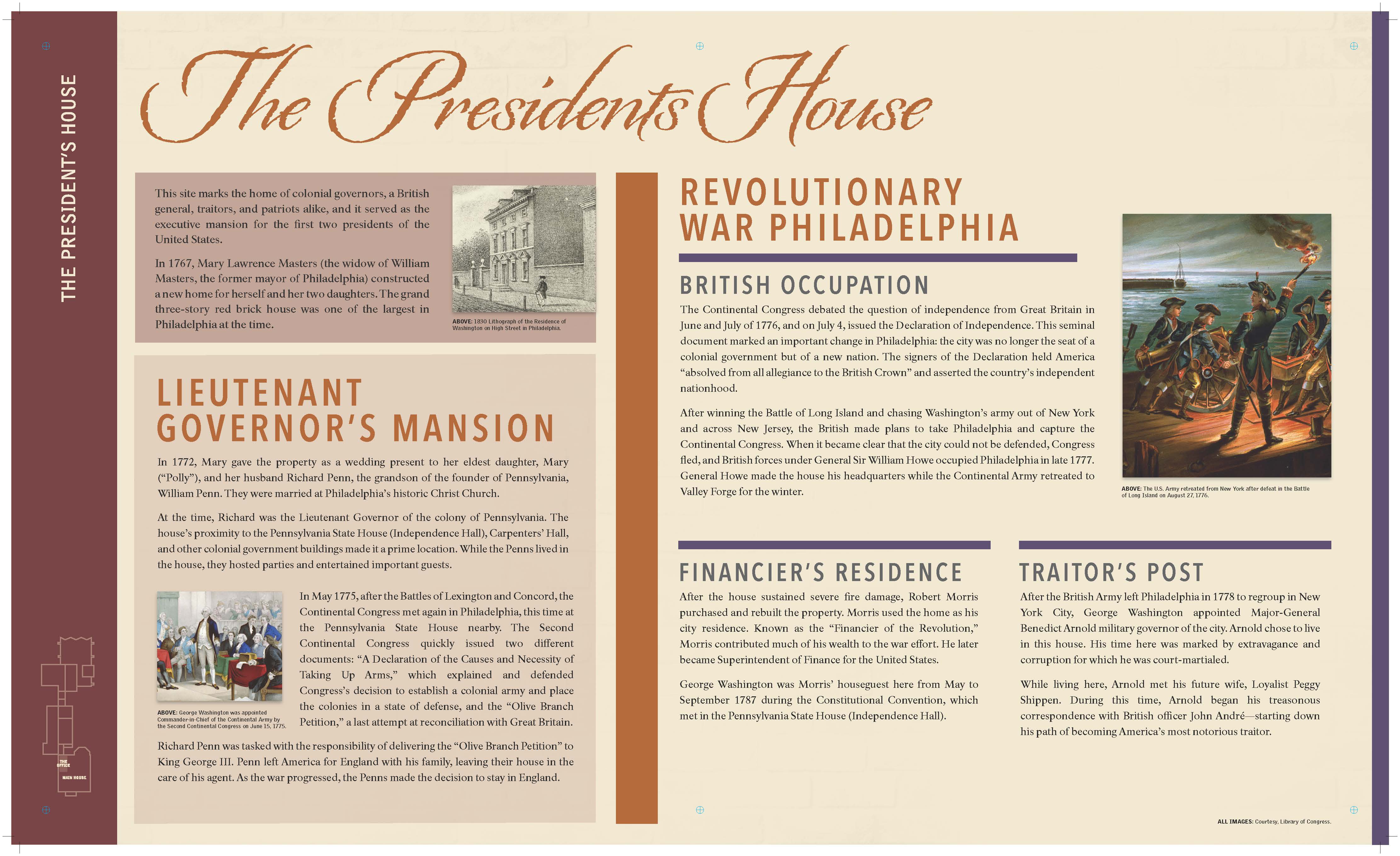
Alt Text for Exhibit Panel: The President's HouseThe President's HouseThis site marks the home of colonial governors, a British general, traitors, and patriots alike, and it served as the executive mansion for the first two presidents of the United States. In 1767, Mary Lawrence Masters (the widow of William Masters, the former mayor of Philadelphia) constructed a new home for herself and her two daughters. The grand three-story red brick house was one of the largest in Philadelphia at the time. Image: illustration of a man with a cane walking by a tall brick house flanked by walls. Lithograph of the Residence of Washington on High Street in Philadelphia. Lieutenant Governor's MansionIn 1772, Mary gave the property as a wedding present to her eldest daughter, Mary (“Polly”), and her husband Richard Penn, the grandson of the founder of Pennsylvania, William Penn. They were married at Philadelphia’s historic Christ Church. At the time, Richard was the Lieutenant Governor of the colony of Pennsylvania. The house’s proximity to the Pennsylvania State House (Independence Hall), Carpenters’ Hall, and other colonial government buildings made it a prime location. While the Penns lived in the house, they hosted parties and entertained important guests. In May 1775, after the Battles of Lexington and Concord, the Continental Congress met again in Philadelphia, this time at the Pennsylvania State House nearby. The Second Continental Congress quickly issued two different documents: “A Declaration of the Causes and Necessity of Taking Up Arms,” which explained and defended Congress’s decision to establish a colonial army and place the colonies in a state of defense, and the “Olive Branch Petition,” a last attempt at reconciliation with Great Britain. Richard Penn was tasked with the responsibility of delivering the “Olive Branch Petition” to King George III. Penn left America for England with his family, leaving their house in the care of his agent. As the war progressed, the Penns made the decision to stay in England. Image: illustration of a man in a powdered wig and breeches addressing a room of similarly dressed, seated men. George Washington was appointed Commander-in-Chief of the Continental Army by the Second Continental Congress on June 15, 1775. Revolutionary War PhiladelphiaBritish OccupationThe Continental Congress debated the question of independence from Great Britain in June and July of 1776, and on July 4, issued the Declaration of Independence. This seminal document marked an important change in Philadelphia: the city was no longer the seat of a colonial government but of a new nation. The signers of the Declaration held America “absolved from all allegiance to the British Crown” and asserted the country’s independent nationhood. After winning the Battle of Long Island and chasing Washington’s army out of New York and across New Jersey, the British made plans to take Philadelphia and capture the Continental Congress. When it became clear that the city could not be defended, Congress fled, and British forces under General Sir William Howe occupied Philadelphia in late 1777. General Howe made the house his headquarters while the Continental Army retreated to Valley Forge for the winter. Image: painting of a soldier wearing a tri-corner hat and waving a firebrand in front of a cannon. The U.S. Army retreated from New York after defeat in the Battle of Long Island on August 27, 1776. Financier's ResidenceAfter the house sustained severe fire damage, Robert Morris purchased and rebuilt the property. Morris used the home as his city residence. Known as the “Financier of the Revolution,” Morris contributed much of his wealth to the war effort. He later became Superintendent of Finance for the United States. George Washington was Morris’ houseguest here from May to September 1787 during the Constitutional Convention, which met in the Pennsylvania State House (Independence Hall). Traitor's PostAfter the British Army left Philadelphia in 1778 to regroup in New York City, George Washington appointed Major-General Benedict Arnold military governor of the city. Arnold chose to live in this house. His time here was marked by extravagance and corruption for which he was court-martialed. While living here, Arnold met his future wife, Loyalist Peggy Shippen. During this time, Arnold began his treasonous correspondence with British officer John André—starting down his path of becoming America’s most notorious traitor. 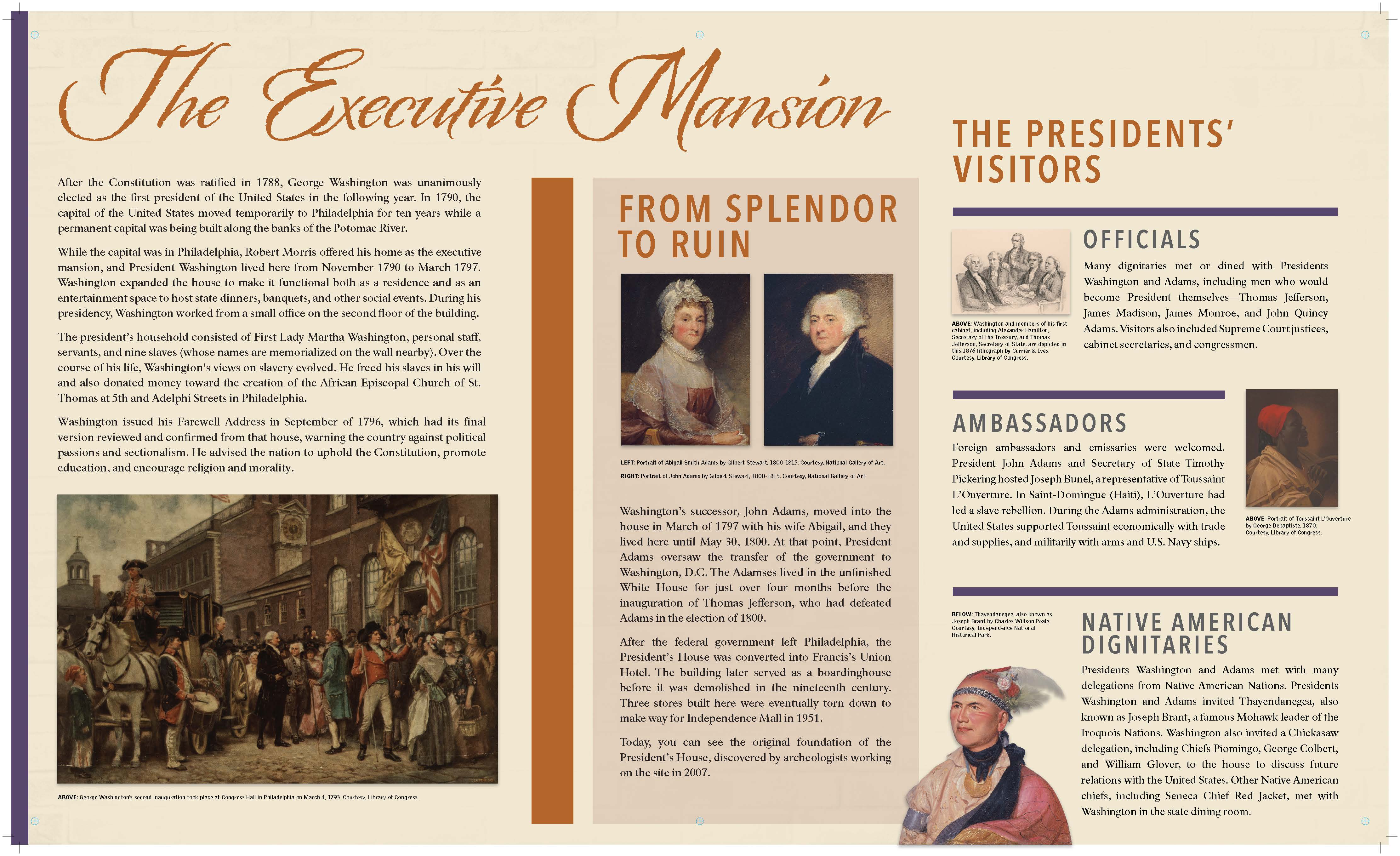
Alt Text for Exhibit Panel: The Executive MansionThe Executive MansionAfter the Constitution was ratified in 1788, George Washington was unanimously elected as the first president of the United States in the following year. In 1790, the capital of the United States moved temporarily to Philadelphia for ten years while a permanent capital was being built along the banks of the Potomac River. While the capital was in Philadelphia, Robert Morris offered his home as the executive mansion, and President Washington lived here from November 1790 to March 1797. Washington expanded the house to make it functional both as a residence and as an entertainment space to host state dinners, banquets, and other social events. During his presidency, Washington worked from a small office on the second floor of the building. The president’s household consisted of First Lady Martha Washington, personal staff, servants, and nine slaves (whose names are memorialized on the wall nearby). Over the course of his life, Washington's views on slavery evolved. He freed his slaves in his will and also donated money toward the creation of the African Episcopal Church of St. Thomas at 5th and Adelphi Streets in Philadelphia. Washington issued his Farewell Address in September of 1796, which had its final version reviewed and confirmed from that house, warning the country against political passions and sectionalism. He advised the nation to uphold the Constitution, promote education, and encourage religion and morality. Image: painting of an older man emerging from a horse-drawn coach to greet a crowd. George Washington’s second inauguration took place at Congress Hall in Philadelphia on March 4, 1793. Courtesy, Library of Congress. From Splendor to RuinImage: painting of an older woman with sharp features and red cheeks wearing a bonnet and shawl. Portrait of Abigail Smith Adams by Gilbert Stewart, 1800-1815. Courtesy, National Gallery of Art. Image: painting of an older, balding man with thick, gray side hair wearing a dark coat. Portrait of John Adams by Gilbert Stewart, 1800-1815. Courtesy, National Gallery of Art. Washington’s successor, John Adams, moved into the house in March of 1797 with his wife Abigail, and they lived here until May 30, 1800. At that point, President Adams oversaw the transfer of the government to Washington, D.C. The Adamses lived in the unfinished White House for just over four months before the inauguration of Thomas Jefferson, who had defeated Adams in the election of 1800. After the federal government left Philadelphia, the President’s House was converted into Francis’s Union Hotel. The building later served as a boardinghouse before it was demolished in the nineteenth century. Three stores built here were eventually torn down to make way for Independence Mall in 1951. Today, you can see the original foundation of the President’s House, discovered by archeologists working on the site in 2007. The Presidents' VisitorsOfficialsImage: illustration of five men seated in a semi circle around a table. Washington and members of his first cabinet, including Alexander Hamilton, Secretary of the Treasury, and Thomas Jefferson, Secretary of State, are depicted in this 1876 lithograph by Currier & Ives. Courtesy, Library of Congress. Many dignitaries met or dined with Presidents Washington and Adams, including men who would become President themselves—Thomas Jefferson, James Madison, James Monroe, and John Quincy Adams. Visitors also included Supreme Court justices, cabinet secretaries, and congressmen. AmbassadorsForeign ambassadors and emissaries were welcomed. President John Adams and Secretary of State Timothy Pickering hosted Joseph Bunel, a representative of Toussaint L’Ouverture. In Saint-Domingue (Haiti), L’Ouverture had led a slave rebellion. During the Adams administration, the United States supported Toussaint economically with trade and supplies, and militarily with arms and U.S. Navy ships. Native American DignitariesPresidents Washington and Adams met with many delegations from Native American Nations. Presidents Washington and Adams invited Thayendanegea, also known as Joseph Brant, a famous Mohawk leader of the Iroquois Nations. Washington also invited a Chickasaw delegation, including Chiefs Piomingo, George Colbert, and William Glover, to the house to discuss future relations with the United States. Other Native American chiefs, including Seneca Chief Red Jacket, met with Washington in the state dining room. Image: painting of a man with red stripes on his cheeks wearing robes and a feathered headdress. Thayendanegea, also known as Joseph Brant by Charles Willson Peale. Courtesy, Independence National Historical Park. 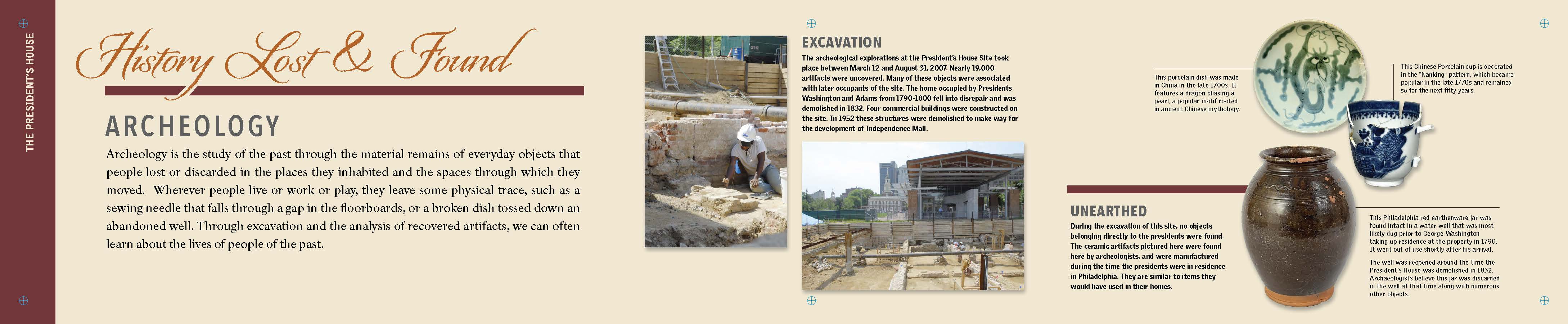 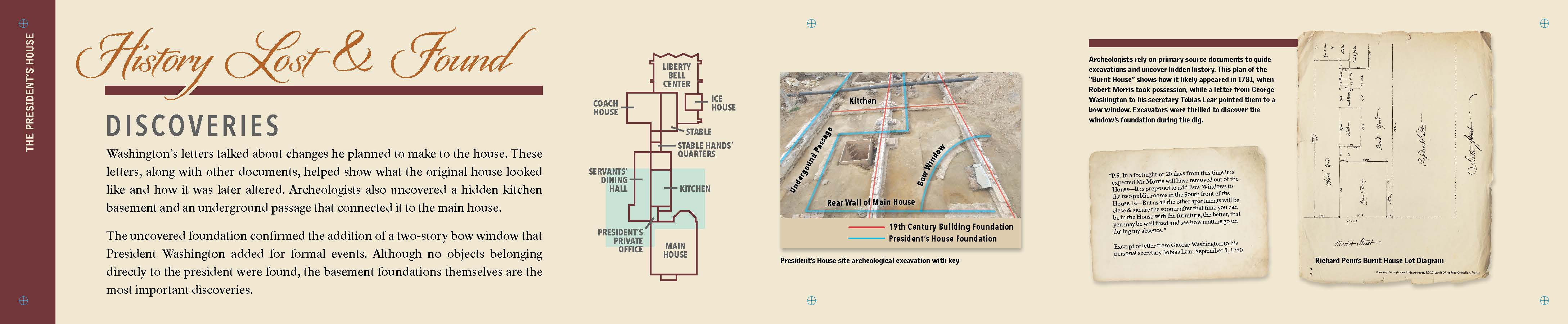 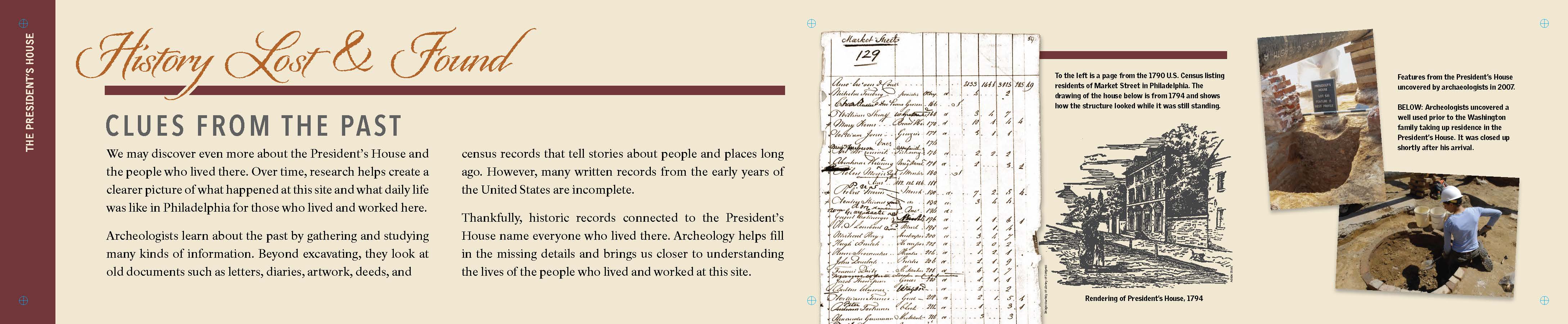
Alt Text for Exhibit Panel: History Lost & FoundHistory Lost & FoundArcheologyArcheology is the study of the past through the material remains of everyday objects that people lost or discarded in the places they inhabited and the spaces through which they moved. Wherever people live or work or play, they leave some physical trace, such as a sewing needle that falls through a gap in the floorboards, or a broken dish tossed down an abandoned well. Through excavation and the analysis of recovered artifacts, we can often learn about the lives of people of the past. ExcavationImage: a person wearing a hard hat sits on the ground in front of a low brick wall. The archeological explorations at the President’s House Site took place between March 12 and August 31, 2007. Nearly 19,000 artifacts were uncovered. Many of these objects were associated with later occupants of the site. The home occupied by Presidents Washington and Adams from 1790-1800 fell into disrepair and was demolished in 1832. Four commercial buildings were constructed on the site. In 1952 these structures were demolished to make way for the development of Independence Mall. Image: a fenced-in dirt plot crossed by low stone or brick walls. UnearthedDuring the excavation of this site, no objects belonging directly to the presidents were found. The ceramic artifacts pictured here were found here by archeologists, and were manufactured during the time the presidents were in residence in Philadelphia. They are similar to items they would have used in their homes. Image: a brown, earthenware jar with a heavily worn glaze. This Philadelphia red earthenware jar was found intact in a water well that was most likely dug prior to George Washington taking up residence at the property in 1790. It went out of use shortly after his arrival. The well was reopened around the time the President's House was demolished in 1832. Archaeologists believe this jar was discarded in the well at that time along with numerous other objects. Image: a light-toned dish with a squiggly creature design. This porcelain dish was made in China in the late 1700s. It features a dragon chasing a pearl, a popular motif rooted in ancient Chinese mythology. Image: a blue and white cup with a broken handle and lip. This Chinese Porcelain cup is decorated in the "Nanking" pattern, which became popular in the late 1770s and remained so for the next fifty years. DiscoveriesWashington’s letters talked about changes he planned to make to the house. These letters, along with other documents, helped show what the original house looked like and how it was later altered. Archeologists also uncovered a hidden kitchen basement and an underground passage that connected it to the main house. The uncovered foundation confirmed the addition of a two-story bow window that President Washington added for formal events. Although no objects belonging directly to the president were found, the basement foundations themselves are the most important discoveries. The uncovered foundation confirmed the addition of a two-story bow window that President Washington added for formal events. Although no objects belonging directly to the president were found, the basement foundations themselves are the most important discoveries. Image: floor plan with features labeled Main House, President's Private Office, Kitchen, Servant's Dining Hall, Stable Hands' Quarters, Stable, Coach House, Ice House, and Liberty Bell Center. Image: photo of a dirt plot with low stone or brick walls and annotation lines labeled 19th Century Building Foundation and President's House Foundation. President’s House site archeological excavation with key. Archaeologists rely on primary source documents to guide excavations and uncover hidden history. This plan of the “Burnt House” shows how it likely appeared in 1781, when Robert Morris took possession, while a letter from George Washington to his secretary Tobias Lear pointed them to a bow window. Excavators were thrilled to discover the window’s foundation during the dig. Image: hand-drawn diagram on old, tattered paper. Richard Penn’s Burnt House Lot Diagram. Courtesy Pennsylvania State Archives, RG-17, Lands Oce Map Collection, #3399. “P.S. In a fortnight or 20 days from this time it is expected Mr Morris will have removed out of the House—It is proposed to add Bow Windows to the two public rooms in the South front of the House 14—But as all the other apartments will be close & secure the sooner after that time you can be in the House with the furniture, the better, that you may be well fixed and see how matters go on during my absence.” Excerpt of letter from George Washington to his personal secretary Tobias Lear, 5 September 1790. Clues from the PastWe may discover even more about the President’s House and the people who lived there. Over time, research helps create a clearer picture of what happened at this site and what daily life was like in Philadelphia for those who lived and worked here. Archeologists learn about the past by gathering and studying many kinds of information. Beyond excavating, they look at old documents such as letters, diaries, artwork, deeds, and census records that tell stories about people and places long ago. However, many written records from the early years of the United States are incomplete. Thankfully, historic records connected to the President’s House name everyone who lived there. Archeology helps fill in the missing details and brings us closer to understanding the lives of the people who lived and worked at this site. Image: a table of handwritten names and numbers on tattered paper. Image: illustration of a child and a woman holding a parasol walking past brick houses and walls. To the left is a page from the 1790 U.S. Census listing residents of Market Street in Philadelphia. The drawing of the house below is from 1794 and shows how the structure looked while it was still standing. Image: photo of an earthen hole flanked by brick pillars and an archeological dig marker. Features from the President's House uncovered by archaeologists in 2007. Image: photo of a person in a hard hat and boots sticks a shovel into a patch of dirt inside a ring of bricks. Archeologists uncovered a well used prior to the Washington family taking up residence in the President's House. It was closed up shortly after his arrival. 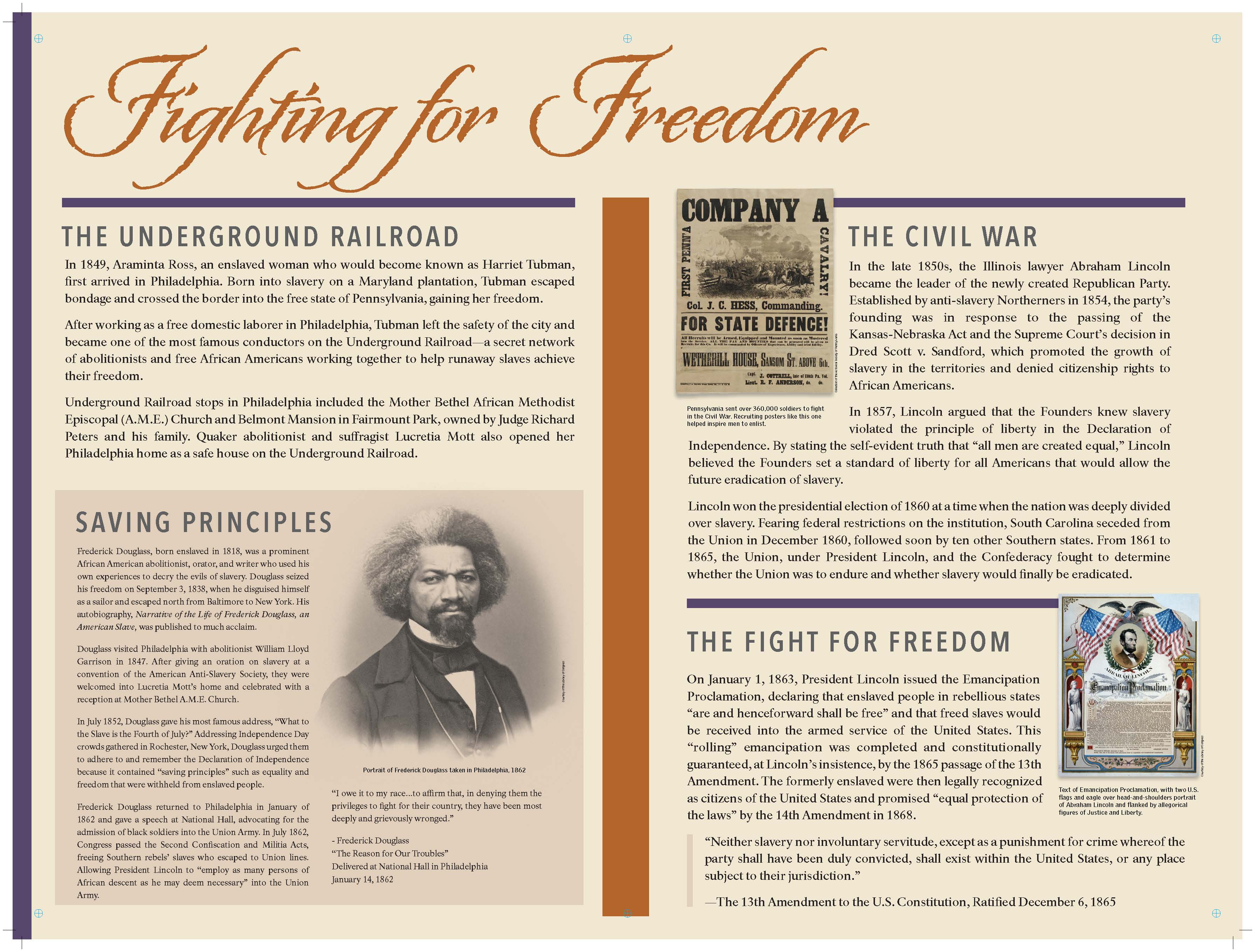
Alt Text for Exhibit Panel: Fighting for FreedomFighting for FreedomThe Underground RailroadIn 1849, Araminta Ross, an enslaved woman who would become known as Harriet Tubman, first arrived in Philadelphia. Born into slavery on a Maryland plantation, Tubman escaped bondage and crossed the border into the free state of Pennsylvania, gaining her freedom. After working as a free domestic laborer in Philadelphia, Tubman left the safety of the city and became one of the most famous conductors on the Underground Railroad—a secret network of abolitionists and free African Americans working together to help runaway slaves achieve their freedom. Underground Railroad stops in Philadelphia included the Mother Bethel African Methodist Episcopal (A.M.E.) Church and Belmont Mansion in Fairmount Park, owned by Judge Richard Peters and his family. Quaker abolitionist and suffragist Lucretia Mott also opened her Philadelphia home as a safe house on the Underground Railroad. Saving PrinciplesFrederick Douglass, born enslaved in 1818, was a prominent African American abolitionist, orator, and writer who used his own experiences to decry the evils of slavery. Douglass seized his freedom on September 3, 1838, when he disguised himself as a sailor and escaped north from Baltimore to New York. His autobiography, Narrative of the Life of Frederick Douglass, an American Slave, was published to much acclaim. Douglass visited Philadelphia with abolitionist William Lloyd Garrison in 1847. After giving an oration on slavery at a convention of the American Anti-Slavery Society, they were welcomed into Lucretia Mott’s home and celebrated with a reception at Mother Bethel A.M.E. Church. In July 1852, Douglass gave his most famous address, “What to the Slave is the Fourth of July?” Addressing Independence Day crowds gathered in Rochester, New York, Douglass urged them to adhere to and remember the Declaration of Independence because it contained “saving principles” such as equality and freedom that were withheld from enslaved people. Frederick Douglass returned to Philadelphia in January of 1862 and gave a speech at National Hall, advocating for the admission of black soldiers into the Union Army. In July 1862, Congress passed the Second Confiscation and Militia Acts, freeing Southern rebels’ slaves who escaped to Union lines. Allowing President Lincoln to “employ as many persons of African descent as he may deem necessary” into the Union Army. Image: photo of a bearded man with dark hair streaked with white. Portrait of Frederick Douglass taken in Philadelphia, 1862. “I owe it to my race...to affirm that, in denying them the privileges to fight for their country, they have been most deeply and grievously wronged.” - Frederick Douglass, “The Reason for Our Troubles”. Delivered at National Hall in Philadelphia, January 14, 1862. The Civil WarImage: a faded poster with headings that read Company A, First Penn'a Cavalry, For State Defence! In the late 1850s, the Illinois lawyer Abraham Lincoln became the leader of the newly created Republican Party. Established by anti-slavery Northerners in 1854, the party’s founding was in response to the passing of the Kansas-Nebraska Act and the Supreme Court’s decision in Dred Scott v. Sandford, which promoted the growth of slavery in the territories and denied citizenship rights to African Americans. In 1857, Lincoln argued that the Founders knew slavery violated the principle of liberty in the Declaration of Independence. By stating the self-evident truth that “all men are created equal,” Lincoln believed the Founders set a standard of liberty for all Americans that would allow the future eradication of slavery. Lincoln won the presidential election of 1860 at a time when the nation was deeply divided over slavery. Fearing federal restrictions on the institution, South Carolina seceded from the Union in December 1860, followed soon by ten other Southern states. From 1861 to 1865, the Union, under President Lincoln, and the Confederacy fought to determine whether the Union was to endure and whether slavery would finally be eradicated. The Fight for FreedomOn January 1, 1863, President Lincoln issued the Emancipation Proclamation, declaring that enslaved people in rebellious states “are and henceforward shall be free” and that freed slaves would be received into the armed service of the United States. This “rolling” emancipation was completed and constitutionally guaranteed, at Lincoln’s insistence, by the 1865 passage of the 13th Amendment. The formerly enslaved were then legally recognized as citizens of the United States and promised “equal protection of the laws” by the 14th Amendment in 1868. “Neither slavery nor involuntary servitude, except as a punishment for crime whereof the party shall have been duly convicted, shall exist within the United States, or any place subject to their jurisdiction.” —The 13th Amendment to the U.S. Constitution, Ratified December 6, 1865 Image: text of Emancipation Proclamation, with two U.S. flags and eagle over head-and-shoulders portrait of Abraham Lincoln and flanked by allegorical figures of Justice and Liberty. 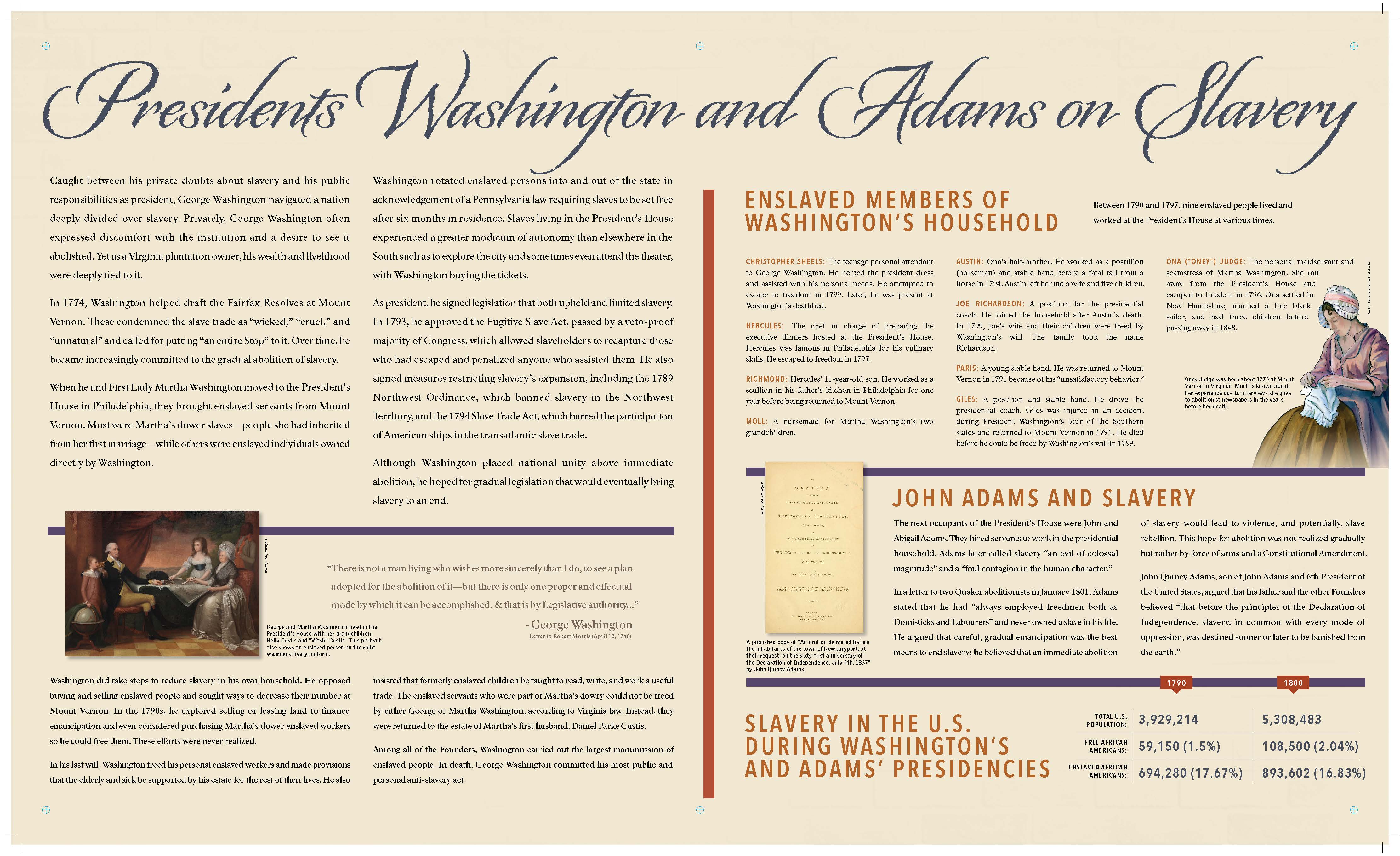
Alt Text for Exhibit Panel: Presidents Washington and Adams on SlaveryPresidents Washington and Adams on SlaveryCaught between his private doubts about slavery and his public responsibilities as president, George Washington navigated a nation deeply divided over slavery. Privately, George Washington often expressed discomfort with the institution and a desire to see it abolished. Yet as a Virginia plantation owner, his wealth and livelihood were deeply tied to it. In 1774, Washington helped draft the Fairfax Resolves at Mount Vernon. These condemned the slave trade as “wicked,” “cruel,” and “unnatural” and called for putting “an entire Stop” to it. Over time, he became increasingly committed to the gradual abolition of slavery. When he and First Lady Martha Washington moved to the President’s House in Philadelphia, they brought enslaved servants from Mount Vernon. Most were Martha’s dower slaves—people she had inherited from her first marriage—while others were enslaved individuals owned directly by Washington. Washington rotated enslaved persons into and out of the state in acknowledgement of a Pennsylvania law requiring slaves to be set free after six months in residence. Slaves living in the President’s House experienced a greater modicum of autonomy than elsewhere in the South such as to explore the city and sometimes even attend the theater, with Washington buying the tickets. As president, he signed legislation that both upheld and limited slavery. In 1793, he approved the Fugitive Slave Act, passed by a veto-proof majority of Congress, which allowed slaveholders to recapture those who had escaped and penalized anyone who assisted them. He also signed measures restricting slavery’s expansion, including the 1789 Northwest Ordinance, which banned slavery in the Northwest Territory, and the 1794 Slave Trade Act, which barred the participation of American ships in the transatlantic slave trade. Although Washington placed national unity above immediate abolition, he hoped for gradual legislation that would eventually bring slavery to an end. Image: painting of older man in military uniform with older woman and two children. George and Martha Washington lived in the President's House with her grandchildren Nelly Custis and "Wash" Custis. This portrait also shows an enslaved person on the right wearing a livery uniform. “There is not a man living who wishes more sincerely than I do, to see a plan adopted for the abolition of it—but there is only one proper and effectual mode by which it can be accomplished, & that is by Legislative authority...” -George Washington, Letter to Robert Morris (April 12, 1786) Washington did take steps to reduce slavery in his own household. He opposed buying and selling enslaved people and sought ways to decrease their number at Mount Vernon. In the 1790s, he explored selling or leasing land to finance emancipation and even considered purchasing Martha’s dower enslaved workers so he could free them. These efforts were never realized. In his last will, Washington freed his personal enslaved workers and made provisions that the elderly and sick be supported by his estate for the rest of their lives. He also insisted that formerly enslaved children be taught to read, write, and work a useful trade. The enslaved servants who were part of Martha’s dowry could not be freed by either George or Martha Washington, according to Virginia law. Instead, they were returned to the estate of Martha’s first husband, Daniel Parke Custis. Among all of the Founders, Washington carried out the largest manumission of enslaved people. In death, George Washington committed his most public and personal anti-slavery act. Enslaved Members of Washington's HouseholdBetween 1790 and 1797, nine enslaved people lived and worked at the President’s House at various times. CHRISTOPHER SHEELS: The teenage personal attendant to George Washington. He helped the president dress and assisted with his personal needs. He attempted to escape to freedom in 1799. Later, he was present at Washington’s deathbed. HERCULES: The chef in charge of preparing the executive dinners hosted at the President’s House. Hercules was famous in Philadelphia for his culinary skills. He escaped to freedom in 1797. RICHMOND: Hercules’ 11-year-old son. He worked as a scullion in his father’s kitchen in Philadelphia for one year before being returned to Mount Vernon. MOLL: A nursemaid for Martha Washington’s two grandchildren. AUSTIN: Ona’s half-brother. He worked as a postillion (horseman) and stable hand before a fatal fall from a horse in 1794. Austin left behind a wife and five children. JOE RICHARDSON: A postilion for the presidential coach. He joined the household after Austin’s death. In 1799, Joe’s wife and their children were freed by Washington’s will. The family took the name Richardson. PARIS: A young stable hand. He was returned to Mount Vernon in 1791 because of his “unsatisfactory behavior.” GILES: A postilion and stable hand. He drove the presidential coach. Giles was injured in an accident during President Washington’s tour of the Southern states and returned to Mount Vernon in 1791. He died before he could be freed by Washington’s will in 1799. ONA (“ONEY”) JUDGE: The personal maidservant and seamstress of Martha Washington. She ran away from the President’s House and escaped to freedom in 1796. Ona settled in New Hampshire, married a free black sailor, and had three children before passing away in 1848. Image: a woman wearing a dress and bonnet sewing. Oney Judge was born about 1773 at Mount Vernon in Virginia. Much is known about her experience due to interviews she gave to abolitionist newspapers in the years before her death. John Adams and SlaveryThe next occupants of the President’s House were John and Abigail Adams. They hired servants to work in the presidential household. Adams later called slavery “an evil of colossal magnitude” and a “foul contagion in the human character.” In a letter to two Quaker abolitionists in January 1801, Adams stated that he had “always employed freedmen both as Domisticks and Labourers” and never owned a slave in his life. He argued that careful, gradual emancipation was the best means to end slavery; he believed that an immediate abolition of slavery would lead to violence, and potentially, slave rebellion. This hope for abolition was not realized gradually but rather by force of arms and a Constitutional Amendment. John Quincy Adams, son of John Adams and 6th President of the United States, argued that his father and the other Founders believed “that before the principles of the Declaration of Independence, slavery, in common with every mode of oppression, was destined sooner or later to be banished from the earth.” Image: yellowed title page of a book. A published copy of "An oration delivered before the inhabitants of the town of Newburyport, at their request, on the sixty-first anniversary of the Declaration of Independence, July 4th, 1837" by John Quincy Adams. Slavery in the U.S. During Washington's and Adams' PresidenciesTotal U.S. Population1790: 3,929,214 1800: 5,308,483 Free African Americans1790: 59,150 (1.5%) 1800: 108,500 (2.04%) Enslaved African Americans1790: 694,280 (17.67%) 1800: 893,602 (16.83%) 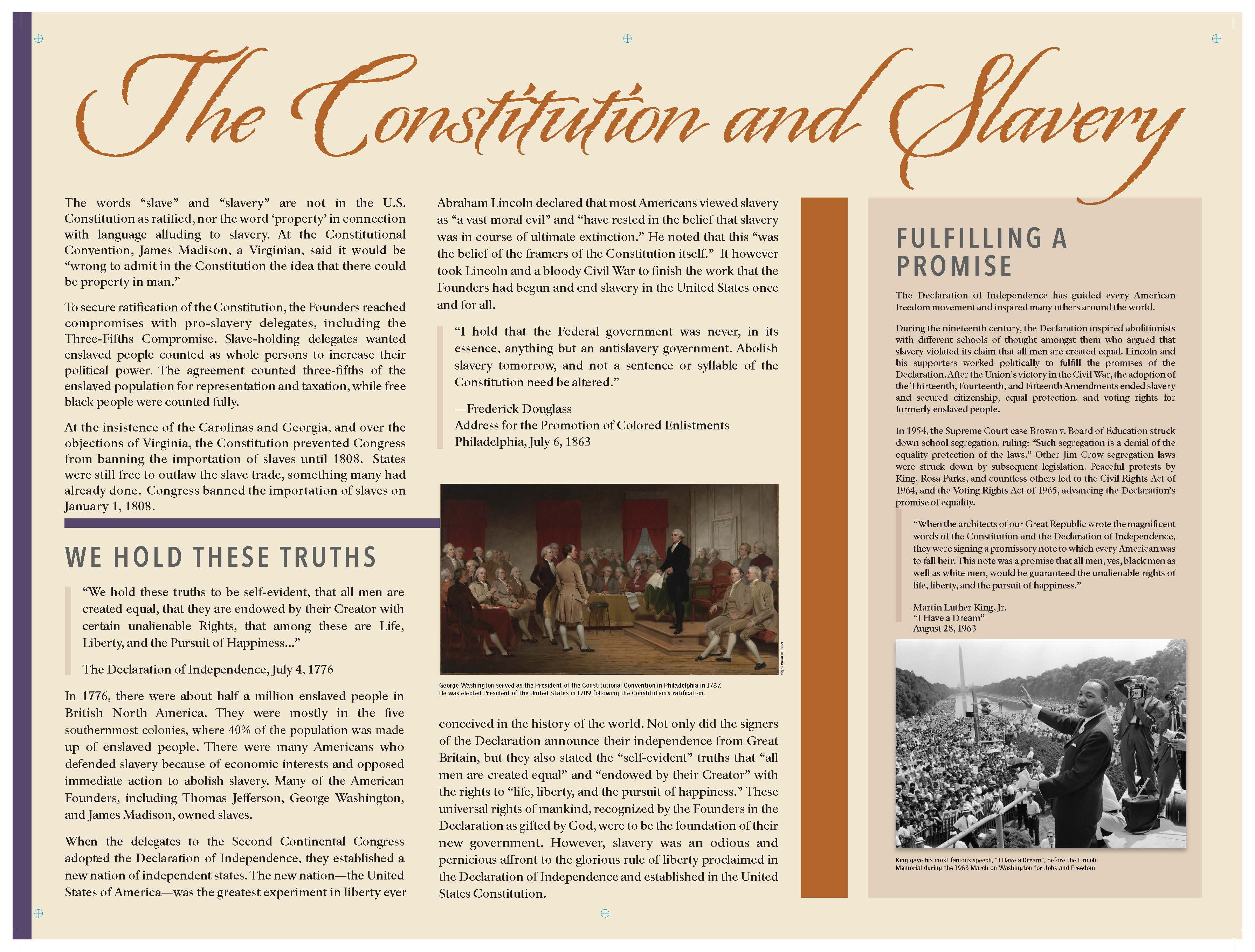
Alt Text for Exhibit Panel: The Constitution and SlaveryThe Constitution and SlaveryThe words “slave” and “slavery” are not in the U.S. Constitution as ratified, nor the word ‘property’ in connection with language alluding to slavery. At the Constitutional Convention, James Madison, a Virginian, said it would be “wrong to admit in the Constitution the idea that there could be property in man.” To secure ratification of the Constitution, the Founders reached compromises with pro-slavery delegates, including the Three-Fifths Compromise. Slave-holding delegates wanted enslaved people counted as whole persons to increase their political power. The agreement counted three-fifths of the enslaved population for representation and taxation, while free black people were counted fully. At the insistence of the Carolinas and Georgia, and over the objections of Virginia, the Constitution prevented Congress from banning the importation of slaves until 1808. States were still free to outlaw the slave trade, something many had already done. Congress banned the importation of slaves on January 1, 1808. Abraham Lincoln declared that most Americans viewed slavery as “a vast moral evil” and “have rested in the belief that slavery was in course of ultimate extinction.” He noted that this “was the belief of the framers of the Constitution itself.” It however took Lincoln and a bloody Civil War to finish the work that the Founders had begun and end slavery in the United States once and for all. “I hold that the Federal government was never, in its essence, anything but an antislavery government. Abolish slavery tomorrow, and not a sentence or syllable of the Constitution need be altered.” —Frederick Douglass, Address for the Promotion of Colored Enlistments, Philadelphia, July 6, 1863 We Hold These Truths“We hold these truths to be self-evident, that all men are created equal, that they are endowed by their Creator with certain unalienable Rights, that among these are Life, Liberty, and the Pursuit of Happiness...” The Declaration of Independence, July 4, 1776 In 1776, there were about half a million enslaved people in British North America. They were mostly in the five southernmost colonies, where 40% of the population was made up of enslaved people. There were many Americans who defended slavery because of economic interests and opposed immediate action to abolish slavery. Many of the American Founders, including Thomas Jefferson, George Washington, and James Madison, owned slaves. When the delegates to the Second Continental Congress adopted the Declaration of Independence, they established a new nation of independent states. The new nation—the United States of America—was the greatest experiment in liberty ever conceived in the history of the world. Not only did the signers of the Declaration announce their independence from Great Britain, but they also stated the “self-evident” truths that “all men are created equal” and “endowed by their Creator” with the rights to “life, liberty, and the pursuit of happiness.” These universal rights of mankind, recognized by the Founders in the Declaration as gifted by God, were to be the foundation of their new government. However, slavery was an odious and pernicious affront to the glorious rule of liberty proclaimed in the Declaration of Independence and established in the United States Constitution. Image: painting of dozens of men in breeches look on as a tall man reads from a handful of papers. George Washington served as the President of the Constitutional Convention in Philadelphia in 1787. He was elected President of the United States in 1789 following the Constitution’s ratification. Fulfilling a PromiseThe Declaration of Independence has guided every American freedom movement and inspired many others around the world. During the nineteenth century, the Declaration inspired abolitionists with different schools of thought amongst them who argued that slavery violated its claim that all men are created equal. Lincoln and his supporters worked politically to fulfill the promises of the Declaration. After the Union’s victory in the Civil War, the adoption of the Thirteenth, Fourteenth, and Fifteenth Amendments ended slavery and secured citizenship, equal protection, and voting rights for formerly enslaved people. In 1954, the Supreme Court case Brown v. Board of Education struck down school segregation, ruling: “Such segregation is a denial of the equality protection of the laws.” Other Jim Crow segregation laws were struck down by subsequent legislation. Peaceful protests by King, Rosa Parks, and countless others led to the Civil Rights Act of 1964, and the Voting Rights Act of 1965, advancing the Declaration’s promise of equality. “When the architects of our Great Republic wrote the magnificent words of the Constitution and the Declaration of Independence, they were signing a promissory note to which every American was to fall heir. This note was a promise that all men, yes, black men as well as white men, would be guaranteed the unalienable rights of life, liberty, and the pursuit of happiness.” Martin Luther King, Jr. “I Have a Dream”, August 28, 1963 Image: photo of a man in a suit lifting his hand to address a crowd with the Washington Monument and reflecting pool visible in the background. King gave his most famous speech, "I Have a Dream", before the Lincoln Memorial during the 1963 March on Washington for Jobs and Freedom. 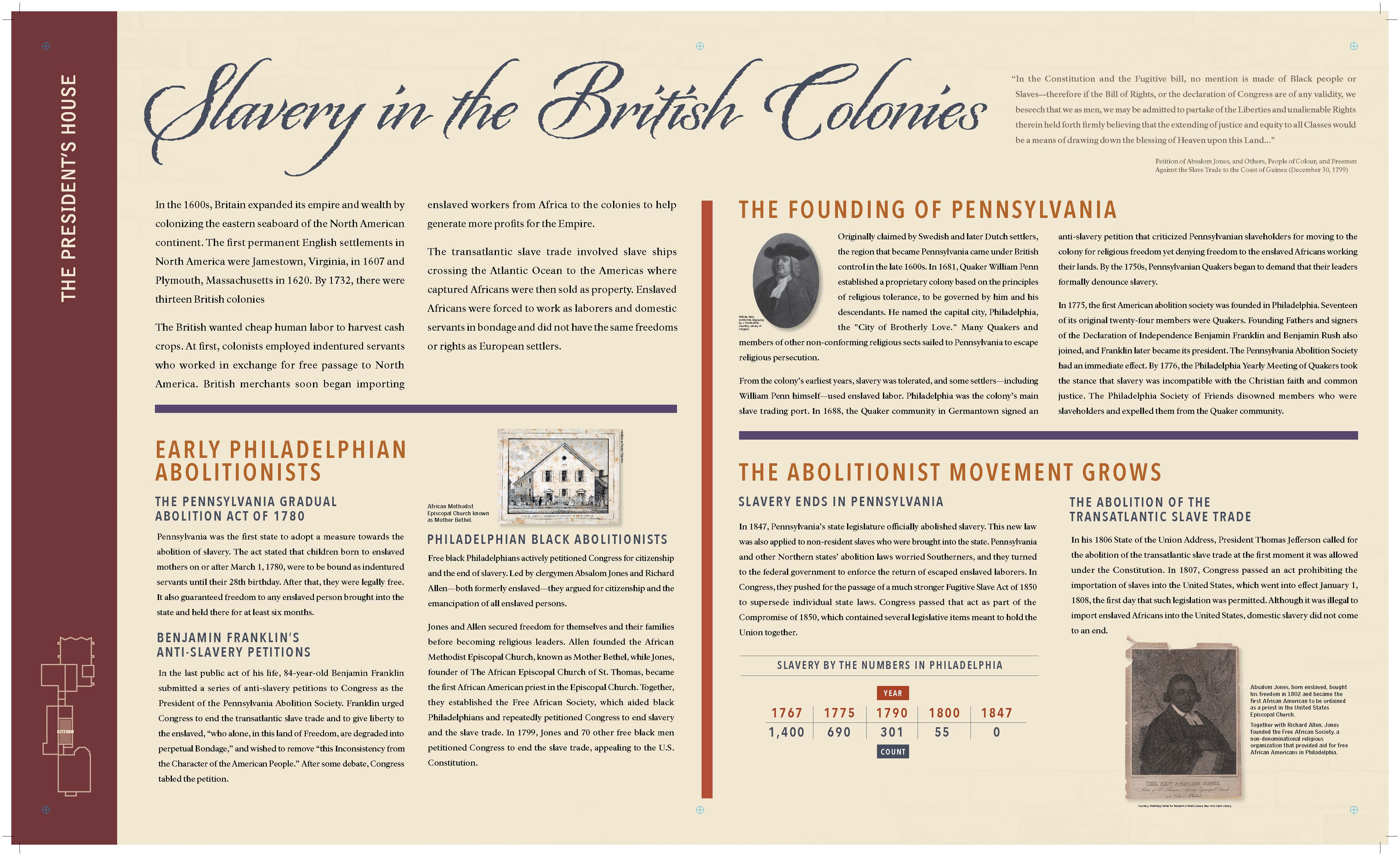
Alt Text for Exhibit Panel: Slavery in the British ColoniesSlavery in the British ColoniesIn the 1600s, Britain expanded its empire and wealth by colonizing the eastern seaboard of the North American continent. The first permanent English settlements in North America were Jamestown, Virginia, in 1607 and Plymouth, Massachusetts in 1620. By 1732, there were thirteen British colonies. The British wanted cheap human labor to harvest cash crops. At first, colonists employed indentured servants who worked in exchange for free passage to North America. British merchants soon began importing enslaved workers from Africa to the colonies to help generate more profits for the Empire. The transatlantic slave trade involved slave ships crossing the Atlantic Ocean to the Americas where captured Africans were then sold as property. Enslaved Africans were forced to work as laborers and domestic servants in bondage and did not have the same freedoms or rights as European settlers. “In the Constitution and the Fugitive bill, no mention is made of Black people or Slaves—therefore if the Bill of Rights, or the declaration of Congress are of any validity, we beseech that we as men, we may be admitted to partake of the Liberties and unalienable Rights therein held forth firmly believing that the extending of justice and equity to all Classes would be a means of drawing down the blessing of Heaven upon this Land...” Petition of Absalom Jones, and Others, People of Colour, and Freemen Against the Slave Trade to the Coast of Guinea (December 30, 1799) Early Philadelphian AbolitionistsThe Pennsylvania Gradual Abolition Act of 1780Pennsylvania was the first state to adopt a measure towards the abolition of slavery. The act stated that children born to enslaved mothers on or after March 1, 1780, were to be bound as indentured servants until their 28th birthday. After that, they were legally free. It also guaranteed freedom to any enslaved person brought into the state and held there for at least six months. Benjamin Franklin's Anti-slavery PetitionsIn the last public act of his life, 84-year-old Benjamin Franklin submitted a series of anti-slavery petitions to Congress as the President of the Pennsylvania Abolition Society. Franklin urged Congress to end the transatlantic slave trade and to give liberty to the enslaved, “who alone, in this land of Freedom, are degraded into perpetual Bondage,” and wished to remove “this Inconsistency from the Character of the American People.” After some debate, Congress tabled the petition. Philadelphian Black AbolitionistsImage: faded illustration of a simple, two-story building. African Methodist Episcopal Church known as Mother Bethel. Free black Philadelphians actively petitioned Congress for citizenship and the end of slavery. Led by clergymen Absalom Jones and Richard Allen—both formerly enslaved—they argued for citizenship and the emancipation of all enslaved persons. Jones and Allen secured freedom for themselves and their families before becoming religious leaders. Allen founded the African Methodist Episcopal Church, known as Mother Bethel, while Jones, founder of The African Episcopal Church of St. Thomas, became the first African American priest in the Episcopal Church. Together, they established the Free African Society, which aided black Philadelphians and repeatedly petitioned Congress to end slavery and the slave trade. In 1799, Jones and 70 other free black men petitioned Congress to end the slave trade, appealing to the U.S. Constitution. The Founding of PennsylvaniaImage: illustration of a long-haired man wearing a hat. William Penn, 1644-1718, Engraving by J. Posselwhite. Courtesy, Library of Congress. Originally claimed by Swedish and later Dutch settlers, the region that became Pennsylvania came under British control in the late 1600s. In 1681, Quaker William Penn established a proprietary colony based on the principles of religious tolerance, to be governed by him and his descendants. He named the capital city, Philadelphia, the "City of Brotherly Love." Many Quakers and members of other non-conforming religious sects sailed to Pennsylvania to escape religious persecution. From the colony’s earliest years, slavery was tolerated, and some settlers—including William Penn himself—used enslaved labor. Philadelphia was the colony’s main slave trading port. In 1688, the Quaker community in Germantown signed an anti-slavery petition that criticized Pennsylvanian slaveholders for moving to the colony for religious freedom yet denying freedom to the enslaved Africans working their lands. By the 1750s, Pennsylvanian Quakers began to demand that their leaders formally denounce slavery. In 1775, the first American abolition society was founded in Philadelphia. Seventeen of its original twenty-four members were Quakers. Founding Fathers and signers of the Declaration of Independence Benjamin Franklin and Benjamin Rush also joined, and Franklin later became its president. The Pennsylvania Abolition Society had an immediate effect. By 1776, the Philadelphia Yearly Meeting of Quakers took the stance that slavery was incompatible with the Christian faith and common justice. The Philadelphia Society of Friends disowned members who were slaveholders and expelled them from the Quaker community. The Abolitionist Movement GrowsSlavery Ends in PennsylvaniaIn 1847, Pennsylvania’s state legislature officially abolished slavery. This new law was also applied to non-resident slaves who were brought into the state. Pennsylvania and other Northern states’ abolition laws worried Southerners, and they turned to the federal government to enforce the return of escaped enslaved laborers. In Congress, they pushed for the passage of a much stronger Fugitive Slave Act of 1850 to supersede individual state laws. Congress passed that act as part of the Compromise of 1850, which contained several legislative items meant to hold the Union together. Slavery By the Numbers in Philadelphia1767: 1,400 1775: 690 1790: 301 1800: 55 1847: 0 The Abolition of the Transatlantic Slave TradeIn his 1806 State of the Union Address, President Thomas Jefferson called for the abolition of the transatlantic slave trade at the first moment it was allowed under the Constitution. In 1807, Congress passed an act prohibiting the importation of slaves into the United States, which went into effect January 1, 1808, the first day that such legislation was permitted. Although it was illegal to import enslaved Africans into the United States, domestic slavery did not come to an end. Image: tattered illustration of a man wearing robes and a clerical collar. Absalom Jones, born enslaved, bought his freedom in 1802 and became the first African American to be ordained as a priest in the United States Episcopal Church. Together with Richard Allen, Jones founded the Free African Society, a non-denominational religious organization that provided aid for free African Americans in Philadelphia. Historical InformationAnti-slavery sentiment in North America emerged well before the American Revolution. In 1688, Quakers in Germantown, Pennsylvania, submitted the first recorded petition against slavery in the colonies. They appealed to the Bible’s Golden Rule, “Do unto others as you would have them do unto you,” and criticized colonists who sought religious freedom while enslaving Africans. By the early 1700s, Quakers regularly petitioned the Pennsylvania colonial legislature to end the slave trade. In 1700, Massachusetts judge Samuel Sewall published The Selling of Joseph, the first anti-slavery tract printed in North America, arguing that slavery violated God’s natural law and the Christian belief that all people share the right to liberty. Sewall drew upon his Puritan beliefs by using the biblical story of Joseph who was sold into slavery in Egypt by his brothers. He argued that all men are coheirs to the right of liberty, and slavery was in violation of God’s natural law. Although Sewall’s legacy is often tarnished by his involvement in the Salem witch trials, his pamphlet was the first anti-slavery tract published in North America. Despite this growing opposition to slavery in several colonies, the British Empire remained one of the largest carriers of enslaved Africans in the transatlantic slave trade, transporting millions of Africans primarily to the Caribbean and Brazil. By the 1770s, several colonies began taking action against slavery and the slave trade. In June 1774, Rhode Island became the first colony to ban the slave trade. At the time, Rhode Island boasted some of the largest slave trading ports in the Thirteen Colonies. Influenced by Quaker abolitionists, future signer of the Declaration of Independence Stephen Hopkins introduced the anti-slavery act in the Rhode Island Assembly. Similarly, the colony of Connecticut banned the importation of Africans and Native Americans as slave labor in 1774. When the First Continental Congress met in Philadelphia in the fall of 1774 to address their grievances against the British Crown and Parliament, the delegates passed a resolution prohibiting further colonial participation in the transatlantic slave trade as part of their larger boycott against British trade. First, they banned the importation of any enslaved Africans into the Thirteen Colonies. Then the Continental Congress resolved that the colonies would discontinue participation in the transatlantic slave trade with any nation. Congress’ ban on the slave trade was the first collective anti-slavery act of the American colonies: “We will neither import nor purchase any Slave imported after the first Day of December next, after which Time, we will wholly discontinue the Slave Trade, and will neither be concerned in it ourselves, nor will we hire our Vessels, nor sell our Commodities or Manufactures to those who are concerned in it.” – The Continental Association (October 20, 1774) The republic of Vermont, not yet a state, passed a law on July 2, 1777, abolishing slavery outright and enfranchising African American men by eliminating property ownership as a requirement to vote. In 1780, Pennsylvania passed the Gradual Abolition Act, banning the future importation of enslaved people and establishing a process for gradual emancipation. Massachusetts effectively abolished slavery through court decisions interpreting the state’s new constitution. Once the Massachusetts Constitution went into effect in 1780, the practice of slavery was effectively abolished through a series of court cases in which judges found slave laws to be in violation of the new constitution’s Declaration of Rights. By 1790, the state of Massachusetts had no slaves recorded in its federal census and was the only state to completely abolish slavery in the 18th century. African Americans played an important role in the fight for American independence. Approximately 5,000 African American soldiers and sailors, including both free and enslaved black men, served in the Patriot forces during the American Revolutionary War. One notable integrated unit was the Marblehead Regiment, commanded by John Glover. The regiment included sailors and fishermen from the small coastal village of Marblehead, Massachusetts. The Marblehead Regiment was one of the first integrated regiments in the Continental Army, with as many as one-third of the soldiers being of African descent. The maritime profession attracted many free blacks in colonial America, and most of them had worked as sailors in Marblehead before enlisting. The Marblehead mariners’ nautical skills proved invaluable to General Washington at key moments during the Revolution. After the Battle of Long Island in late August 1776, Washington called upon the Marblehead Regiment to ferry the Continental Army troops on Long Island to safety. The Marblehead Regiment rowed 9,000 men in addition to their horses and supplies from Long Island to Manhattan during a secret nighttime evacuation across the East River. This successful operation allowed Washington and his army to retreat from British-occupied New York City without further loss of life. Then on the night of December 25, 1776, Washington enlisted Glover and his soldiers to ferry 2,400 men as well as horses and artillery across the Delaware River to surprise the Hessian camp at Trenton, New Jersey. After fighting in the battle, the Marblehead Regiment then rowed the Continental Army and approximately 1,000 Hessian prisoners back across the Delaware River. William Lee, often called Billy Lee, was purchased by George Washington in 1768 and served as his personal valet for more than two decades. Lee accompanied Washington throughout the Revolutionary War, managing his personal affairs and assisting with daily military duties. Lee rode with Washington during campaigns, endured the winter at the Valley Forge encampment, and witnessed the war from the siege of Boston to the British surrender at Siege of Yorktown. Lee’s dedication to the general earned him Washington’s trust and affection. After suffering severe knee injuries in the 1780s, Lee continued to serve Washington until he was appointed as a shoemaker at Mount Vernon. In Washington’s will, in which Washington freed all of the slaves he personally owned after the death of his wife Martha, Lee was granted immediate freedom upon Washington’s death in 1799 and a lifetime annuity as recognition of his loyal service. He remained at Mount Vernon until his death in 1810. Without Washington’s Continental Army winning the war, the establishment of a new government based on the consent of the governed would not have been achieved. Armed with the principles of liberty enshrined in the Declaration of Independence, the abolitionist movement gained support in the North. Pennsylvania, Massachusetts, New Hampshire, Connecticut, Rhode Island, and Vermont were among the first states to enact abolitionist measures. By 1804, all the Northern states which had formerly been British colonies either abolished slavery or had passed laws outlining a plan of gradual emancipation for the enslaved men and women within their state. Although Great Britain abolished the slave trade on a similar timeline as the United States, slavery remained legal in the British colonies after 1807 and continued until 1843 when Great Britian finally abolished slavery in all of the territories in the British Empire. The widespread abolitionist sentiment in the North, which started in the 1770s, eventually led to the abolition of slavery with the Thirteenth Amendment in 1865. Inspired by Christian teachings and ideals of liberty, abolitionism grew rapidly after the Revolution. In Philadelphia, former enslaved men Richard Allen and Absalom Jones were inspired by their Christian faith to advocate for their freedom and the freedom of their fellow enslaved Africans. These men convinced their owners, by appealing to their Christian goodwill, to allow the slaves to keep a portion of their earnings and buy their own freedom. Together, they founded the Free African Society, a non-denominational religious organization that provided aid for free African Americans in Philadelphia and frequently petitioned to abolish slavery. Allen later founded Mother Bethel African Methodist Episcopal Church in 1799, the first AME church in the United States, while Jones founded the African Episcopal Church of St. Thomas. These institutions became important centers of the black abolitionist movement. Approximately 10 to 12 million Africans were sold into the transatlantic slave trade. It is estimated that out of the total number of African slaves shipped to the Western Hemisphere, 12 to 22% died during the transatlantic voyage. The vast majority of enslaved Africans were trafficked to the Caribbean islands and the Portuguese colony of Brazil. Out of the 10 to 12 million slaves transported in the transatlantic slave trade, it is estimated that between 350,000 and 400,000 African slaves (less than 5%) were brought to continental North America before the U.S. Congress abolished the slave trade in 1808. Although the importation of enslaved men and women was banned in the United States after 1808, the domestic slave trade continued, and the number of enslaved grew from the existing population in the United States. From 1619 to 1865, approximately 9 to10 million slaves lived in continental North America. This number is cumulative and includes all the enslaved from the French and Spanish North American colonies in addition to the British Thirteen Colonies. It is estimated that out of this 9-10 million, approximately 5 million of these enslaved men and women lived in the Thirteen Colonies and later, the United States and its territories. However, this estimation does not include those who died in the transatlantic passage and never made it to North America. Christian faith played a major role in the abolition movement. Many enslaved and free African Americans relied on religious faith as a source of hope and strength. Harriet Tubman, known as the “Moses of the Underground Railroad,” often attributed to God the success of her thirteen missions to liberate others from slavery. In her memoirs, Tubman described how she constantly prayed to the Lord to show her the way to elude the slave catchers during her dangerous journeys north. Tubman’s Christian faith linked her to the larger abolitionist community, which was composed of many Christians. Christian abolitionists also used churches as stations on the Underground Railroad, providing shelter and assistance to freedom seekers. One of the most influential acts of Christian witness was Harriet Beecher Stowe’s publication of Uncle Tom’s Cabin in 1852. Stowe was raised in a devout Christian household, and her father Lyman Beecher was a famous Presbyterian Calvinist minister and religious leader in the Second Great Awakening. Inspired by her Christian beliefs, Stowe portrayed her novel’s enslaved protagonist, Uncle Tom, as a Christ-like figure and used Christian themes such as love of neighbor to argue for racial equality. Her novel had such an impact on public opinion regarding slavery that President Abraham Lincoln reportedly called her “the little woman who wrote the book that started this great war.” One of the most popular Union marching songs was “John Brown’s Body,” which was about the abolitionist John Brown who led the raid at Harpers Ferry, Virginia (now West Virginia), to liberate the town’s slaves. Although the attack on the town’s armory and arsenal failed and Brown was executed for treason, Brown’s death fueled the anti-slavery cause, and he became a martyr for the Union. Sung by Union troops, the song “John Brown’s Body” used biblical imagery, calling Brown a “soldier in the army of the Lord.” Julia Ward Howe wrote the song “The Battle Hymn of the Republic” in 1861 after visiting Union Army camps. Howe was active in the abolitionist movement, and the song reflected her anti-slavery beliefs. Howe’s husband Samuel was a member of the Secret Six, the abolitionist group which funded John Brown’s work. Using the same tune as “John Brown’s Body,” Howe wrote new lyrics, equating God’s justice and righteousness with the Union cause. Her song became a new rallying cry for the Union Army and portrayed Union soldiers as Christian martyrs who would sacrifice their lives to end slavery: “As He [Christ] died to make men holy, let us die to make men free.” In 1861, the U.S. government refused to officially recruit black troops for the Union Army as they believed this measure would alienate slaveholding border states. This practice upset black abolitionist leaders such as Frederick Douglass who believed that African Americans ought to have the opportunity to fight for their own freedom. Douglass spoke at National Hall in Philadelphia in January 1862, advocating for the admission of black soldiers into the Union Army. In his speech, Douglass pointed to the historic example of Washington’s Continental Army, which had free and enslaved black men among its ranks. In July 1862, Congress passed the Second Confiscation Act and Militia Act, freeing slaves held by Southern rebels and allowing President Abraham Lincoln to “employ as many persons of African descent as he may deem necessary” into the Union Army. However, blacks were not authorized to serve in combat until Lincoln issued the Emancipation Proclamation on January 1, 1863. Douglass’ sons, Charles and Lewis, enlisted in the 54th Massachusetts Infantry Regiment of the Union Army in April 1863. The 54th Massachusetts Infantry, led by Robert Gould Shaw and depicted in the movie Glory, was the second African American regiment established following the Emancipation Proclamation. In addition to freeing persons held as slaves, the Emancipation Proclamation declared that former slaves could serve in the armed forces of the United States. From 1863 to 1865, approximately 179,000 black soldiers served in the Union Army and another 19,000 served in the Union Navy, bringing the total number of African Americans in the Union forces to 198,000 men. The number of African American units grew from a few regiments in spring 1865 to over 175 regiments of the United States Colored Troops (USCT) by the war’s end. Out of these USCT units, it is estimated that between 38,000 and 43,000 black men were killed in combat or died because of infection and disease. More than 500,000 Pennsylvanians served in the Union military during the Civil War. Of those, approximately 15,000 were killed in battle, while another 10,000 died from disease. Across both Union and Confederate forces, the Civil War caused between 620,000 and 850,000 deaths, making it the deadliest conflict in American history. The Union victory preserved a government based on the principle of consent of the governed, as articulated in the Declaration of Independence. Ultimately, growing abolitionist sentiment in the North led to the passage of the Thirteenth Amendment to the United States Constitution, which abolished slavery in the United States in 1865. More to Explore Nearby |
Last updated: April 7, 2026