An official website of the United States government
Here's how you know
Official websites use .gov A
.gov website belongs to an official government
organization in the United States.
Secure .gov websites use HTTPS A
lock (
) or https:// means you've safely connected to
the .gov website. Share sensitive information only on official,
secure websites.
Great Smoky Mountains National Park is Bear Country
Over the last 10 years, an average of 339 negative human-bear encounters have been reported annually; many more go unreported. High bear activity can occur in any area, and your safety is not guaranteed.
To improve your chances of a safe visit, follow best practices for living and recreating in bear habitat. Stay alert, be ready to respond appropriately to bear encounters, and report any unusual bear behavior as soon as possible.
NPS Graphic
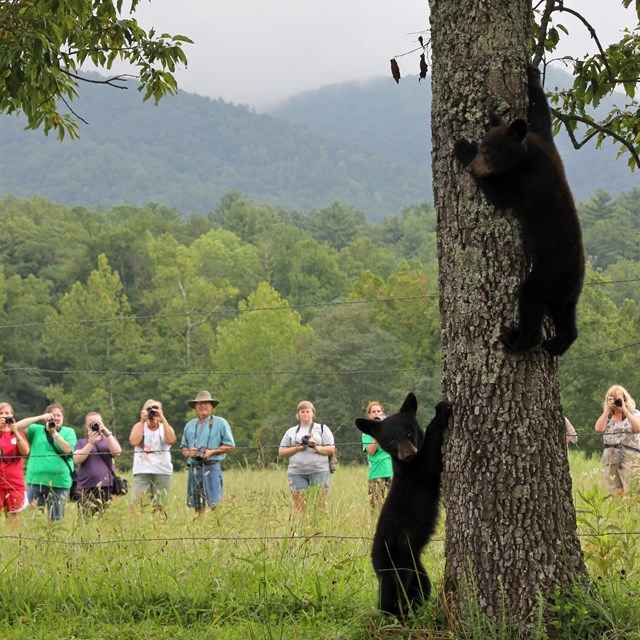
Giving a bear plenty of space helps reduce its stress and minimizes the risk of conflict.
NPS / Betty Blanton
If you encounter a bear
If you encounter a bear, it's important to stay calm and alert. Never approach the bear or allow it to come closer to you. If the bear is at a distance and continues its normal activities like walking or feeding after noticing you, it's generally safe to continue—just keep a close eye on it. However, if the bear changes its behavior in response to your presence, such as stopping what it's doing, watching you, or altering its direction, you are too close. In that case, slowly back away while facing the bear, and never run.
If a bear approaches or follows you
If a bear approaches or follows you, change your direction. If it continues to follow, stand your ground. Never run or turn your back. If the bear gets closer, shout and act aggressively to scare it off. If it persists, throw non-food items like rocks toward it. Never leave food behind, and do not fire a gun, as it can create a safety hazard. Use bear spray only if necessary and the bear is within 20 yards. If you're with others, stay together and make yourselves appear larger to increase your chances of deterring the bear.
If a bear is after your food, move away from the food and slowly back off to avoid escalating the situation. However, if the bear attacks you and it’s not interested in your food, fight back with everything you have. Do not play dead. Defend yourself using any available objects and do your best to deter the bear.
Never burn trash or cook food in a fire ring. The lingering scent can attract bears—not just during your stay, but long after you've left, putting future campers at risk.
NPS
Garbage and Food Scraps Kill Bears
Black bears have an incredible sense of smell; about seven times stronger than a bloodhound. This powerful nose helps them find natural foods like insects, nuts, and berries, but they can be drawn to any food source, including human food and trash.
Items like hot dogs, apple cores, chip crumbs, and watermelon rinds left behind in picnic areas, campgrounds, or along trails can be deadly to bears. Once a bear gets a taste of human food, its behavior changes. It loses its natural fear of people and may begin approaching them, becoming unpredictable and dangerous.
These food-conditioned bears often damage property, threaten public safety, and sadly, have to be euthanized. Bears are unfortunately euthanized in the Smokies almost every year.
Additionally, bears can teach this behavior to other bears, such as their cubs. Studies show that bears who rely on human food live shorter lives as they’re more likely to be hit by cars, targeted by poachers, or suffer from poor health.
To protect bears and people, park rangers strictly enforce rules against littering, feeding wildlife, and improper food storage. Violations can result in fines up to $5,000 and jail time up to six months.
The lifespan of a black bear in the wild is about 12-15 years. However, bears that gain access to human food and garbage often live only half as long.
Paul Driessche
Bears in the Smokies
Great Smoky Mountains National Park is one of the largest protected areas in the eastern United States where black bears live. Bears inhabit all elevations of the park. Though populations are variable, biologists estimate that roughly 1,900 bears live in the park. This equals a population density of approximately two bears per square mile. The Smokies has the densest population of black bears in the country.
Before European colonization, the black bear's range included most of North America. However, loss of habitat and unregulated hunting resulted in a significant reduction in this range. By the early 1900s, bear populations were nearly eliminated in the continental US.
Biology
Black bears in the Smokies are typically black with a brown muzzle and sometimes a white chest patch, though in other regions they may appear brown or cinnamon. Adult males (boars) average about six feet in length and three feet tall at the shoulder, weighing around 250 pounds in summer. Females (sows) are smaller, usually just over 100 pounds. As fall approaches, both sexes can nearly double their weight, in preparation for winter.
Black bears are well-equipped for life in the wild. They have small eyes, rounded ears, long snouts, and large, muscular bodies. Their non-retractable claws and flat-footed gait help them climb trees, swim efficiently, and run up to 30 miles per hour.
A black bear’s diet changes with the seasons and food availability.
NPS / Betty Blanton
Diet
Black bears are omnivores, meaning they eat both plant and animal matter. Roughly 85% of their diet consists of plant materials, nuts and acorns are especially important during the fall. These high-energy foods help bears build up fat reserves for winter.
In addition to plants, bears consume insects like ants, bees, and beetles, which provide essential protein. They also feed on animal carrion when available, but it’s rare for a black bear to hunt live animals.
Hibernation
Typically, between late October and mid-December, black bears begin settling into their winter den sites. These dens are often in locations such as hollow stumps, tree cavities, or dense brush piles. Uniquely, many bears in the Smokies region choose to den high above the ground in standing hollow trees, which is a behavior rarely seen in other parts of the country.
Black bears have a distinctive approach to hibernation. Although they are not considered “true hibernators” like some smaller mammals, they enter a state known as torpor, which is a lighter and less intense form of hibernation. During torpor, bears do not eat, drink, urinate, or defecate. However, they remain more alert than true hibernators and may briefly leave their dens if disturbed or during periods of warmer weather.
Depending on where a bear lives, has a big impact on the length and depth of its torpor. In the northernmost part of their range, hibernation has been known to last as long as seven months. Bears in the Smokies, however, may only sleep for a month or two at a time before being awoken.
What makes black bear hibernation especially fascinating is that most animals that hibernate are small, often weighing just a few ounces. The fact that a large mammal, which can weigh hundreds of pounds, is able to hibernate at all is still not fully understood. Scientists continue to study this phenomenon, as it remains a remarkable adaptation.
Once a female black bear reaches maturity, she typically reproduces every other year, depending on cub survival and the availability of food.
NPS / Betty Blanton
Life Cycle
As winter approaches, pregnant sows begin to prepare their winter dens for their cub(s). In the days leading up to birthing, expectant mothers often gather bedding materials, chewing them into smaller pieces to create an insulated space. Cubs are typically born in late January or early February while the mother is in her den.
At birth, black bear cubs are born weighing only 8 to 12 ounces. They are hairless, blind, and dependent on their mother. Most litters consist of two cubs, although litters of one to four are possible. The mother cares for her newborns and keeps them warm, nursing them through the winter.
When the cubs finally emerge from their den in late March or April, the cubs have grown to about five pounds, that is about half the weight of a house cat. They remain with their mother for about 18 months, staying close as she teaches them how to navigate their new environment.
Mating season occurs in early to mid-summer, typically around July. Although mating takes place in summer, the embryo does not begin developing immediately. Instead, black bears exhibit a reproductive strategy known as delayed implantation, where the fertilized egg remains dormant until the mother enters her den in the fall. A sow will only become pregnant if she has gained enough weight in the fall to support a pregnancy. If she hasn’t built up sufficient fat reserves, the embryo will not implant, and she will not carry cubs that year.
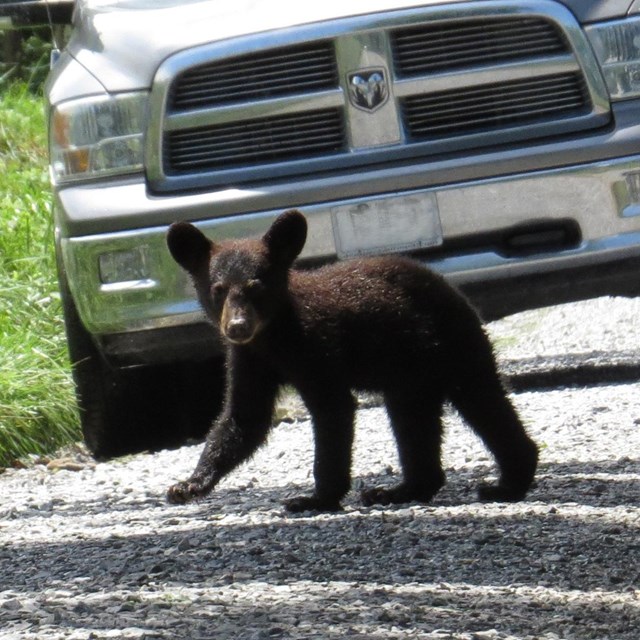
Once a bear becomes use to getting human food, it may go to extreme lengths to get it. This photo shows the aftermath of a vehicle break-in by a bear determined to reach food locked inside.
NPS
Threats to Black Bears
Black bears in the Smokies face a variety of threats, many of which are directly or indirectly caused by human activity.
Human food and garbage: One of the most preventable threats is access to human food and trash. When bears learn to associate people with food, they lose their natural fear and may become aggressive or dependent. This behavior often leads to conflict, and in many cases, the bear must be euthanized.
Habitat loss: As development expands near park boundaries, bear habitat is lost. This reduces the space available for bears to roam, forage, and den. Once these habitats are destroyed, bear populations may decline. Bears that venture into nearby communities in search of food often encounter unsecured garbage or food, which can lead to habituation.
Non-native species: Invasive species such as the European wild hog compete directly with black bears for food. Additionally, the invasive spongy moth, an insect that defoliates oak trees, reduces both food availability and potential denning sites in old-growth forests.
Poaching: Illegal hunting, or poaching, continues to be an issue sometimes driven by high profits on international markets. While bears are protected within the national park, enforcement outside park boundaries can be difficult.
Bear Management
Visitors play a critical role in bear management. When people are careless—such as leaving food out, littering, or approaching bears too closely—they could be unintentionally contributing to a bear’s death. To help prevent this, the park has taken several steps to help visitors protect bears.
Bear-proof trash cans and dumpsters are available in all campgrounds, picnic areas, and high-use areas like visitor centers. During the summer, some picnic areas close each evening to allow for thorough cleaning before dark.
Park rangers patrol campgrounds and picnic areas to enforce rules around littering, food storage, and evening closures. They also strictly enforce regulations that prohibit approaching, feeding, disturbing, or harassing bears.
Volunteers support bear safety by patrolling popular trails, picnic areas, roads, and campgrounds. They educate visitors, remove unattended food and coolers, clean up litter, and help manage crowds during roadside bear jams.
At backcountry campsites, park rangers have installed food storage cables to help backpackers hang their food and trash safely out of reach of bears.
The park shares bear safety information through visitor centers, the park newspaper, interpretive programs, website, and social media. Educational signs are also posted in restrooms, on picnic tables, and throughout the park.
Wildlife managers actively monitor bear activity and use proactive techniques to keep bears wild and wary of humans. This helps bears stay within their natural home range and avoid developed areas.
These combined efforts are making a difference. In some areas, the number of bears that need to be trapped and relocated has decreased thanks to improved visitor awareness and responsible behavior.