


Last updated: April 7, 2026
Place
Rancho de las Cabras
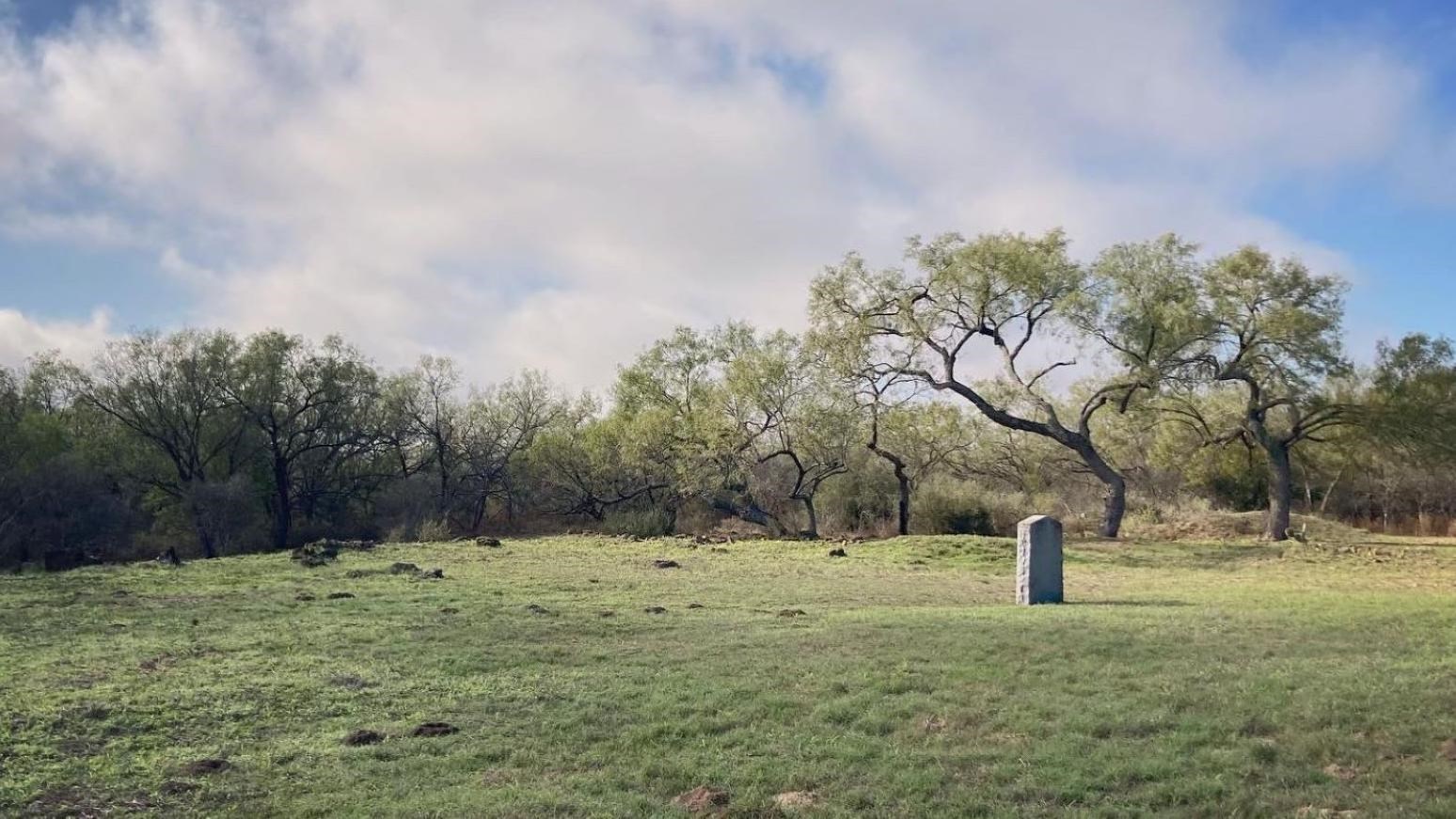
NPS Photo
Quick Facts
Location:
Rancho de las Cabras is managed by the National Park Service as part of San Antonio Missions National Historical Park in San Antonio, Texas. You can visit Rancho de las Cabras as part of a guided tour with a park ranger from San Antonio Missions National Historical Park.
Significance:
Rancho de las Cabras served as a mission outpost for the San Francisco Mission Espada, which is about 30 miles north. Both missions were on the San Antonio River, which played a vital role in shaping Texas.
OPEN TO PUBLIC:
No
Amenities
2 listed
Historical/Interpretive Information/Exhibits, Picnic Table
The historic Rancho de las Cabras (Ranch of the Goats) is located just southwest of Floresville, Texas, on El Camino Real de los Tejas. This is one of the oldest ranches in the region, established by Spanish missionaries, priests, soldiers, and officials as a ranch outpost of San Francisco de la Espada Mission in San Antonio.[1]
Like other missions in Texas, the San Francisco de la Espada Mission served as a point of interaction between Native Americans and Spanish missionaries, who aimed to convert Indigenous peoples to Catholicism. Rancho de las Cabras served as the principal location of livestock ranching that supported the mission’s activities. Archaeological digs have revealed the presence of a large stone wall and defensive towers built to protect inhabitants.[2] Most of the ranch’s vaqueros (cowboys) were Indigenous people who converted to Catholicism. They handled the ranch’s horses, sheep, goats, and pigs.[3]
The Texas missions were a drain on the resources of the Spanish Crown. Beginning in the 1790s, the Spanish Crown began secularizing them, turning control over to local bishops and distributing mission lands to the Indigenous people who had resided there.[4] Mission lands eventually became available to the general public as well. Ygnacio Francisco Xavier Calvillo, who had leased part of the Rancho de las Cabras for decades, purchased a large portion of it by 1809.[5] In 1814, Calvillo’s own grandson and a group of accomplices killed him and tried to cover up their actions by making it look like he had fallen victim to Comanche or Apache raiders.[6]
After Calvillo’s death, his daughter Maria del Carmen Calvillo inherited the ranch. Her husband, Juan Gavino de la Trinidad Delgado, had been forced to flee the area after backing rebellions against the Spanish Empire.[7] The two never formally divorced, but they did separate and, in 1828, Calvillo petitioned the Mexican government for the power to manage her estates and properties as she saw fit.
Maria Calvillo made numerous changes to Rancho de las Cabras. She ordered the creation of a new irrigation system and new buildings for storing grain and processing sugar. She also expanded the size of the estate, purchasing land where the former mission-era structures stood.[8] Family tradition holds that she dressed as a man to better ride around and keep an eye on her holdings. She negotiated with the Lipan Apache, offering them beef in exchange for the protection of her ranch, and with the Mexican government to secure her title to the property after Mexico won its independence from Spain.[9]
The ranch’s location along El Camino Real de los Tejas presented additional opportunities for Calvillo to make money. Rumored to have been involved in the contraband trade between Louisiana, Texas, and points further south, historian Nora E. Rios McMillan notes that at least one relative of Calvillo was involved in the contraband trade, but that no clear evidence has emerged to definitively prove involvement by Maria herself.[10]
Calvillo sold much of the ranch in the years before her death in 1856.[11] What remained of her holdings passed to her two adopted children. Later owners of the land continued to use it for ranching until the early twentieth century, when they began farming the land instead.[12]
In the late 1970s, the Texas Parks and Wildlife Department purchased the property and transferred it to the National Park Service in 1995.[13] By this time, all that was left aboveground was a sandstone perimeter wall and the bases of defensive towers.[14] Archeological research has provided more insights on the site and its history. Archaeologists identified the likely location of four jacales, thatched-roof structures made of upright wooden posts, which correspond with a 1772 inventory of the ranch. Archaeologists also identified expansions of the building after 1772, which included a chapel. Pottery at the site reflects both Native and European ceramic styles. A variety of animal bones show that residents had a diverse diet.[15]
Today, the site is part of San Antonio Missions National Historical Park. For access, visitors must register for a guided tour by contacting the park. This section of El Camino Real de los Tejas is nearby the Floresville El Camino Trail, the longest walkable section of this historic trade and transportation route.
Site Information
Location: Floresville, Texas
From October to March, monthly tours are open for reservations.
Program length is approximately 2 hours. Reservations required with limited availability and first come first serve. To reserve your spot please saan_interpretation@nps.gov and include your name, email, phone number and # in party.
El Camino Real de los Tejas National Historic Trail
[1] “Rancho de las Cabras,” Texas Beyond History (https://www.texasbeyondhistory.net/st-plains/images/he4.html: accessed 10 July 2024).
[2] “Rancho de las Cabras,” Texas Beyond History.
[3] Oculus, Rancho de Las Cabras Cultural Landscape Report (National Park Service, November 1998), pg. I-17.
[4] “Spanish Missions in Texas,” Texas Almanac, accessed October 25, 2024, https://www.texasalmanac.com/articles/the-spanish-missions-in-texas
[5] Rancho de Las Cabras Cultural Landscape Report, pg. I-18; Porter, Amy, “Calvillo, Ignacio Francisco Xavier (1731–1814),” Handbook of Texas Online, accessed October 25, 2024, https://www.tshaonline.org/handbook/entries/calvillo-ignacio-francisco-xavier
[6] Porter, Amy, “Calvillo, Ignacio Francisco Xavier (1731–1814)”; Cox, I Waynne, “Calvillo, Maria del Carmen (1765–1856),” Handbook of Texas Online, accessed October 25, 2024, https://www.tshaonline.org/handbook/entries/calvillo-maria-del-carmen; Rancho de Las Cabras Cultural Landscape Report, p. 2-40
[7] Amy Porter, “Tejans and Ranching Maria Calvillo and Her Ranching Enterprises,” in Texas Women and Ranching: On the Range, at the Rodeo, and in Their Communities,” Deborah M. Liles and Cecilia Gutierrez Venable (eds.), (College Station: Texas A&M Press, 2019), pg. 15.
[8] Rancho de Las Cabras Cultural Landscape Report, pg. 2-40. Nora E. Rios McMillan, “Calvillo, Ana Maria Del Carmen,” in Latinas in the United States: A Historical Encyclopedia, Vicki L. Ruiz, Virginia Sanchez Korrol (eds.), (Bloomington: Indiana University Press, 2006), pg. 113.
[9] McMillan, “Calvillo, Ana Maria Del Carmen,” pg. 113-114.
[10] Nora E. Rios McMillan, “Calvillo Ana Maria Del Carmen,” in Latinas in the United States: A Historical Encyclopedia, Vicki L. Ruiz (eds.), (Bloomington, Indiana University Press, 2006), pg. 114.
[11] Rancho de Las Cabras Cultural Landscape Report, pg. 2-45.
[12] Rancho de Las Cabras Cultural Landscape Report, pg. 2-51-2-52.
[13] Christopher Long and Laurie E. Jasinski, “Rancho de las Cabras,” Texas State Historical Association, last updated August 11, 2020, https://www.tshaonline.org/handbook/entries/rancho-de-las-cabras
[14] Rancho de las Cabras,” Texas Beyond History.
[15] Rancho de las Cabras,” Texas Beyond History.