



News Release
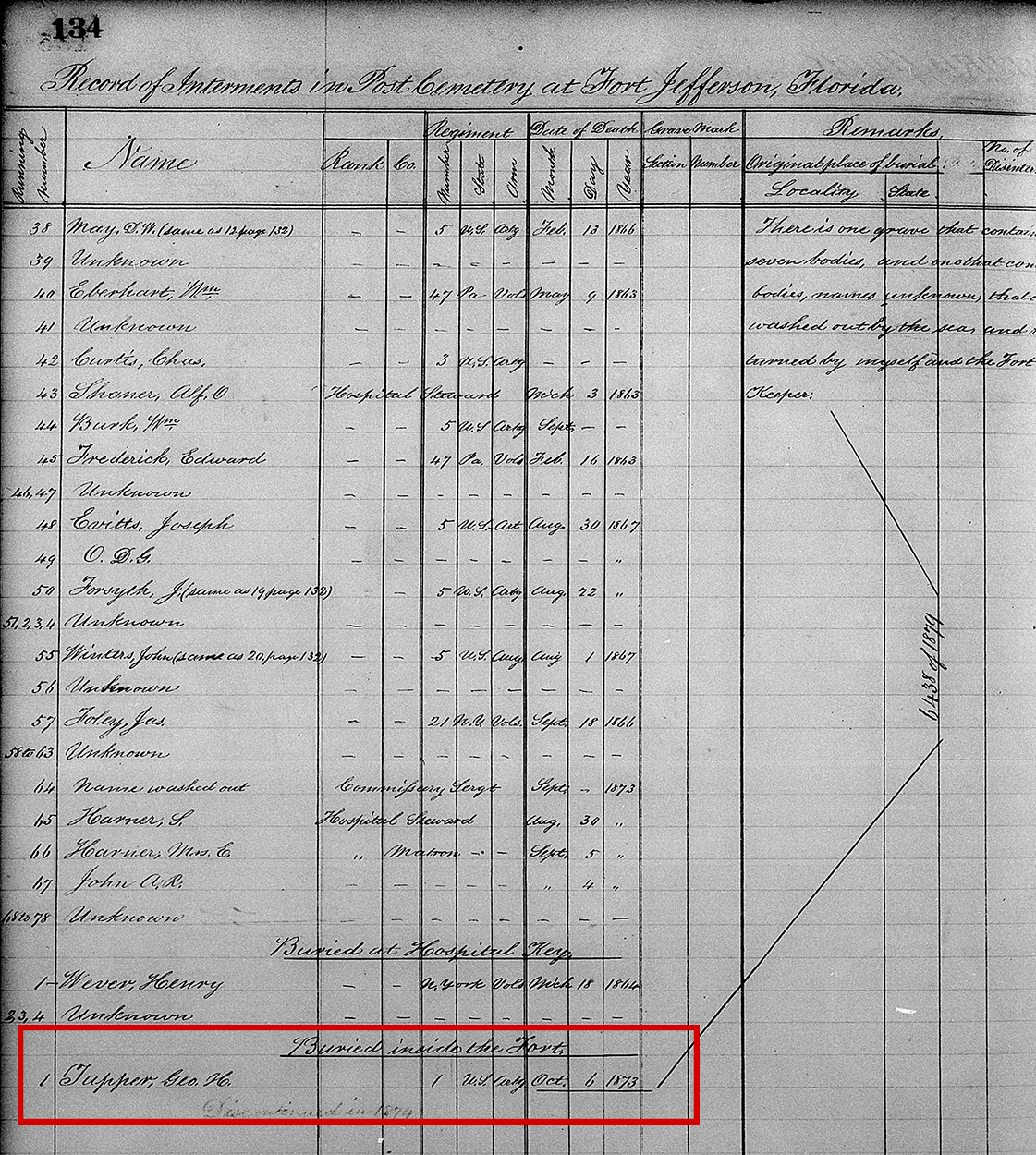
courtesy of National Archives and Records Administration
Subscribe
 |
What is RSS |
What is RSS
|
Contact: Dry Tortugas Communications
Contact: Dry Tortugas General Information
KEY WEST, Fla. — National Park Service archeologists have identified the original burial site of Private George Tupper, a 22-year-old U.S. Army soldier and the only known service member buried within the walls of Fort Jefferson on Garden Key
“Locating Private Tupper’s original grave allows us to honor him and the service members who lived and served at Dry Tortugas,” said Josh Marano, NPS archeologist and field director for the project. “It is also a great reminder of why careful survey work before projects is essential.”
Tupper served in Battery M, 1st U.S. Artillery, and enlisted in Boston on Oct. 16, 1872. Army records describe him as 5 feet 8 inches tall, with gray eyes, brown hair and a fair complexion. He listed his occupation as a “book binder,” though a commanding officer later described him as an actor. Tupper died of yellow fever at Fort Jefferson on Oct. 6, 1873, just weeks before completing his first year of service.
His death occurred during a yellow fever outbreak that claimed multiple lives at the remote island fort and coincided with an approaching hurricane that prevented burial in the post cemetery. Historical records state he was buried in a “lime pit, near the parade, being the only remains buried within the fort limits.” While civilians may also have been buried within the parade grounds, Tupper is the only documented service member interred inside the fort. He was later exhumed and likely reinterred at Fort Barrancas National Cemetery in Pensacola, Florida.
During the survey, archeologists also recovered artifacts including buttons, marbles, bullets and clay smoking pipes that provide information about daily life at Fort Jefferson in the 19th century.
In June 2024, archeologists with the park’s cultural resources team, assisted by the NPS Southeast Archeological Center, discovered Private Tupper’s burial site while surveying potential locations for a new radio tower. The team used ground-penetrating radar as part of compliance with Section 106 of the National Historic Preservation Act, which requires federal agencies to consider effects on historic properties before undertaking projects.
The discovery supports ongoing research into the fort’s post cemetery, located on a nearby submerged island. While U.S. Army records document at least 83 deaths at Fort Jefferson, park archeologists have since identified more than 200 individuals who died there, many previously listed as unknown.
For more information about Private Tupper, visit: Private George Tupper.
To learn more about the Fort Jefferson Post Cemetery, visit: Underwater Hospital and Cemetery.

National Park Service

National Park Service
Last updated: March 31, 2026