An official website of the United States government
Here's how you know
Official websites use .gov A
.gov website belongs to an official government
organization in the United States.
Secure .gov websites use HTTPS A
lock (
) or https:// means you've safely connected to
the .gov website. Share sensitive information only on official,
secure websites.
What were some of the challenges that the sailors faced?'
What was the importance of the Great Lakes on shipping in the 1840s-1900s?
Enduring Understanding
The problems and solutions of sailing through history.
The role of the Great Lakes in shipping goods, people, and materials.
Geographical and geological details of the Great Lakes and identify them identify the lakes by name.
Objectives
Explain how all the Great Lakes are connected and why that matters for shipping between the lakes and from the ocean.
Students should be able to recognize the physical challenges of sailing on the Great Lakes such as waterfalls, canals, etc.
Identify 3 challenges the early sailors faced while transporting cargo of copper, people, and supplies. (Fog, blizzards, gales, collisions, sandbars, rocky shores, fire, smoke, and explosions on board)
Name the 5 Great Lakes (Superior, Michigan, Huron, Erie, Ontario) and several shipping ports.
Explain why the Great Lakes are so important for shipping.
Instructional Time
30 minutes to 1 hour
*Individual activities can be completed in one sitting or across multiple days, at instructor's pace
W 4.3 - Write narratives to develop real or imagined experiences or events using effective technique, descriptive details, and clear event sequences. W 4.4 - Produce clear and coherent writing in which the development and organization are appropriate to task, purpose, and audience.
Michigan K-12 Speaking and Listening Standards:
SL 4.1 - Engage effectively in a range of collaborative discussions (one-on-one, in groups, and teacher-led) with diverse partners on grade 4 topics and texts, building on others’ ideas and expressing their own clearly.
Michigan K-12 Language Standards:
L 4.1 - Demonstrate command of the conventions of standard English grammar and usage when writing or speaking. L 4.2 - Demonstrate command of the conventions of standard English capitalization, punctuation, and spelling when writing.
Michigan K-12 Social Studies Standards:
4 – H3.0.1 - Use primary and secondary sources to explain how migration and immigration affected and continue to affect the growth of Michigan. 4 – H3.0.1 - Use historical inquiry questions to investigate the development of Michigan’s major economic activities from statehood to present.
Michigan K-12 Geography Standards:
4 – G4.0.3 - Describe some of the movements of resources, goods, people, and information to, from, or within the United States, and explain the reasons for the movements.
Assessments
Students will explain to partners why the Great Lakes are so important to shipping, the names of the Great Lakes, and dangers of sailing on the lakes.
Eagle Harbor Lighthouse, Keweenaw County Historical Society
NPS Photo
Background
Not familiar with the Keweenaw Peninsula? Start here:
This lesson plan focuses on the Keweenaw County Historical Society, or KCHS for short. KCHS is made up of a group of dedicated volunteers who work to preserve and showcase 11 historic sites on the Keweenaw Peninsula in the Upper Peninsula in Michigan, United States. The various sites KCHS maintains are not only known for copper mining, but also shipping, commercial fishing, lumber, and even maritime history.
Although there are many themes that KCHS embodies, the focus of this lesson is going to be on the importance of shipping in the Great Lakes. From 1840 to around 1900, ships were the only way to move people, goods, copper, and other supplies into and out of towns on the Keweenaw Peninsula. Sailors faced great challenges and navigated safely using lighthouses. The Great Lakes waters flow from 602 feet all the way down to sea level. Ships are unable to pass over waterfalls such as Niagara Falls, and so locks were built to efficiently move ships between lakes.
In this lesson students will focus on learning about the danger and difficulties of shipping (fog, blizzards, gales, collisions, sandbars, rocky shores, fire, smoke, and explosions on board), the five great lakes and shipping ports, the locks that allow ships to transition between lakes, and major shipping events.
Activity Objective: Understand the role of lighthouses and fog signals in ship safety and navigation.
Start by playing the video tour for the class to watch together.
After watching, lead a short discussion on the following questions, or similar questions:
Why do you think the lighthouse is colored a specific color? (to stand out against the land so that sailors can easily see it during the day)
What do you think the other buildings around the lighthouse are for? (housing for the lighthouse keeper and family, assistant keeper, building for the fog signal)
Activity Objective: Think creatively and apply previously learned material to an open-ended prompt on safety and navigation in sailing the Great Lakes.
Hand out printouts of the Lighthouse Keeper’s Log template. Introduce the activity as the students are now Lighthouse Keepers in Eagle Harbor, Michigan. Imagine living at a lighthouse in the Great Lakes region in the early 1900s, What challenges might you face? How has technology evolved? What would you observe every day?
Give them time to write out a Lighthouse Keepers Log that they can take home at the end of the day.
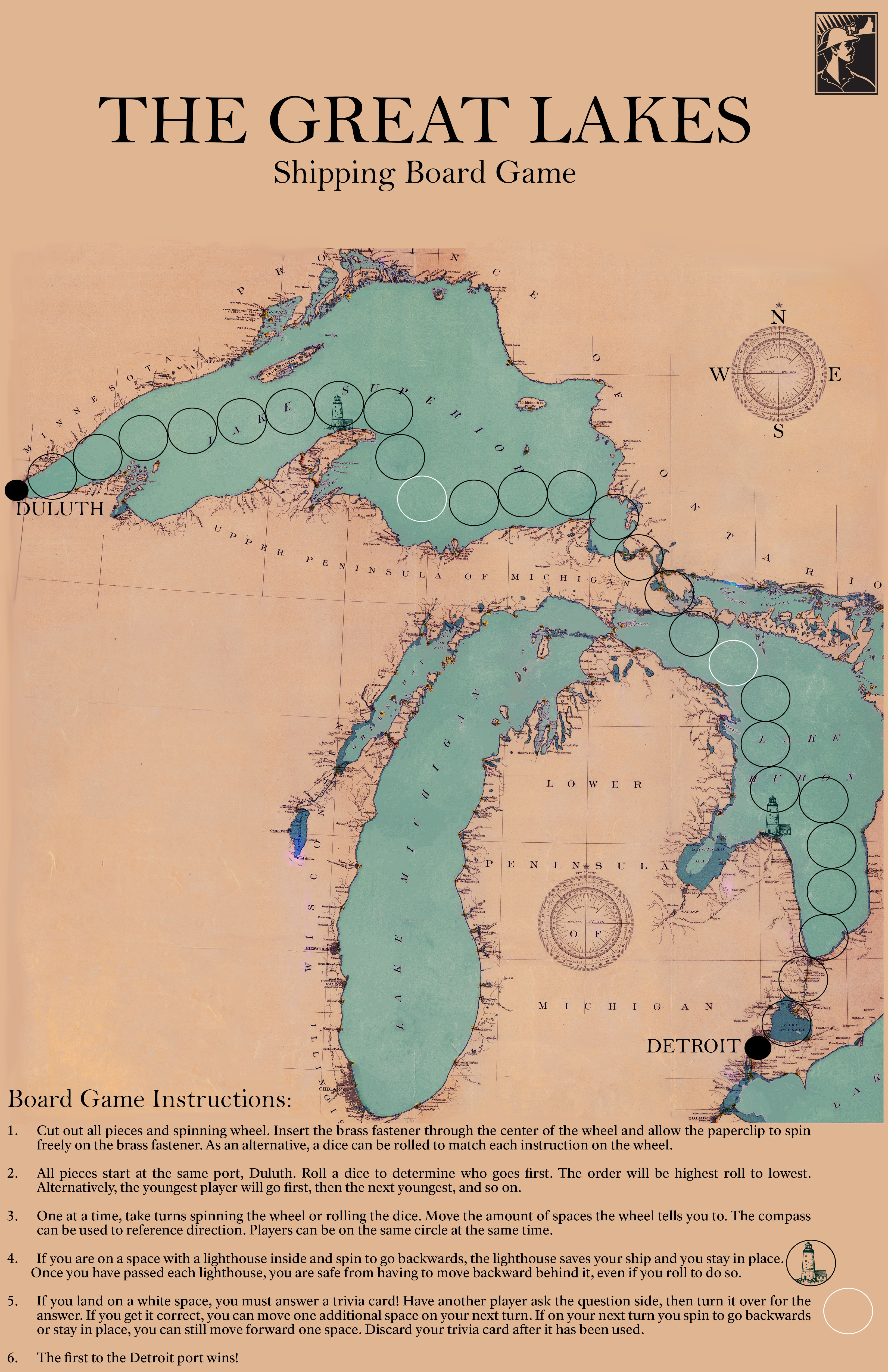
Great Lakes Shipping Board Game
Extension Activities
Shipping Board Game
Activity Objective: Understand how slow and difficult the process of shipping on the Great Lakes is.
Print enough copies of the board game activity so that students can work in groups of 2-4. The ideal print size is 11x17 but 8.5x11 will work. Gather students into the groups.
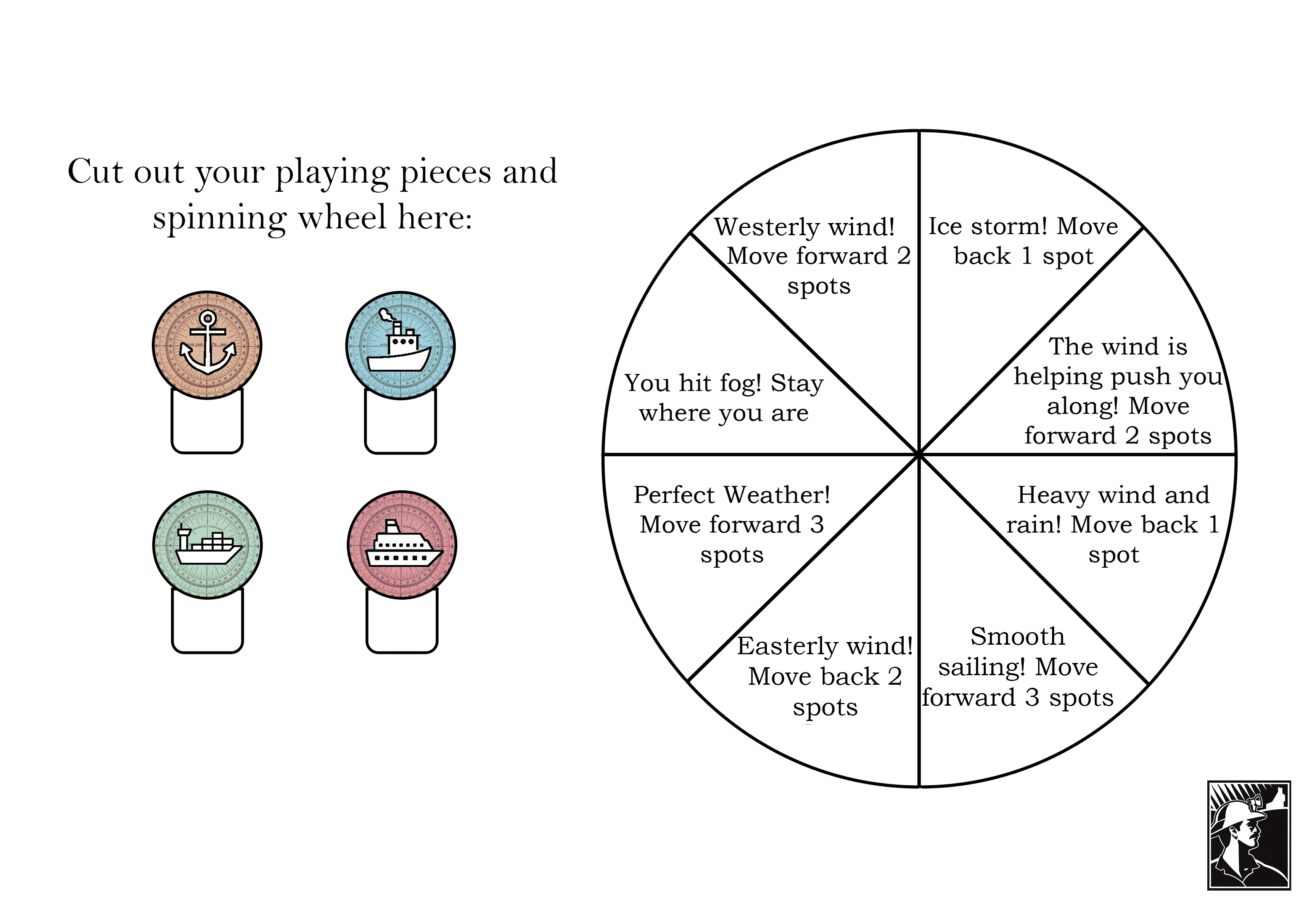
Hand out printouts of the game board, paper pieces, and spinner to each group.
Read the instructions below and have the students start playing the game.
Shipping Board Game Instructions:
Cut out all pieces and spinning wheel. Insert the brass fastener through the center of the wheel and allow the paperclip to spin freely on the brass fastener. As an alternative, a writing utensil can be used as a spinner.
All pieces start at the same port, Duluth.
If you are on a space with a lighthouse inside and spin to go backwards, the lighthouse saves your ship and you stay in place.
If you land on a white space, you can turn to the backside of the spinner and spin for a trivia question! If you get it correct, you can move one additional space on your next turn. If on your next turn you spin to go backwards, you can still move forward one space.
One at a time, take turns spinning the wheel. Move the amount of spaces the wheel tells you to. The compass can be used to reference direction.
The first to the Detroit port wins!
Once everyone is done, lead a short discussion which could include the following questions:
What did you think of the game?
Is there any strategy or does it feel random?
Based on this game, do you think sailing on Lake Superior is easy or difficult?
Activity Objective: Understand the historic routes ships on Lake Superior would take to transport people and cargo.
Pull up the shipping map on the Keweenaw National Historical Park website.
Guide them through the following questions, or similar questions, that they discuss in small groups:
Why do you think the route shown on the map is the route that sailors took? Why wouldn’t they stick closer to land? (Going out across open water in straight lines is faster, trying to avoid rocky shores or shallow spots, etc.)
How do you think captains knew they were close to land? What if it was foggy or dark out and they couldn’t see the land? (Lighthouses, fog signals)