



A few months ago, my daughter introduced me to the “6-7" meme that is all the rage these days, although it might (thankfully) be past its peak by now. Although there is some disagreement about how the meme got so popular, I prefer to believe that it is referring to the planet grouping that is going to be visible in the sky this February. With the help of binoculars or a small telescope and a star map, it is indeed possible to locate six planets in the evening sky this month. With just your unaided eyes, Saturn and Jupiter will be easy, with Mercury and Venus doable if you have a clear, low western horizon.
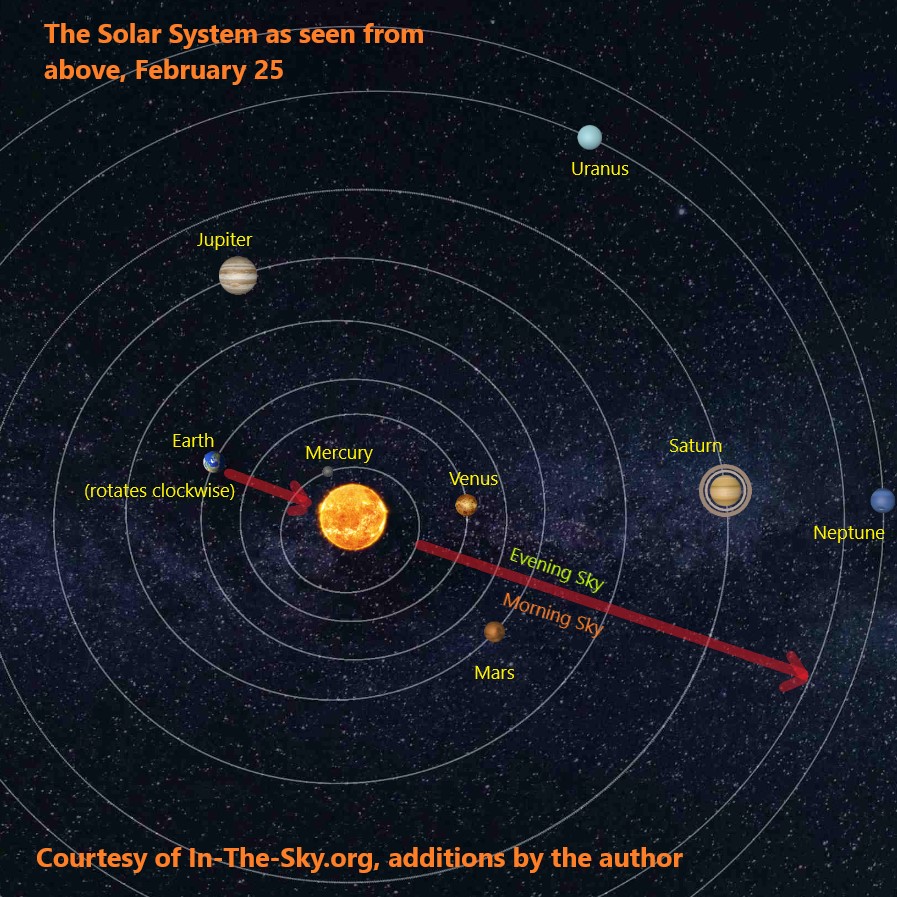
This grouping is referred to as an “alignment” online, but nothing could be further from the truth. As the overhead view shows, the six planets are merely all in the same half of the sky as seen from Earth. Since our planet rotates clockwise as seen from above, the Sun leads the planets above the line on the map, so they are visible in the evening sky after sunset. The grouping spans the least area in the sky on the night of February 28 and that is what is being trumpeted online, but the best actual visibility is from about February 15-24- see below to see why.
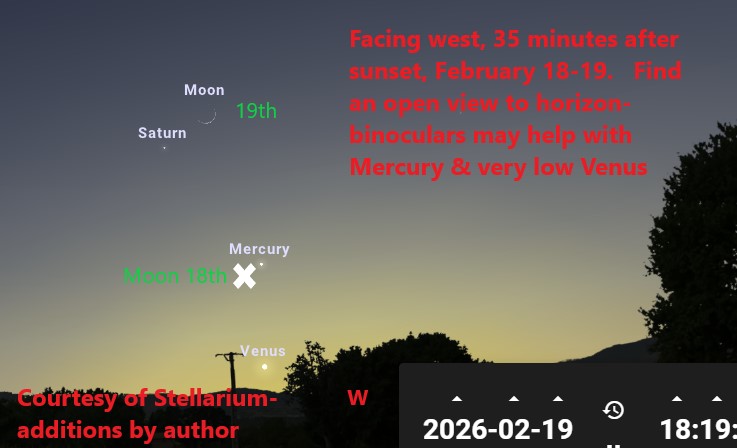
To find the six planets that actually are visible, you must find a spot that has an open view to the western horizon, and it is helpful to bring binoculars as the first two are seen against the twilight background. Venus passed on the far side of the Sun as seen from Earth in January and is slowly emerging into view in the second half of February. Find your local time of sunset (in St. Louis, it is about 5:35 on the 15th and 5:50 on the 28th) and look about a half hour later. Venus is normally very bright, but it will be dimmed severely by the bright twilight background. Can you glimpse Venus glimmering low in the western twilight? Binoculars may help, especially if the night is a little hazy or cloudy.
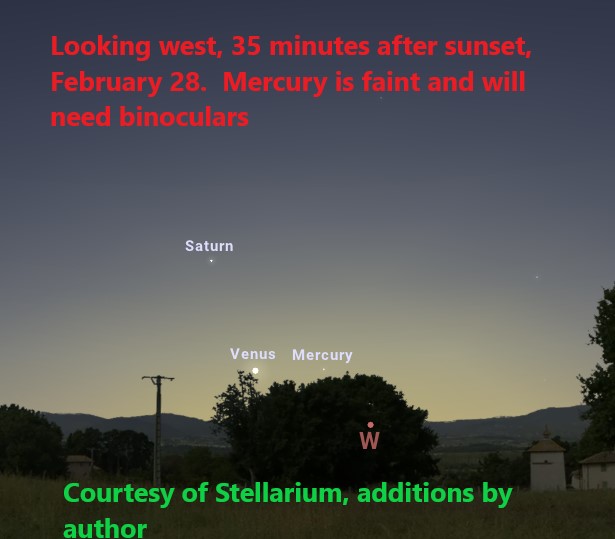
Look about a fist’s width at arm’s length above Venus, preferably about 15-20 minutes later- Mercury should be the next to be visible. On the night of the 18th, a threadlike crescent moon points the way, as shown on the chart. If the night is quite clear, both should be visible to the unaided eye. On the night of the 19th, the moon, a slightly thicker crescent will point the way to Saturn- otherwise look about a fist and a half to the upper left of Mercury. Being higher, Saturn should definitely be naked eye visible at the only bright “star” in this direction, low just south of west once Mercury and Venus have set or gotten too low. Mercury turns more of its dark side towards Earth as it passes more between our planet and the Sun towards the end of the month. It appears to drop towards the Sun and fades. On the 28th, Mercury will be about half a fist to Venus’ right but will definitely need binoculars to be seen, so the view is better a week or two earlier.
If you have successfully found our first three planets, now comes the greatest challenge of all. The only good thing is that as can be seen in the overhead map, Neptune is in the same direction as Saturn, but nearly 2 billion miles farther away. This is so distant that it is about five times too dim to be seen with the unaided eye. If you have too many city lights, you may need a small telescope to glimpse Neptune, otherwise good binoculars may bring it out. Magnifications of 7-10x and apertures of 35mm are greater are recommended.
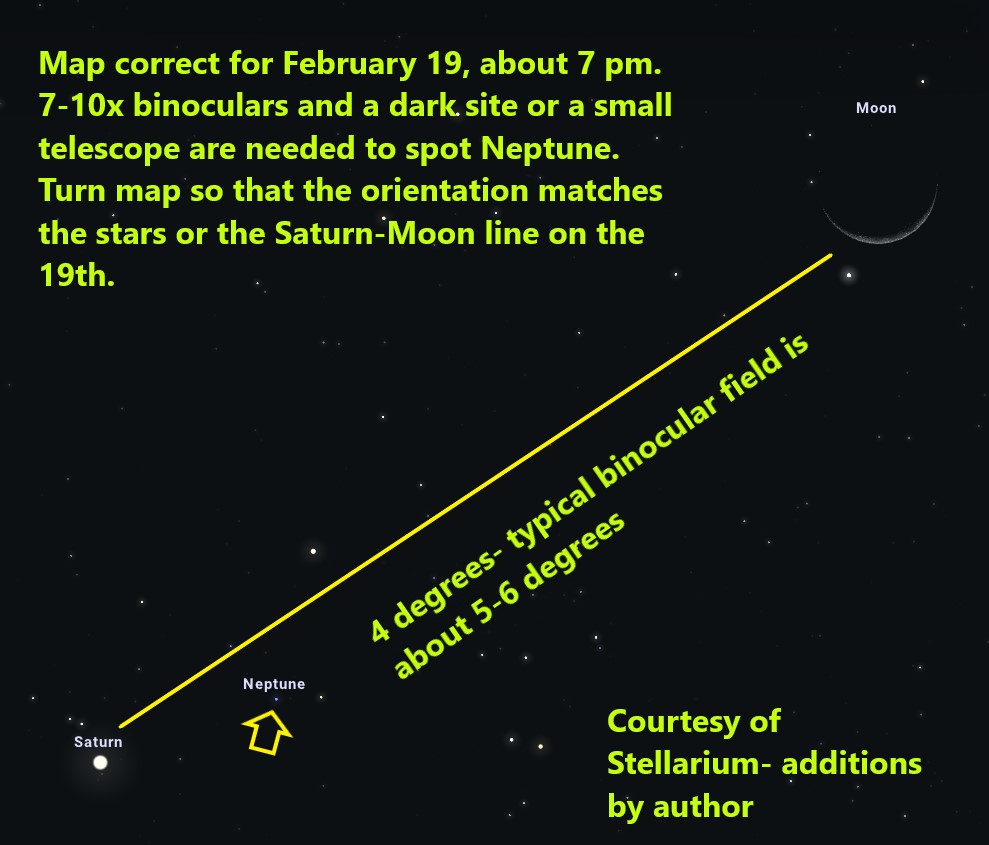
If you use binoculars, the map should match what you see- with a telescope, with the lenses or mirrors used, you may need to flip the map so that the orientation of the stars agrees with what you see. Neptune will be about one low power telescope view from Saturn this month, but almost right in line with the Moon on the night of the 19th.
Going from one extreme to the other, finding Jupiter will be an absolute cinch. It is the super bright “star” that dominates the eastern sky- you can’t miss it if the night is clear! Some or all of Jupiter’s four large Galilean moons can be found with binoculars and small telescopes. Use the map below to find your way to the Pleiades star cluster, which will be your guide to finding Uranus. The Pleiades look like a tiny dipper shaped cloud in the sky. If your eyes are good and the sky dark, most people can see six individual stars. They are one of the best objects to see in binoculars. Uranus is about a billion miles closer than Neptune and is a fairly easy mark in binoculars. If you are viewing from a very dark site and there is little or no moonlight, it might even be possible to glimpse Uranus with the unaided eye, but you’d still need the binoculars to identify it amongst the stars in the same direction.
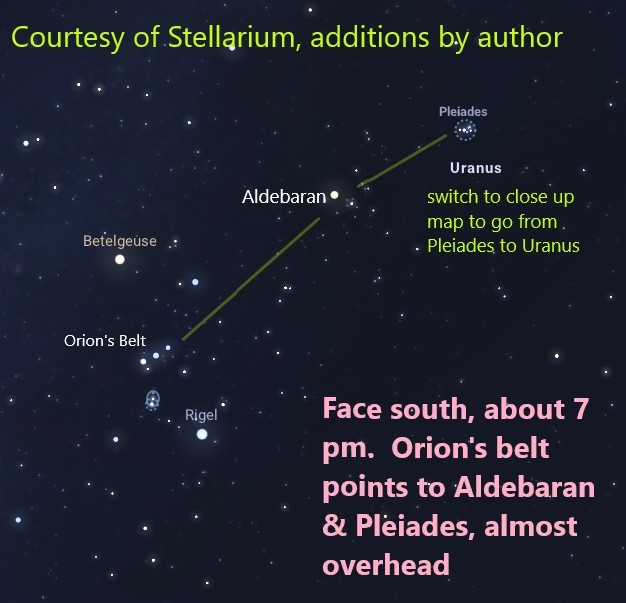
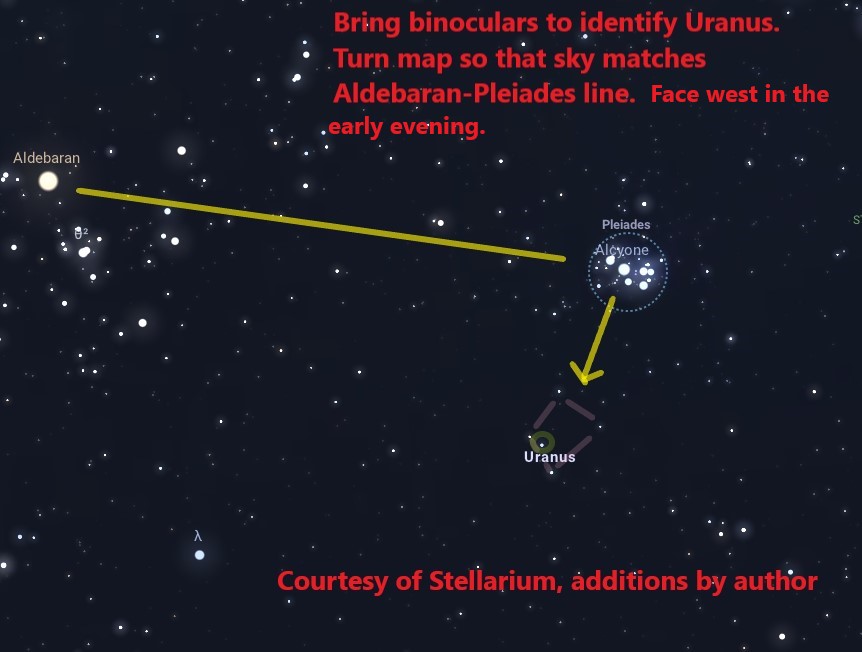
Turn the close-up map so that the line from Aldebaran to the Pleiades matches what you see, and scan with binoculars most of a field away from the Pleiades. Uranus will be within the box like group of similarly bright stars during February. Can you spot it?
Wait a minute- I did write “6-7 planets” as the title to this blog entry. I have mentioned six- Mercury, Venus, Saturn, and Neptune in the west, Uranus in the south, and Jupiter in the eastern sky. What is the seventh planet? It is not Mars- as can be seen on the overhead solar system map, it leads the Sun across the sky and rises just before sunrise in the morning sky. Mars is actually too low to be seen from our latitude for several more weeks. It is not Pluto either- it is no longer considered to be a major planet, and in any case is nowhere near the same direction as the others. Look down at your feet - good old Earth is #7!
The Gateway to the Stars program is scheduled to resume at 7 pm on May 23. Join Matt Barton from the St. Louis Audubon Society and learn about the effects that buildings and their accompanying lights have on bird migration. Weather permitting, free telescope viewing will follow this and all the other programs, which are planned for June 20, July 18, August 22, September 26, and October 24.