



Although the nights are usually cold, December offers some cool celestial gems that are easy to collect. The first would be the planet Saturn, which is often called the “Gem of the Heavens.” It is easy to find, no matter how light polluted your sky. In the early evening, Saturn is the brightest star about halfway up in the south to southwestern sky during December evenings, setting in the west during the middle of the night. If you take out a telescope, Saturn’s rings may currently be hard to see, as we are seeing them nearly edge-on for the first time in fifteen years. Saturn forms a triangle with the dimmer stars Fomalhaut and Diphda, as shown on the map below.
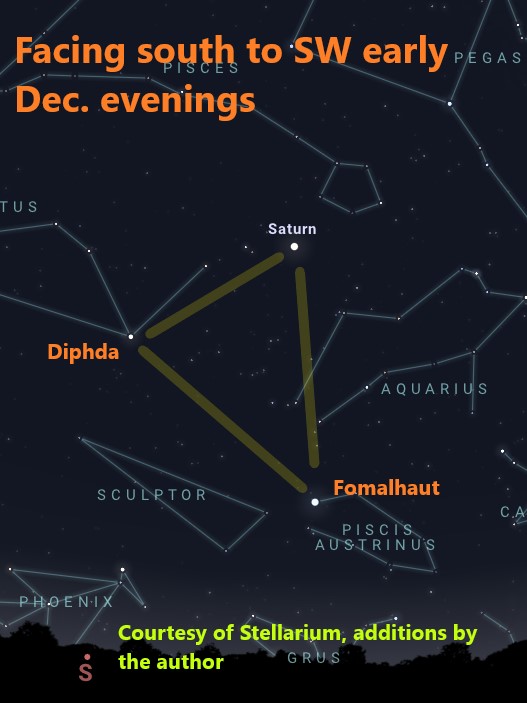
Face south to locate the planet Saturn, which forms a triangle with two other fairly bright stars
The two brightest starlike objects in the skies of December are the planet Jupiter and the Dog Star Sirius. If you have an open enough view to the east-northeast horizon, you can spot Jupiter as early as 8 pm at the beginning of September, and about a half hour earlier each week after that. Because Jupiter is the largest planet and its cloudy atmosphere reflects the sun’s light well, it outshines all stars in the sky. To me it looks yellowish-white. Good binoculars can bring out at least some of Jupiter’s four large Galilean moons. A bit dimmer but still brilliant, Sirius appears about 80 minutes after Jupiter, south of east. A line through the three bright stars of Orion’s belt always helps identify it. Sirius is particularly striking when seen rising or setting, as it twinkles violently due to its light passing through the thicker atmosphere close to the horizon. Jupiter twinkles much less as it is much closer to us and appears larger. Sirius to me appears bluish-white in color.
All three of the “gems” described so far can be easily seen on any evening in December and indeed through most of the winter. The Geminid Meteor shower is best seen on one night, that of December 13-14. If the forecast for that night is bad, a decent number of meteors can be seen a night or two on either side of that date. This meteor shower is probably the richest of all the annual events, although due to the warmer weather the August Perseids are understandably more popular. Unlike the Perseids which are best seen well after midnight, the radiant point for the Geminids gets decently high up in the late evening, although I would watch later than the 9 pm time of the map below for greater numbers. BUNDLE UP and find a comfortable lawn or other chair that you can lay back on, or possibly a sleeping bag. The meteors will appear to come from a point just above the star Castor in Gemini, but it is best to center your gaze in the darkest part of the sky, two to three fist-widths above the radiant. If you can head to a dark sky location you will be able to see far more meteors, possibly several dozen per hour. This is a good year for the Geminids, as the crescent moon will not rise until about 3 am and will not interfere much. Is December too cold for you? Good news! The Perseid shower will peak on the morning of August 13 and will have NO moonlight interference next year.
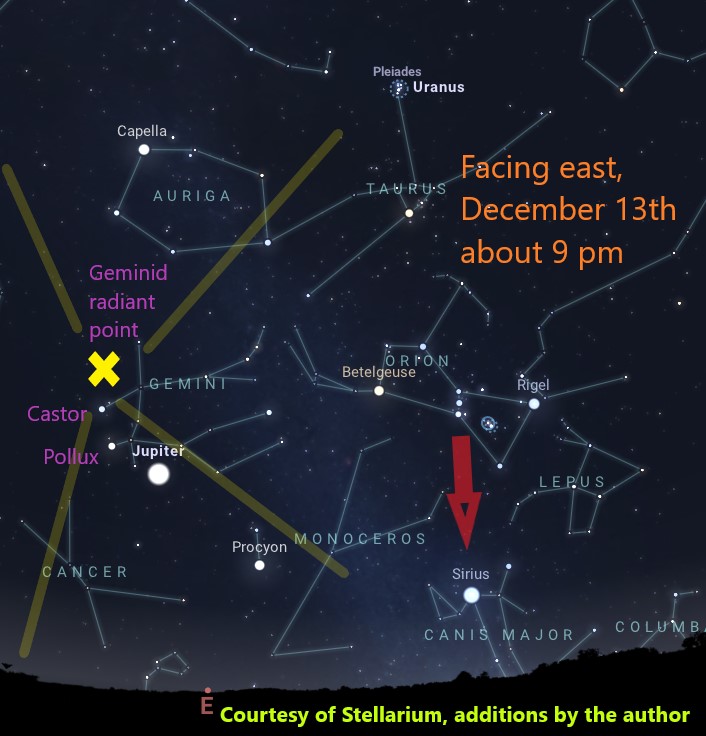
Face east to find brilliant planet Jupiter and Dog Star Sirius on December nights. Choose the night of the 13th-14th for the best chance to catch some of the Geminid meteors.
The Gateway to the Stars program series is complete for 2025. These programs consist of astronomy and National Park related educational programs held inside and outside the Gateway Arch Visitor Center from May-October. Weather permitting, telescope viewing is held on the Entrance Plaza following these programs, provided by the Park and our St. Louis Astronomical Society partners.