What's Going on With the Volcano?
|
Eruption Update: April 26, 2012: On Kīlauea's east rift zone, surface lava flows continue to be active on the pali (cliffs) and the coastal plain southeast of Puʻu ʻŌʻō (within the abandoned Royal Garden subdivision). These flows have entered Hawaiʻi Volcanoes National Park over the past day. These flows were just 180 ft (55 meters) within the Park boundary, and 0.6 miles (900 meters) from the ocean. There is no active ocean entry, however there have been reports of visible glows on the pali from the end of Chain of Craters Road and the Kalapana viewing area. Please note: The Kalapana viewing area is outside of Hawaiʻi Volcanoes National Park and is managed by Hawaiʻi County. There is no fee to enter the viewing area. Currently the viewing area is open from 2:00 p.m. to 10:00 p.m. with the last vehicle allowed in at 8:00 p.m. To hear a recorded message of updated viewing conditions, call 808-961-8093. Map to the Kalapana public viewing area (pdf-466KB)
NPS The End of Chain of Craters Road Surface flowing lava is currently accessible from the end of Chain of Craters Road, however you should be prepared for an extremely arduous, advanced and challenging hike that should only be attempted by the most physically fit people. It is roughly 10 miles round trip from the end of Chain of Craters Road, with an estimated time to complete of at least 5.5 hours. Hiking across lava fields requires continous awareness and concentration. The lava is uneven, jagged and very sharp. All skin should be covered. If you decide to do this hike, you should have:
Please view this four minute video - "Plan for Safe Viewing of Lava Flows" HAZARD ALERT: Lava entering the ocean builds lava deltas. The lava delta and adjacent areas both inland and out to sea are some of the most hazardous areas on the flow field. Frequent delta/bench collapses give little warning, can produce hot rock falls inland and in the adjacent ocean, and can produce large local waves. The steam plume produced by lava entering the ocean contains fine lava fragments and an assortment of acid droplets that can be harmful to your health. The rapidly changing conditions near the ocean entry have been responsible for many injuries and a few deaths.
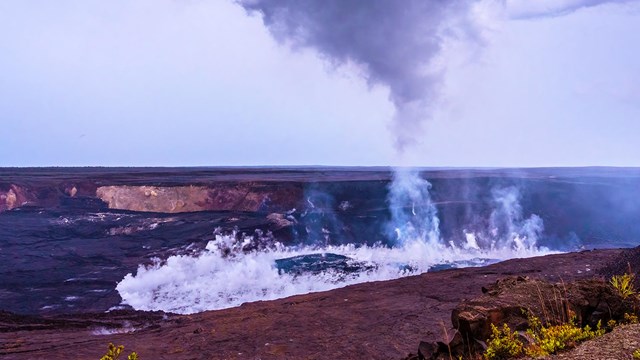
NPS Photo There is a 150m (520 ft) wide active vent in Halemaʻumaʻu Crater that is emitting a gas and steam plume viewable from Jaggar Museum and the Kīlauea Overlook (and other caldera viewing areas in the park). The level of the lava lake in the vent fluctuates from about 90 to 115m (295 to 377 ft) below the surface. On a clear night there is often a strong orange glow. Halemaʻumaʻu web cam (opens in new window). The lava lakes in the Puʻu ʻŌʻō crater and Halemaʻumaʻu crater, as well as other views may be viewed on webcameras made available by the scientists at USGS Hawaiian Volcano Observatory. Daily updates by staff that monitor Hawaiʻi's volcanoes provide visitors with the most recent observations on volcanic conditions. .............................................................................................................................................
USGS Webcamera Webcam view of the lava lake within the summit vent in Halemaʻumaʻu on June 2, 2011. Links to More Information: USGS Hawaiian Volcano Observatory If you are interested in more information about the Kīlauea east rift zone, we invite you to watch the video cast of USGS Hawaiian Volcano Observatory geophysicist Mike Poland from our After Dark in the Park presentation on August 23, 2011. Mike discusses the volcanic history of the area. It's one hour in length and can be viewed here
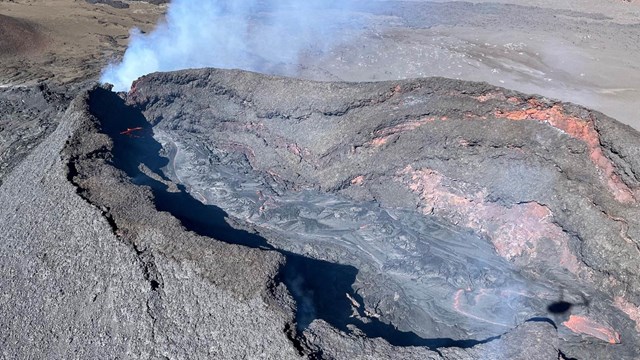
Scott Rowland of The University of Hawaiʻi captured this shot of Puʻu ʻŌʻō from the Puʻu Huluhulu lookout the evening before Puʻu ʻŌʻō collapsed and the west flank eruption began on August 3rd 2011.
The following links are to NPS informative posters regarding the Kamoamoa eruption. March 5, 2011: New Changes in the Eruption of Kīlauea (pdf-604KB) |
Did You Know?
The endangered Honu (Green Sea Turtle) are frequently seen in shallow waters and basking in the sun on beaches. They return to the Northwest Hawaiian Islands to lay their nests, over 700 miles away.