



Last updated: June 4, 2026
Lesson Plan
Building Barriers: Measuring Fort Raleigh
Download Lesson Plan
38KB
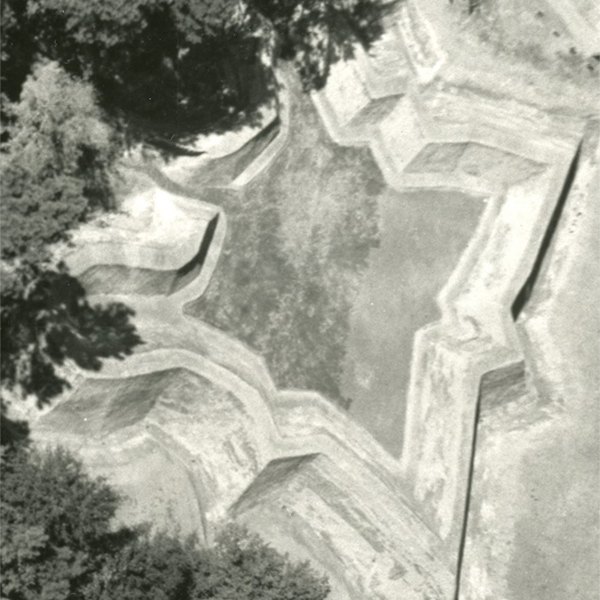
Fort Raleigh is an early example of a bastion-style fort in North America
NPS Photo
- Grade Level:
- Middle School: Sixth Grade through Eighth Grade
- Subject:
- Math,Social Studies
- Lesson Duration:
- 60 Minutes
- State Standards:
- •8.G.1.2 – Explain how location, resources, and human geography have influenced the development of North Carolina and the nation
•8.G.1.5 – Explain how geographic expansion has impacted the development of North Carolina and the nation - Thinking Skills:
- Understanding: Understand the main idea of material heard, viewed, or read. Interpret or summarize the ideas in own words.
Essential Question
How does geometry play a role in how a fort is structured?
Objective
Practice using the Pythagorean Theorem and learn how it can be applied to the real world
Background
The earthwork fort at Fort Raleigh National Historic Site was built by the second voyage to Roanoke Island in 1585. Lead by Sir Richard Grenville, 7 ships and 600 men sailed across the Atlantic from Europe with the goal of establishing a military colony on the island. Upon arrival the Tyger, one of the ships, takes damage and they lose most of their food supplies, forcing Grenville to return to England with most of the men to gather more supplies. The 100 men who remain are led by Ralph Lane, an experienced military man and expert in fortification, who quickly directed his men to construct a fort for protection on Roanoke Island.
Preparation
To prepare for this lesson plan, the teacher will need to print out all of the following materials for each student
- Fort Raleigh Graph
- Fort Examples
- Fort Raleigh with Labeled parts
They will also need to print a few of the Extra Graph for High Achievers and a Fort Raleigh Graph with Answers for themselves. Additionally, the aerial photos of Fort Raleigh can be printed to show students the outline of the fort to give them an idea of what the end should look like.
Materials
This is the graph paper printout for students to graph the outline of Fort Raleigh
Download Fort Raleigh Graph For Students
This is the Fort Raleigh graph with answers for each hypotenuse for teachers.
Download Fort Raleigh Graph with Answer
An image of Fort Raleigh with the parts of the bastion-style fort labelled.
Download Fort Raleigh Labelled
A listing of other U.S. bastion-style forts to use for additional challenges.
This is a blank graph for high achievers to build their own fort outline and graph it.
Download Extra Graph for High Achievers
Lesson Hook/Preview
Experience one of the many ways math is used in real-world situations by learning about historic forts like the one seen at Fort Raleigh NHS. Practice working with the Pythagorean Theorem to calculate the perimeter of the earthwork fort then try designing a fort of your own.
Procedure
Introduction: Discuss fortification in the 1500sThe primary reason forts are built is to act as a base to protect and control territory and settlements from attacks. In the late 1500s forts were designed specifically to protect against “black powder weapons” which were weapons that used traditional gunpowder like muskets or cannons.This kind of fort design is known as the bastion system, identifiable by its star-like shape thanks to the bastions that protrude beyond the main wall of the fort. Bastions eliminate blind spots soldiers may have and allow little cover for the enemy. It also made it so multiple guns or cannons could fire in every direction.Fort Raleigh is specifically an earthwork, or a fortification made of dirt. Soldiers would dig dry moats around the fort to act as another line of defense and use the dirt to build up their parapet which would be supported from the inside with fallen trees. On top of the parapet would be embrasures, notches from which soldiers could aim their weapons.Assignment: When a military colony was established on Roanoke in 1585, an earthen fort was built under the guidance of Ralph Lane, a military man and governor of the colony. Over time the original fort eroded away but a reconstruction based on archeology can be seen at Fort Raleigh today.
- Use the following data points to map out on a graph what the earthen fort would have looked like when it was built. Draw a line connecting the dots in the order you plot them
| x | y | x | y | x | y | x | y | x | y | ||||
| 11 | 0 | -1 | 18 | -6 | 2 | -2 | -5 | 12 | -3 | ||||
| 15 | 9 | -2 | 14 | -11 | 2 | -2 | -8 | ||||||
| 8 | 11 | -1 | 11 | -14 | -1 | 1 | -8 | ||||||
| 7 | 13 | -7 | 9 | -12 | -3 | 8 | -16 | ||||||
| 4 | 12 | -4 | 6 | -7 | -3 | 10 | -4 |
- Calculate the perimeter of the fort, using the Pythagorean theory when needed. Round to the nearest 100th for each hypotenuse.
- As an added challenge, choose one of the other example forts provided and attempt to plot out the shape onto a graph. Record the points in the table below.
| x | y | x | y | x | y | x | y | x | y | ||||
- Calculate the perimeter of the fort, using the Pythagorean theory when needed.
Vocabulary
- Rampart – interior slope of the fort walls
- Parapet – fort walls
- Embrasures – notches cut on top of the fort walls
- Moat – deep, broad trench around the fort
- Bastion – star shaped fortress
- Hypotenuse - The side of a right triangle opposite the 90 degree corner. The longest side
Assessment Materials
- What is one thing you learned from this lesson?
- How accurate was your graph of the fort? If you made any mistakes do you understand what went wrong?
- Why do you think there is not just one shape for a fort? Why are there so many different shapes and styles of bastion forts?
Rubric/Answer Key
Fort Raleigh Graph, the perimeter is 109.5
Supports for Struggling Learners
For struggling learners, try to have them break up the fort outline into many smaller triangles to make it seem less daunting. Overall, it looks quite large, but the triangles make it much smaller.You can also show them the Fort Raleigh Graph or the Fort Raleigh Graph with Answers to assist and give them a visual for what their end product should look like.
Enrichment Activities
Design a New Fort
- Have a student try to design their own bastion style fort. Have them graph it out completely new and not based on any of the other fort examples. Once they have graphed it out, have them calculate their perimeter and see how it stacks up against the other forts.
- Ask them the following questions
- How did you design the fort to eliminate any blind spots?
- Where would you put the embrasures inside the walls to protect it and allow for multiple angles of protection?
- Have students try to calculate the area inside the fort after finding the perimeter
- Have them break the inside into smaller chunks of triangles, squares, and rectangles
- Have them use the following formulas to calculate the inside area of the fort
- Triange: Area = ½ Base x Height
- Square: Area = Base^2
- Rectangle: Area = Base x Height
- Trapezoid: A = (short length + long length)/2 x Height
- Parallelogram Area = Base x Height
- The area of the Fort Raleigh fort should come out to be 409.5 units.
Additional Resources
Related Lessons or Education Materials:
Polygon - Geometry Calculator
Forts (U.S. National Park Service)
Bastions - Castillo de San Marcos National Monument (U.S. National Park Service)
The Anatomy of A Fort (U.S. National Park Service)
DC's Civil War Earthworks (U.S. National Park Service)