



Last updated: March 4, 2026
Place
Winona
Quick Facts
Location:
Lansing Edmond Road, Winona, WV
Significance:
Carter G. Woodson, founder of Black History Month, once was a coal miner in nearby Nuttallburg and later taught school in Winona.
African American Heritage Driving tour Stop 3: Carter G. Woodson
If using the NPS app, to listen to the audio narrative, press the green button below or read the audio narrative text below.
This tour stop is not advised for trailers, RVs, or motorhomes due to narrow roadways, limited parking, and difficulty turning around.
Audio Narration
Written by: Dr. Michael E. Workman
Narrated by: Adrienne Jenkins and Joshua Flynn (quote)
“When you control a man’s thinking you do not have to worry about his actions. You do not have to tell him not to stand here or go yonder. He will find his “proper place” and will stay in it. The mere imparting of information is not education. Carter G. Woodson
West Virginia can boast of more than its share of great African-American leaders. Booker T. Washington and Henry L. Gates are among those who have made significant impacts on American thought and culture. Another leader who made a deep impact was Carter G. Woodson, the educator, historian, and publisher who founded the whole genre of African-American history. Woodson was the only American of slave parentage to earn a Ph.D. in history. He wrote and published nineteen books and numerous articles, founded the first scholarly journal dedicated to African-American history, and started Negro History Week, which eventually became our current Black History Month.
Although Dr. Woodson’s greatest achievements came later in life while he lived in Washington, D.C., his spent his formative years in West Virginia as a coal miner and educator. Woodson was born in 1875 near New Canton in Buckingham County, Virginia. Both his father and mother were former slaves. Poor, but fiercely independent, his father valued education and taught Carter to be “polite to everybody, but to insist always on recognition” and respect. Frustrated by the lack of opportunity in Virginia, young Woodson left the family farm in 1892. He followed the Chesapeake & Ohio Railway into the New and Kanawha River region and found work on the railroad laying ties near Charleston.
Woodson went to work at the Nuttallburg mine in the New River coal field at the age of seventeen or eighteen. He worked hard in the mines, but also worked to receive an education and learned what little there was available on Black history. Oliver Jones, who operated a tearoom for Black miners out of his home, upon learning that Woodson was literate, engaged him to read the daily newspapers to the miners in return for free treats. Woodson later referred to Jones’s establishment as “all but a reading room,” with volumes that described Black history, particularly stories of Black Civil War veterans. His political education grew also as he read “speeches, lectures, and essays dealing with civil service reform, reduction of taxes, tariff for revenue only, and free trade.”
Woodson left Nuttallburg in 1895 and returned to Huntington to attend Frederick Douglass High School, the city’s only Black high school. He graduated in two years, and enrolled at Berea College in Kentucky, one of the few colleges that offered interracial education. He enrolled for only one quarter, but he picked up enough credits later at the University of Chicago to earn his bachelor’s degree from Berea in 1903.
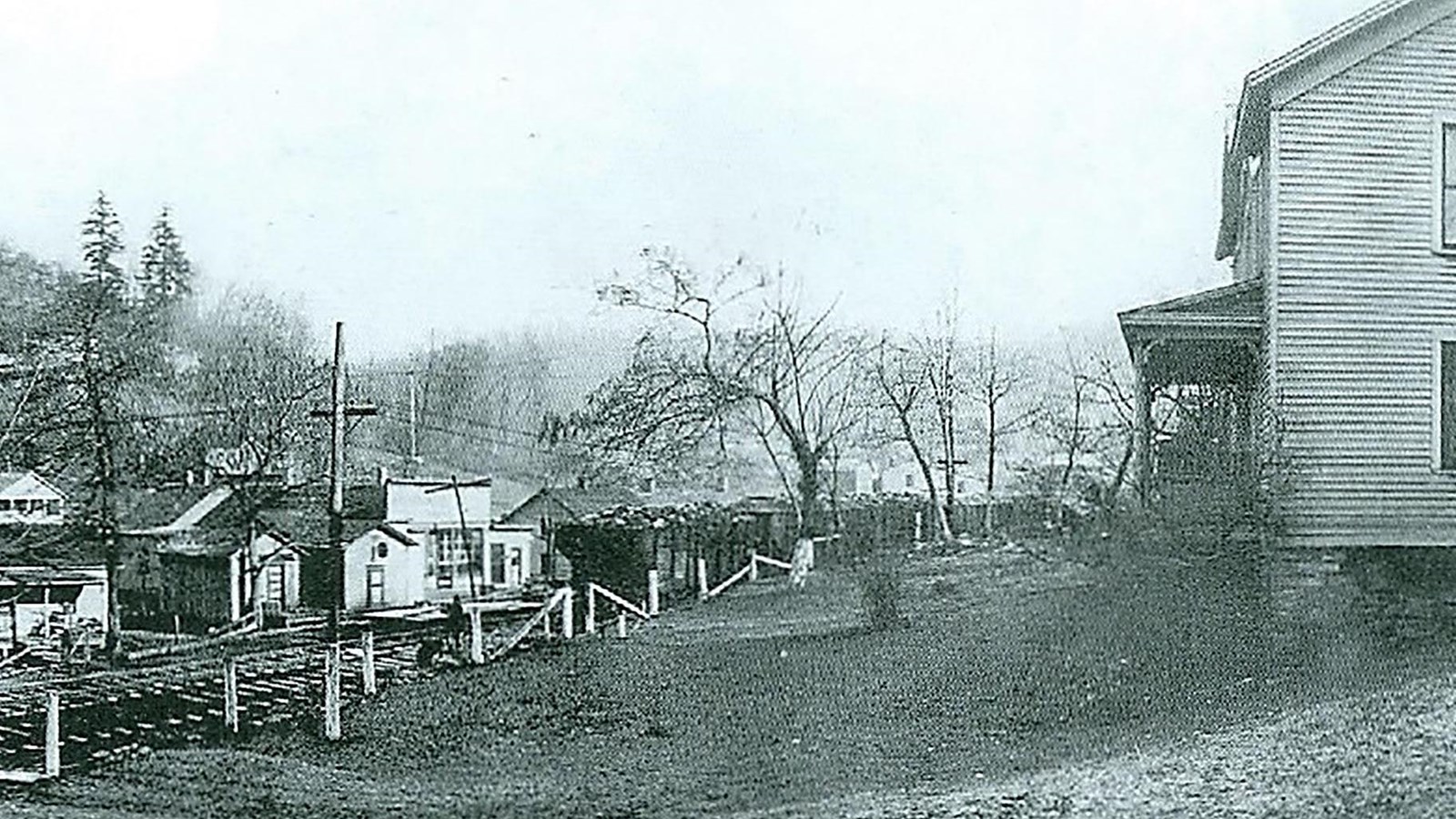
Woodson returned to Fayette County in the late 1890s to teach at a school in Winona, just five miles from Nuttallburg. According to his biographer, he taught at “a school established by Black miners for their children” from 1897 to 1900. The 1900 Federal Census lists Carter G. Woodson as a “boarder” in the household of William M. Shorts. It also notes that he is 23 years old, single, Virginia-born, and working as a “Public School Teacher.”
Woodson left Winona in 1900 to return to Huntington where he taught history and was the principal at Douglass High School until 1903. From 1903 to 1907, he traveled to the Philippines to teach and serve as supervisor of schools and teacher-training. Woodson returned to the United States to attend graduate school. He obtained his master’s degree in history at the University of Chicago, and his doctorate in history from Harvard.
Dr. Carter G. Woodson settled in Washington, D.C. where he taught in the segregated Black schools of the Nation’s Capital, published his first works on the history of Black education, and founded the Association for the Study of Negro Life and History in 1915. As Director of the Association, Dr. Woodson launched a celebration of Negro History Week in 1926. He chose the second week of February to commemorate the birthdays of Frederick Douglass and Abraham Lincoln. The annual week-long celebration was expanded into Black History Month in 1976.
Sources:
Cavalier, John. Panorama of Fayette County. Parsons, WV: McClain Printing Company, 1985.
Goggin, Jacqueline. A Life in Black History: Carter G. Woodson. Baton Rouge: Louisiana State University Press, 1991.
United States Census, 1900. Fayette County, WV, Nuttall District, Winona. Manuscript census of fifteen pages accessed at www.ancestry.com .
Withrow, Dolly, with Elizabeth H. Scobell. From the Grove to the Stars: West Virginia State College, 1891-1991. Pictorial Histories Publishing Company, [1991].
West Virginia State Archives. A Brief History of African Americans in West Virginia, accessed at www.wvculture.org .
Woodson, Carter G. Early Negro Education in West Virginia, West Virginia Collegiate Institute: 1921. Reprinted at www.wvculture.org
__________. The Mis-Education of the Negro. Associated Publishers, 1933. Reprint, 2010.
Additional Information:
Located on Keeneys Creek in the highlands north of the lower New River Gorge, Winona is inhabited, though little is left of the community. The entire site of present-day Winona was owned by Robert M. Holliday, Sr., farmer and pioneer settler who came to the area prior to the Civil War. The mineral rights to Holliday's land were purchased by John Nuttall in December of 1870. The Winona post office was named for Winona Gwinn, oldest daughter of William Gwinn, who operated a hotel in the town.
The development of the coal lands surrounding Winona occurred due to the efforts of John Nuttall, who had by the 1880s acquired a tract of 30,000 acres of coal lands along Keeneys Creek in the highlands above his coal operations in the New River Gorge at Nuttallburg, which he had opened in 1873.
Carter G. Woodson spent his formative years in West Virginia as a coal miner in Nuttallburg and a teacher in Winona. He went on to start Negro History Week, which eventually became Black History Month.
For the full story go to Carter G. Woodson: Winona, WV
Before Dr. Carter G. Woodson, there was very little accurate written history about the lives and experiences of Americans of African descent. Today a National Historic Site, Dr. Woodson’s home served as the headquarters for the Association for the Study of African American Life and History. To learn more about Carter G. Woodson, visit Carter G. Woodson Home National Historic Site.
Driving Directions:
WinonaPhysical Address: 18 County Route 85/2, Winona, WV 25942
GPS Coordinates: N38-046680 -W80.992164
From Beckley and Fayetteville, WV: Take Highway 19 north to Highway 60. Exit onto Highway 60. Turn left on Highway 60 east and travel 4 miles to Lansing Edmond Road (Route 82). Turn right onto Lansing Edmond Road and travel 2 miles to the three-way junction at Lansing Edmond Road and Keeney’s Creek Road. Turn right at the junction. The Tour Stop #3 and parking space is immediately on the left.
Directions to Next Tour Stop:
Nuttallburg
Physical Address: Keeney’s Creek Road
Add GPS Coordinates: N38.049301 -W81.038065
From the ‘Winona’ Tour Stop make a u-turn then a right turn on Keeney’s Creek Road (Route 82/2). (CAUTION, this road of mostly one lane and very narrow in places.) Travel approx. 3.5 miles to the ‘Segregated Coal Town’ wayside exhibit at Short Creek. The wayside exhibit on the left is Tour Stop #4 (To visit the Nuttallburg Historic Site continue .5 tenths of a mile to the parking lot at the end of the road.)
The requested video is no longer available.