



Last updated: March 4, 2026
Place
Helen, WV
Mark Bollinger
Quick Facts
Location:
Helen, WV
Amenities
2 listed
Historical/Interpretive Information/Exhibits, Parking - Auto
African American Heritage Driving Tour Stop 13: African American Coal Miners
If using the NPS app, to listen to the audio narrative, press the green button below or read the audio narrative text below.
This tour stop is not advised for trailers, RVs, or motorhomes due to a steep railroad crossing.
Audio Narrative
Written By: Mark Bollinger
Narrated By: Doris A. Fields
Quote By: Xavier Oglesby
Between 1870 and 1930, thousands of white, black, and European immigrants came to West Virginia to work in the coal mines. Blacks migrated to mines throughout the State, but most of them came to work in the smokeless coal fields of Southern West Virginia. What they found was the opportunity to build a better life for themselves and their families. By 1909, African Americans made up over 26 percent of West Virginia mine workers.
In the mines, unskilled labor was in great demand. Many of the unskilled jobs such as coal loaders, mule handlers, and coke oven workers, were filled by African Americans. About 75 percent of all African American miners became coal loaders. Many African Americans preferred coal loading because it allowed them to simply leave the mine when they had loaded enough coal for the day. Coal loading also offered less direct supervision. Black miners usually did not see a foreman more than once during an entire shift. This was an important consideration for black workers who came to the mines to escape the constant scrutiny of Whites in the Jim Crow South.1
Picking and loading coal was hard, dangerous, back-breaking work; however, it provided the greatest opportunity for the miner to earn good money. As coal loaders, black and white miners were paid by the ton of coal mined, not by the hours worked. Hard-working miners could cut and load an average of five tons of coal daily, earning $2.20 to $5.00 per day. Today, a West Virginia miner earns an average of $325.00 for an eight-hour day.
For nearly sixty years, coal was mined by hand using a pick, a drill, a needle, and a No. 2 and No. 4 shovel. A miner was required to purchase his tools from the company store. Once the black coal loader was underground, he performed the laborious tasks of cutting, drilling, blasting, and loading coal. William Tams’s describes from his personal knowledge the job of a black coal miner.
“The loader carried into the mine his picks, shovels, auger, tamping bar, fuse and a can of black powder. He was charged fifth cents per month for the services of the company blacksmith in re-sharpening and tempering the pick …. After taking two and a half to three hours to make an undercut, the miners drilled, loaded, and fired the holes, bringing down the undercut coal. They then pushed up empty mine cars from the room mouth, loaded them, and returned them to the entry…. The miner put his brass check near the bottom of each car he loaded. The check was removed after the car was dumped at the tipple and the load credited to the proper man.”2
To make an undercut, the miner had to lie on his side, wedged part way under the ledge of coal in order to make a four to six foot cut along the base of the coal seam. Undercutting the coal allowed it to fall to the mine floor when the coal was blasted. The miner then drilled holes into the face of the coal using a mechanical crank breast auger. Black powder, purchased by the miner, was rolled into paper cartridges and inserted into the drilled hole. The miner then inserted a long, thin, copper rod called a “needle” into the hole. The blasting hole was then carefully tamped with clay mud and the needle extracted. A fuse was inserted into the cavity left from the needle. When the miner was ready to blast the coal, he shouted “fire in the hole” three times to warn fellow miners. The fuse was lit and the miner retreated to the nearest cross-cut for cover. If the powder was tamped and charged correctly, an ear-popping blast would bring the entire cut down to the mine floor.
Once the dust settled, the miner began the laborious task of loading the coal into cars. It was critical that the miner load only clean coal because he was not paid for loading rock. When the car was full, he pushed it to the mouth of his room where it was hauled away to the head house. Before the miner could start a new cut, he had to perform “dead work” for which he received no pay. Dead work involved installing roof supports, maintaining ventilation, and extending the tramway to the coal face.
A tramway system similar to a light-duty railroad hauled the coal to the outside. Mule drivers and their brakemen, often African Americans, hauled the loaded coal cars to the mainline. There the cars were made up into trains and hauled to the headhouse. At the headhouse, the coal was weighed and the miner credited for payment. Until the advent of electric motors at the turn of the twentieth century, mules or horses were used to pull coal cars out of the mines. From the mine, some of the coal headed to coke ovens where workers performed the hot and laborious job of tending the ovens. They shoveled coal into the ovens, fired the coal, then unloaded the finished coke into train cars, earning an average of $1.60 per day.
- Dr. Ronald L. Lewis, Black Coal Miners in America: Race, Class, and Community Conflict 1780-1980 , The University Press of Kentucky, 1987.
- Christopher Wildinson, Big Band Jazz in Black West Virginia, 1930-1942, University Press of Mississippi, Jackson. 2012.
Major Sources Consulted
Bailey, Kenneth R. “A Judicious Mixture: Negroes and Immigrants in the West Virginia Mines, 1880-1917,” West Virginia History.
Black Diamond, Volume 68, No. 25 (June 24, 1922).
Lewis, Ronald L. Black Coal Miners in America. University Press of Kentucky, 1987.
Miller, Truman I. Miner, A Life Underground. Lexington, KY: Bacchante Books, 2015.
Tams . W.P. Jr. The Smokeless Coal Fields of West Virginia. Morgantown, WV: West Virginia University Press, 1963, 2001.
Joe Trotter, “Black Migration to Southern West Virginia,” in Transnational West Virginia, editors, Ken Fones-Wolf and Ronald L. Lewis. West Virginia University Press, 2002.
White, I.C. Report on Coal, Vol. Two, West Virginia Geological Survey. Morgantown, W.Va.: Morgantown Post Company, 1903.
West Virginia Department of Mines, Annual Report, Various, 1883 - 1940.Workman, Michael, “Coal Mining in the United States: A Technological Context,” Institute for History of Technology & Industrial Archaeology, 2000, Unpublished manuscript.
U.S. Census, 1900 - 1940, Fayette & Raleigh Counties, manuscript copy, accessed at ancestry.com.
Additional Information
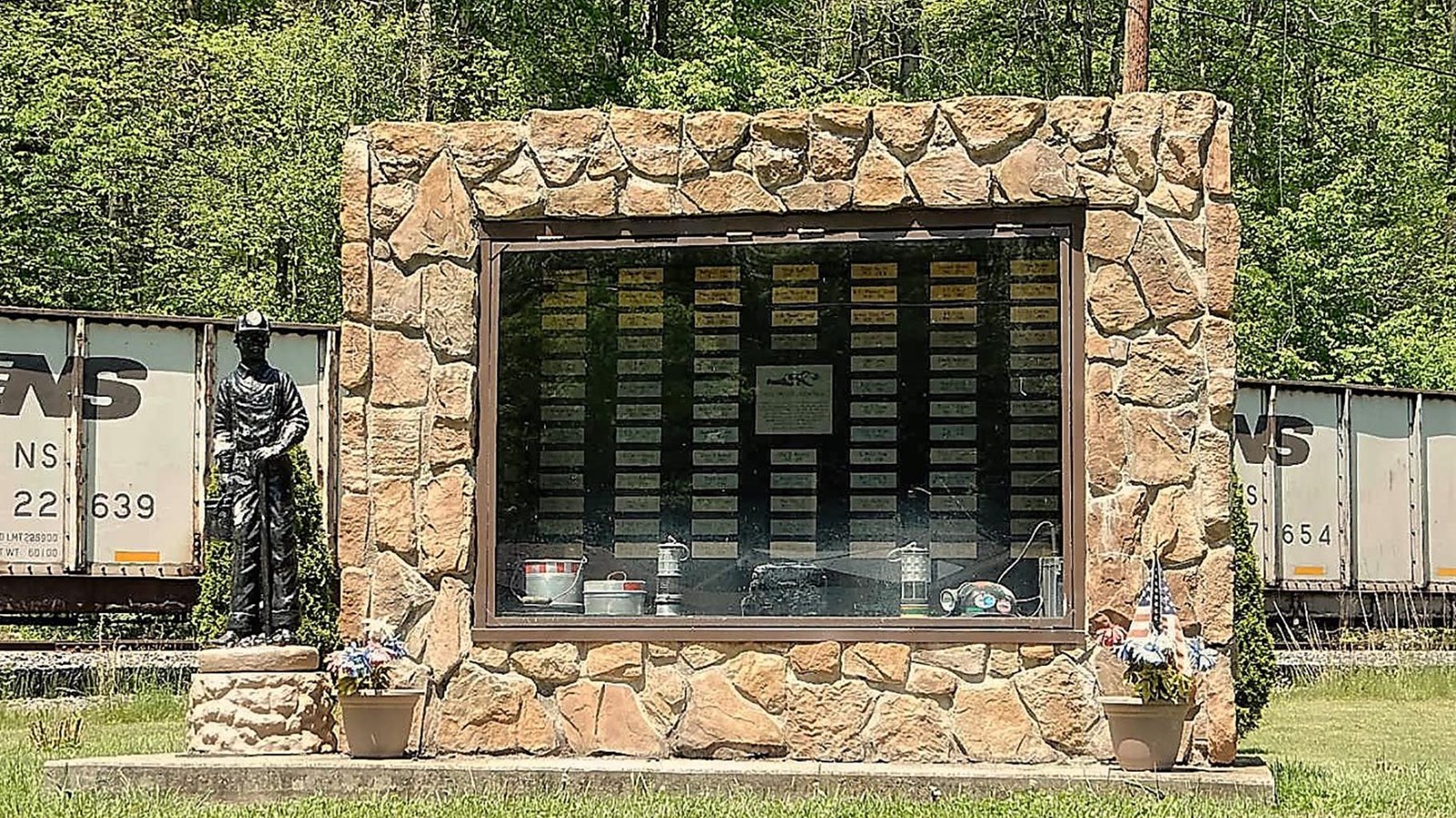
In the 1910s, the East Gulf Coal Company opened what came to be known as the Helen Mine and Coal Camp. Realizing their need to attract a more reliable and family-oriented workforce, the coal operators began constructing “model towns.” Here in the model town of Helen there was a boarding house, company store, clubhouse, movie theater, and even a telephone exchange.
Although Helen had separate and segregated residential areas and businesses, equality for the black coal miner did exist in the coalfields of southern West Virginia. African Americans could vote, hold public office, and send their children to school. In the mines, blacks were provided equal wages for equal work. About 75 percent of black workers became coal loaders. Others were daymen and coke workers. Picking and loading coal was hard, dangerous, back-breaking work, but provided the most opportunity for earning money. Loaders were paid by the ton, rather than by the hour. A coal loader performed the laborious task of cutting, drilling, blasting, and loading the coal. A dayman hauled the loaded coal from the rooms to the mine face where the coal was weighed and the miner credited for payment. Coke workers performed the hot and laborious job of tending the “beehive” ovens. They filled the ovens with coal and unloaded the finished coke into train cars.
Helen’s population began to decline, especially for African Americans, in the 1950s with the advent of new machinery. After 1953, the services of hand loaders or unskilled laborers were no longer needed. The town, like so many, began its long decline in population and vitality. Helen’s rich heritage lives on in its citizens and in the community’s coal-related street names: Lantern, Check, and Scrip Alleys.
For the full story go to: African American Coal Miners: Helen, WV
Other nearby places of interest:
Driving Directions:
Physical Address: Tams Highway (Highway 16), Helen WV 25853
GPS Coordinates: N37.636248 -W81.314486
From Beckley, WV: Travel on I-77 north or south to Exit 42. Follow the exit ramp onto Highway 16 south/97 west toward MacArthur and Sophia, WV. Travel 3 miles on Highway 16 south/97 west. Move to the left lane and continue straight at the split onto Highway 121 (Coalfield Expressway). Travel 3.8 miles to McKinney Mountain Road (Route 12/12) and turn left. Travel until the road dead end at Highway 16. Turn right on Highway 16 south and travel approximately 5 miles to Helen. In Helen, turn right on the first road (Route 16/17, Old Delta 60) into the Coal Miners Memorial Park. Tour Stop #13 and parking is at the park.
Directions to the next Tour Stop:
Fitzpatrick Park896 Fitzpatrick Road, Beckley, EV 25801
GPS Coordinates: N37.14378 -W81.1954
From Helen, take Hwy 16 north 8 miles to Sophia and turn left at the traffic light onto Highway 16 north/Robert C. Byrd Drive. Travel 4.3 miles to the stop light at I-77/I-64 and turn right onto Fitzpatrick Road. Travel .2 tenths of a mile and turn right to stay on Fitzpatrick Road. Continue 1.5 miles and stay straight at the Waste Water Treatment Plant to enter Fitzpatrick Park. Tour Stop #14 and parking is at the park.
The requested video is no longer available.