



Last updated: December 23, 2025
Place
Winfield Scott Memorial
National Park Service photo by Nathan Adams
Quick Facts
Amenities
2 listed
Historical/Interpretive Information/Exhibits, Public Transit
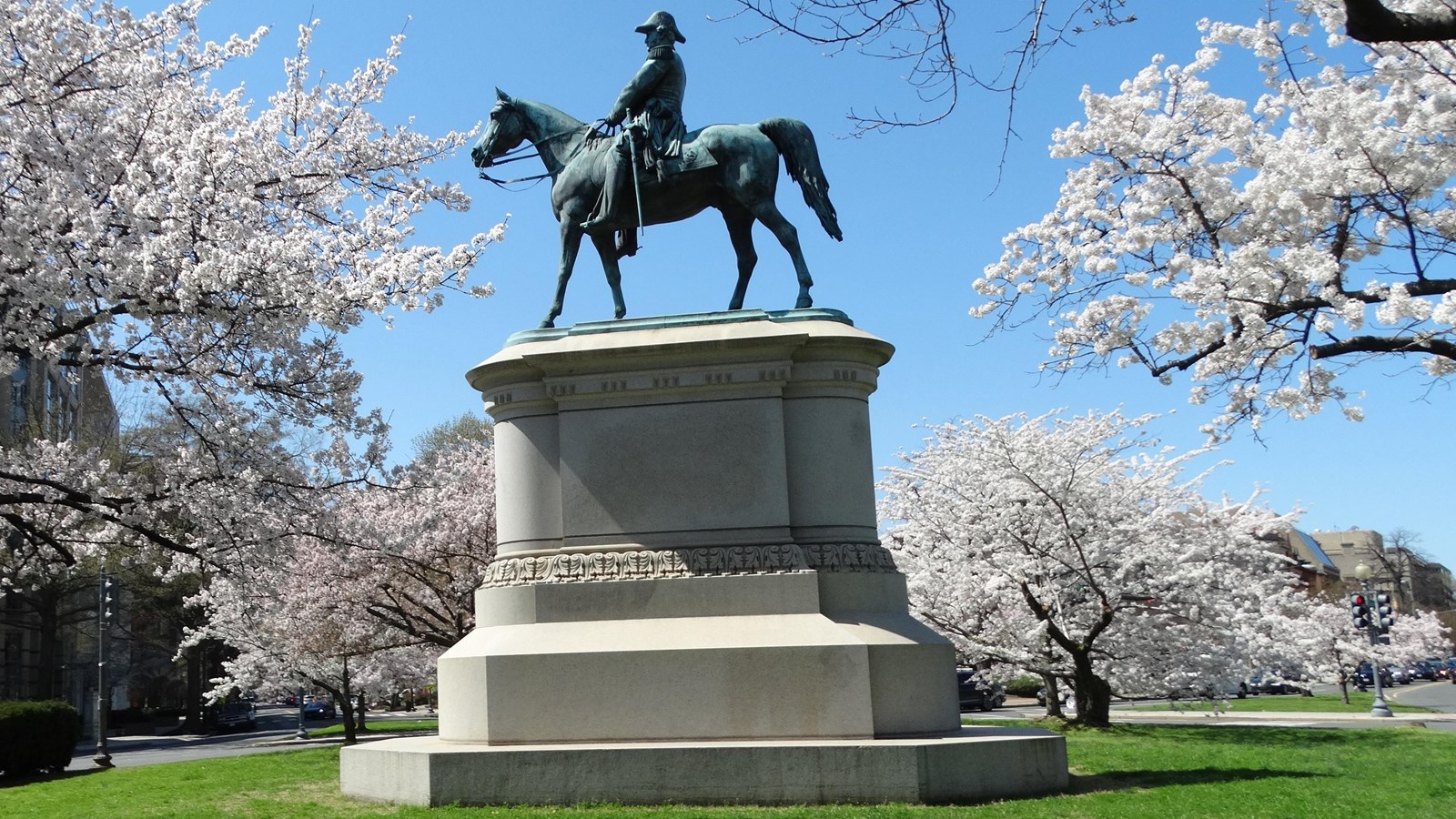
The Winfield Scott Memorial celebrates one of the most prominent American military leaders of the 19th century. Erected in 1874 at the convergence of 16th Street, Massachusetts Avenue, and Rhode Island Avenue NW, it was one of the earliest Civil War–era monuments erected in the capital and helped define the use of traffic circles and small parks as commemorative sites.
Nicknamed “Old Fuss and Feathers” for his insistence on discipline and military decorum, and the “Grand Old Man of the Army,” due to the longevity of his career, Winfield Scott (1786-1866) served in the U.S. Army for 53 years, longer than any other officer in U.S. history. Scott’s career spanned the War of 1812, the Black Hawk War, the Seminole Wars, the Mexican–American War, and the early phase of the Civil War. As Commanding General of the Army, he devised the Anaconda Plan, a strategic blockade and divide campaign that eventually helped bring about Union victory. Congress authorized funding for the statue in 1867, the year after Scott’s death.
The statue was sculpted by Henry Kirke Brown, a distinguished American artist also known for equestrian works of George Washington and others. The bronze figure of Scott in full field uniform rises about 15 feet above a massive granite base. The base itself was quarried as one of the largest single stones in the United States at the time. The general is shown holding the reins in his left hand with field glasses in his right, gazing down 16th Street toward the White House.
Brown originally modeled the horse as a mare, reflecting Scott’s personal preference for riding female horses. But when his descendants objected, arguing that a general’s monument should feature a more traditionally heroic stallion, Brown reluctantly added male anatomy to the sculpture, resulting in a somewhat awkward hybrid that has become part of the statue’s lore. The bronze statue was cast from melted down cannons captured by Scott’s soldiers during the Mexico City campaign.
Reception of the statue has been mixed since its unveiling. Contemporary critics derided the portrayal of Scott as “too old, too fat, too stiff, too short‑legged,” while the horse drew even harsher reviews for its small size and odd proportions. It has been described in later art histories and local commentary as one of the city’s more peculiar equestrian monuments. Over time, it has been frequently judged less favorably than nearby equestrian memorials, earning reviews ranging from curious to comically disproportionate.