



Last updated: December 22, 2025
Place
Jefferson Pier Stone
National Park Service photo by Nathan Adams
Quick Facts
Amenities
1 listed
Scenic View/Photo Spot
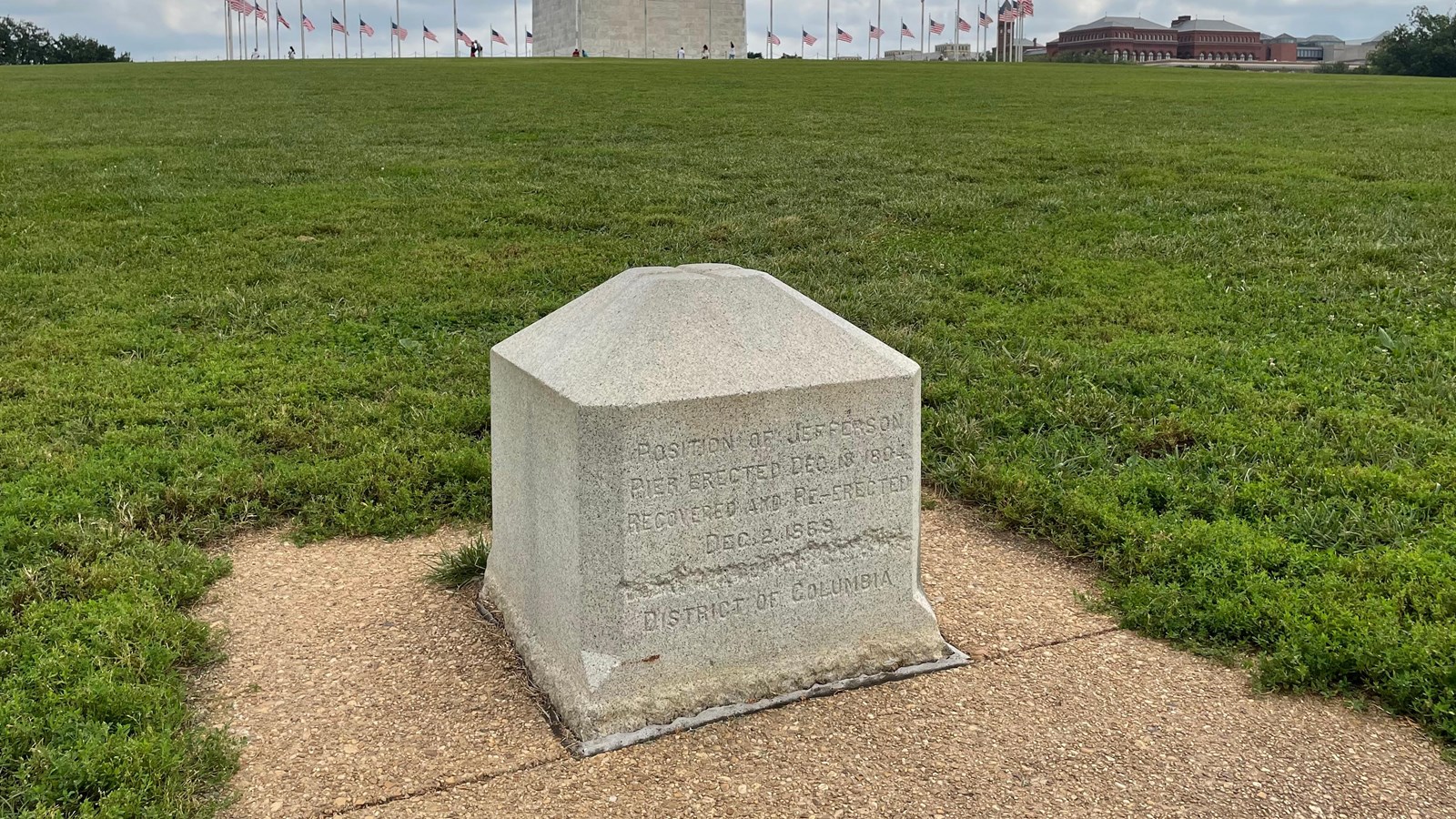
The Jefferson Pier marker on the grounds of the Washington Monument is a small and easily overlooked monument that connects Washington, D.C.’s original city plan with early American scientific and surveying traditions. What today appears as a modest granite block—just over two feet square and approximately three feet tall—once marked a central point in the young nation’s survey of its capital and reflected Thomas Jefferson’s vision for a “Washington Meridian.”
In the early years of the federal city, surveyors working under the direction of Pierre Charles L’Enfant sought to lay out the axes and geometry of Washington according to Enlightenment ideals of order, rationality, and symbolic alignment. In 1793, the intersection of a north–south line from the White House and an east–west line from the U.S. Capitol was first marked on the south bank of Tiber Creek, near the Potomac shoreline, as a proposed reference point for the new capital. This point later became known as the site of the Jefferson Pier.
Under the presidency of Thomas Jefferson, who had a strong interest in science, astronomy, geography, and standards of measurement, the original wooden marker from 1793 was replaced in 1804 with a stone pier intended to serve as a kind of prime meridian for the United States and a key geodetic reference in the layout of the District of Columbia. The idea was to use this Washington Meridian, defined by the line connecting the White House and future Jefferson Memorial, as a local longitude reference, though it was never legally adopted or widely used beyond local surveying.
As the federal city evolved, the landscape around the marker changed dramatically. The marshlands near the Tiber were filled in during the late 19th century to create what would become West Potomac Park, and the construction of the Washington Monument was completed began. During this period of transformation in the 1870s, workers with the U.S. Army Corps of Engineers inadvertently removed the original pier stone while grading the grounds around the unfinished monument. However, its foundations were left in place and in 1889, a new granite marker was erected directly above the recovered foundation by the Office of Public Buildings and Grounds.
Though modest in size and prominence, the Jefferson Pier stands at a historically meaningful intersection of axes intended to reflect the new nation’s orderly layout and scientific ambitions. Jefferson’s advocacy for the Washington Meridian speaks to a time when mapping and geography were critical to national development. Ultimately, the marker was overtaken by later standards. By 1850 a meridian based at the Old Naval Observatory became preferred for U.S. mapping, and by 1912 the Greenwich Meridian was adopted internationally—but the Jefferson Pier remains engraved in the landscape as a tangible piece of early American geodetic history.