



Last updated: June 18, 2026
Place
Master Armorer's Quarters
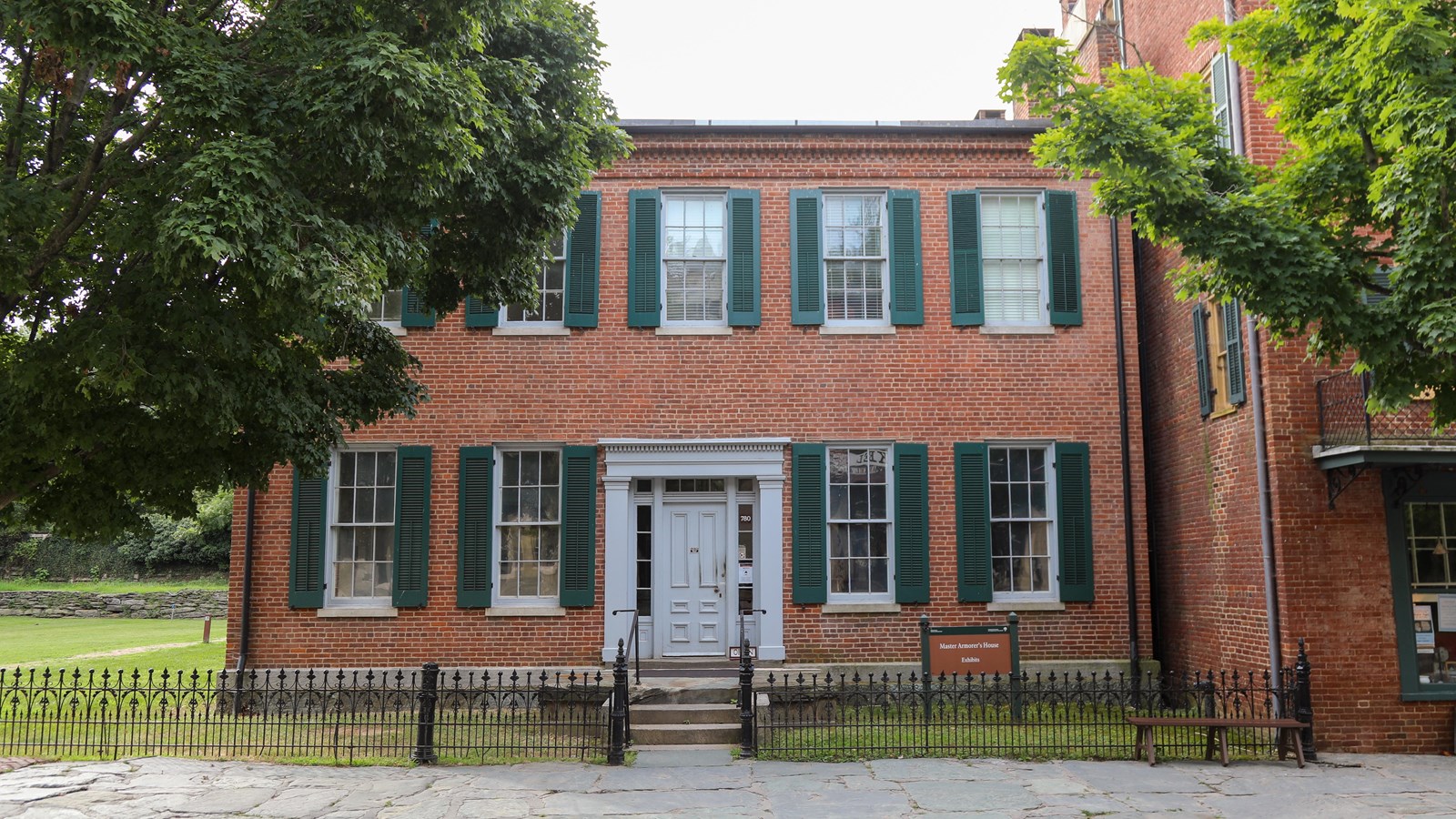
NPS / Claire Hassler
Quick Facts
Amenities
2 listed
Historical/Interpretive Information/Exhibits, Wheelchair Accessible
Please note: This building is undergoing repairs. Check the conditions and alerts page to see the current operating status.
Built in the late 1850s, this building was originally used as housing for the Master Armorer. Visitors can also find small exhibits and artifacts that substantially cover a broad overview of Harpers Ferry's history.
Accessibility
There are four steps up to the front entrance of the Master Armorer's House. There is an accessible entrance without steps on the left side of the building. Follow the brick path to the left of the building to the back porch where there is a metal ramp.
Learn more about accessibility in the park.
About the Master Armorer's House
The strategic location of the Master Armorer's House made it ideal for the headquarters of the commanding officer at Harpers Ferry. The Master Armorer's House is at the junction of Shenandoah and High Streets only one block from the Baltimore & Ohio (B&O) Railroad Bridge and the Potomac River pontoon crossing. The Master Armorer's House was easy to find and a nerve center for communications during the Civil War.
Completed just before the John Brown Raid in 1859, the Master Armorer's House was one of the newest buildings in Harpers Ferry at the outbreak of the Civil War.
The most famous general who stayed in the Master Armorer's House was Union Lt. Gen. Ulysses S. Grant. Grant only spent one night in the house, on September 16, 1864, when returning from a strategy meeting in Charles Town with his Shenandoah Valley commander, Maj. Gen. Philip H. Sheridan. During Grant's stay, the building was the headquarters of Union Brig. Gen. John D. Stevenson. Stevenson commanded the Military District of Harpers Ferry along with managing Sheridan's logistics operations during the 1864 Valley Campaign. Stevenson was known to control Harpers Ferry, and the surrounding region, with a "hard-hand" of martial law. Stevenson also combated Confederate guerillas; he even entrapped John Mobberly, his nemesis, and killed him just before the end of the war. Stevenson also displayed Mobberly's corpse at the Master Armorer's House, as a reminder of the war's ruthlessness.
Union commander Col. Dixon S. Miles, who opposed Stonewall Jackson during the Battle of Harpers Ferry on September 12-15, 1862, also used the Master Armorer's House as his headquarters. Miles was mortally wounded during the battle, and died here on September 16.