



Last updated: December 22, 2025
Place
George Mason Memorial
National Park Service photo
Quick Facts
Location:
Washington, DC
Designation:
Memorial
Amenities
2 listed
Historical/Interpretive Information/Exhibits, Wheelchair Accessible
The George Mason Memorial in Washington, D.C., is a tribute to an often-overlooked Founding Father. Dedicated in 2002 and tucked into West Potomac Park near the Tidal Basin and Thomas Jefferson Memorial, the site offers an intimate space of reflection amid gardens and water—a fitting setting for commemorating a man who helped shape the philosophical foundations of the United States.
George Mason IV was born on December 11, 1725, on his family’s plantation in what is now Fairfax County, Virginia. A lawyer, planter, and political leader in Colonial Virginia, Mason emerged as one of the most influential advocates for individual rights in the era of the American Revolution. In 1776, he authored the Virginia Declaration of Rights, a pioneering document that articulated the natural rights of individuals and government’s role in protecting them. This document directly influenced Thomas Jefferson as he drafted the Declaration of Independence, and later, the language and spirit of the United States Bill of Rights. Mason’s insistence on protecting personal freedoms and limiting governmental power marked him as a pivotal voice in the framing of American constitutional democracy. Yet Mason’s legacy was complex: he was a lifelong slaveholder, and at the Constitutional Convention of 1787, he refused to sign the Constitution because it did not abolish the slave trade and lacked adequate protections for individual liberties.
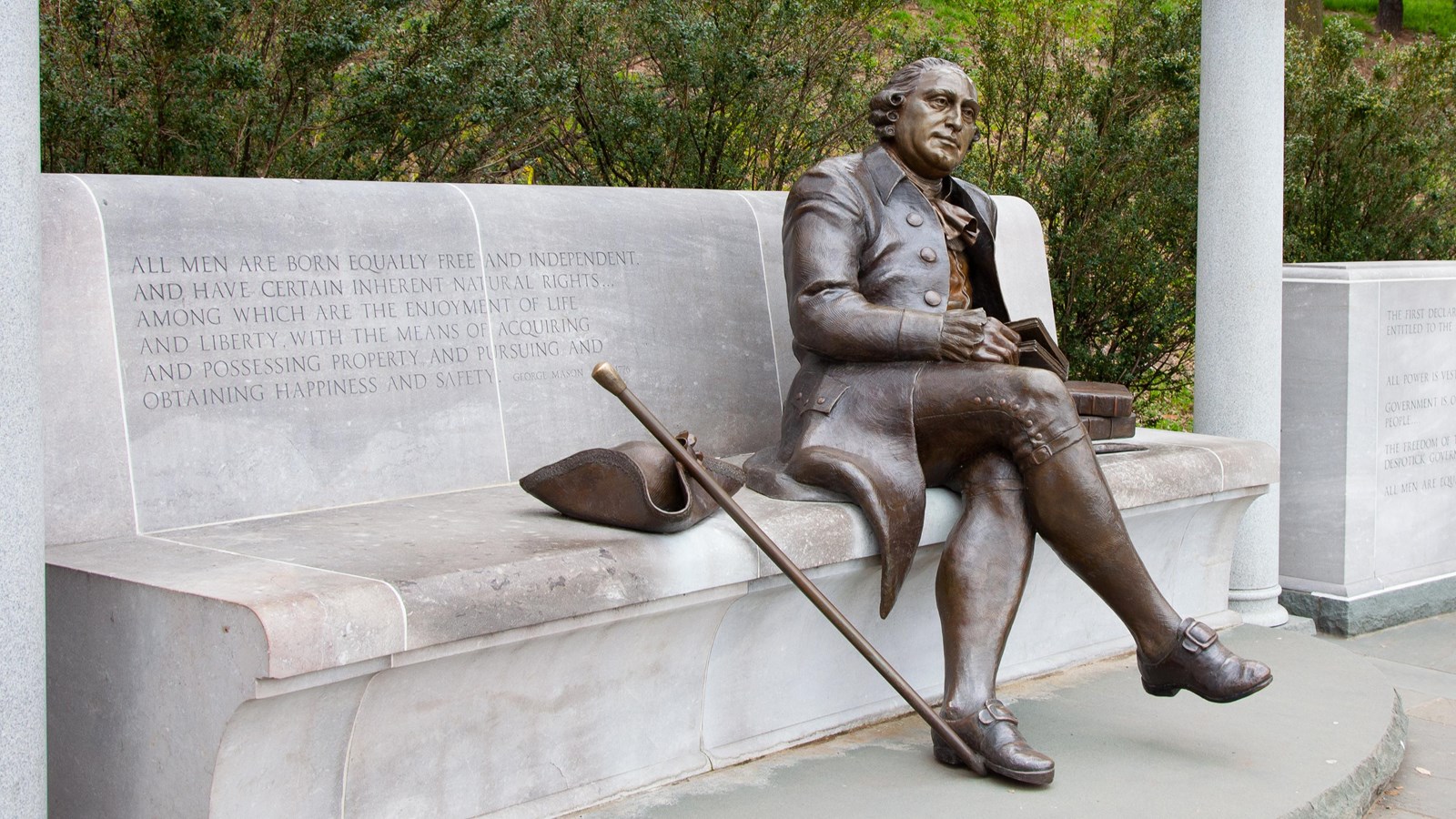
The memorial’s design reflects both Mason’s philosophical depth and the character of the site. At its heart is sculptor Wendy M. Ross’s larger-than-life bronze statue of Mason seated thoughtfully on a bench beneath a gently curving trellis, his tricorn hat and walking stick at his side and bronze volumes representing works by Cicero, Locke, and Rousseau nearby—symbols of the intellectual currents that shaped his thinking. Behind him, a 72-foot wall and stone inscriptions echo his own words and those of contemporaries, offering visitors a chance to engage directly with the ideas that underpinned his commitment to liberty and rights. A circular fountain and concentric garden beds integrate the memorial into the surrounding landscape, preserving the historic character of the site while inviting quiet contemplation.
The location near the Tidal Basin is deliberate: it situates Mason’s memorial in conversation with other landmarks of the nation’s founding era, especially the Jefferson Memorial, toward which Mason’s figure gazes. This spatial dialogue underscores Mason’s influence on his fellow Virginians and on the broader project of American constitutionalism. The memorial’s modest scale and garden setting distinguish it from larger national monuments, emphasizing nuance, thoughtfulness, and personal reflection over monumental grandeur.
Today, the memorial stands not only as a testament to George Mason’s role as a “forgotten founder” whose words helped shape core American freedoms, but also as a serene garden place where visitors can consider the enduring complexities of liberty, rights, and the American experiment.