



Last updated: December 1, 2025
Place
Benito Pablo Juárez Memorial
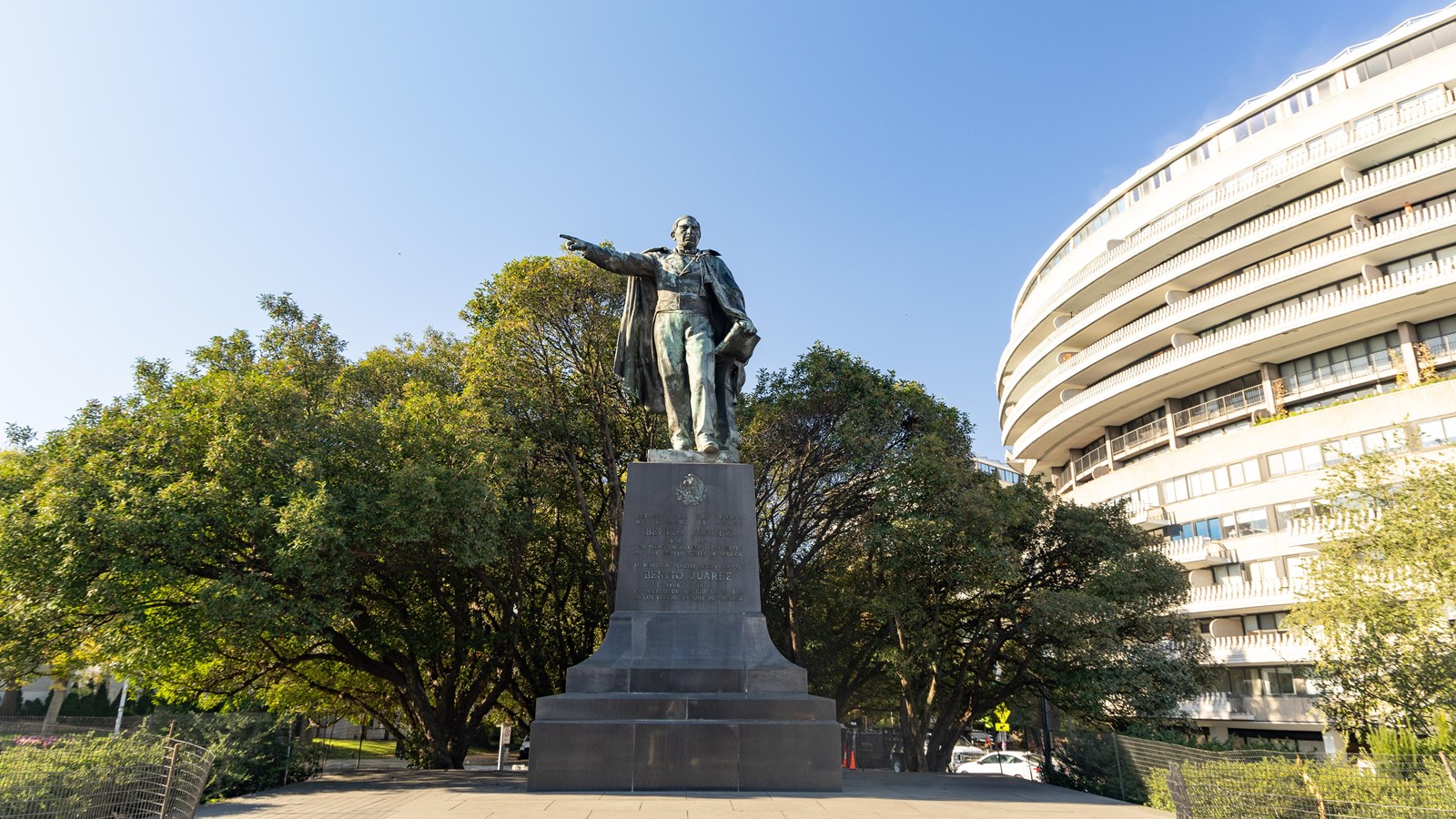
NPS / Kelsey Graczyk
Quick Facts
Amenities
2 listed
Historical/Interpretive Information/Exhibits, Public Transit
Mexican President Benito Juárez’s statue stands approximately 19 feet tall and weighs about 3,600 pounds. It was sculpted by Luis Sosa Villasenor and Luis Ortiz Macedo. The statue is a replica of French-Italian sculptor Enrique Alciati’s 1891 work of art found in Juárez’s hometown, Oaxaca City, Mexico. On the outside of the base is an inscription of Juárez’s famous quote in both English and Spanish:
“Respect for the rights of others is peace /
El respeto al derecho ajeno es la paz.”
Mexico gifted the commanding statue of Benito Juárez to the U.S. on January 7, 1969, after the U.S. gifted Mexico a statue of Abraham Lincoln in 1966, a belated gift to commemorate Mexico’s sesquicentennial. Both U.S. Secretary of State Dean Rusk and Mexican Foreign Minister Antonio Carrillo Flores spoke at the event. Rusk said:
“We shared with Mexico one of our greatest heroes and now Mexico is sharing with us one of its greatest sons.”
An exchange of gifts not only strengthened ties between the U.S. and Mexico but serves as a moment to remember their most revered presidents who shared similar hopes for their countries.
Born in a small village, San Pablo Guelatao, in the state of Oaxaca and orphaned before the age of four. He spoke mostly Zapotec until learn Spanish at age 12. He finally finished his high school training in 1827 and received his law degree in 1834.
In 1831, he entered the political realm as a liberal. By 1846 he was elected to the national Congress but went back to Oaxaca and was elected governor in 1847. When Santa Anna’s dictatorship returned to the presidency in 1853, Juárez was exiled to New Orleans where he joined forces with other liberals there.
When the liberals regained power in 1855, Juárez became the Minister of Justice and Ecclesiastical Affairs and wrote the Ley Juárez (Juárez Law) which separated church and military before law. In 1857 Juárez became Minister of Government, and then elected president of the Supreme Court, first in line for succession to the presidency. When President Comonfort was overthrown by Félix Zuloaga, Juárez was sworn in as president, giving Mexico two presidents and a civil war.
Upon taking the presidency, Juárez suspended payment on the foreign debt, leading to the intervention with France. During this intervention, Juárez gained a reputation for steadfastness and ultimately outlasted the French army. He was reelected president in December 1867 and again in 1871. He died on July 18, 1872.