
National Park Service LogoU.S. Department of the InteriorNational Park ServiceNational Park Service
National Park Service:  U.S. Department of the InteriorNational Park Service Arrowhead
Yosemite National ParkSnowy Half Dome
view map
text size:largestlargernormal
printer friendly
Yosemite National Park
Reptiles
 
Two striped alligator lizards mate

San Diego Southern Alligator Lizards

Twenty-two reptile species and 12 amphibian species inhabit Yosemite National Park. Reptiles and amphibians are often considered together because both are poikilotherms, animals that lack the ability to generate their own body heat, relying instead on their environment to regulate body temperature. Amphibians spend the early part their life cycle in water as larva before metamorphosing into adults that live on land. Toads are a good example. As tadpoles, they are restricted to aquatic environments. In contrast, reptiles are generally terrestrial throughout their life cycle. Amphibians are also characterized by moist, highly vascularized skin while reptiles are typically covered by scales and prefer dry, rocky places.
 
Dark gray snake basks in the sun on rocks

Mountain Western Terrestrial Garter Snake

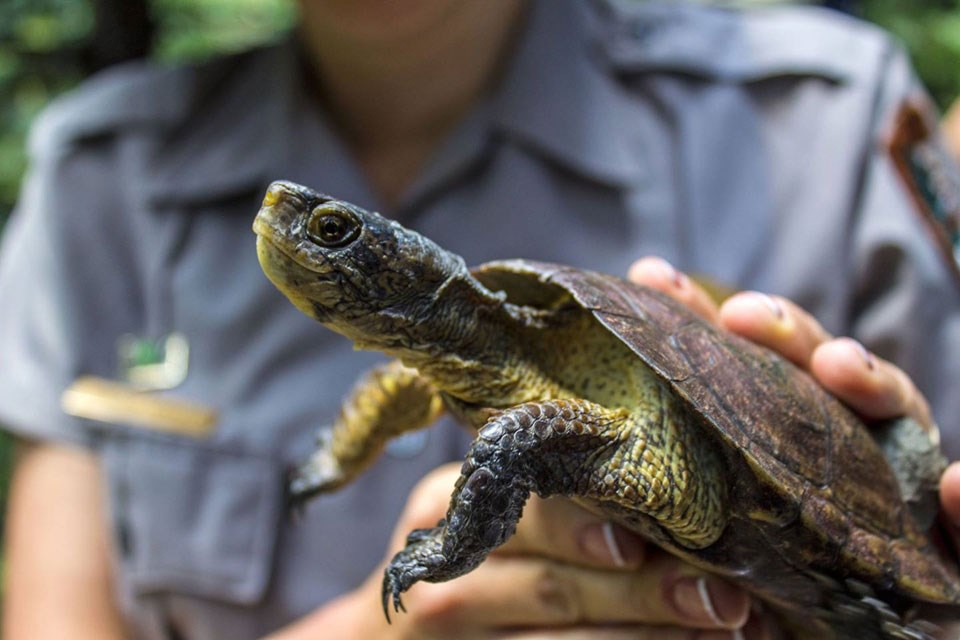
Yosemite’s reptile fauna can be divided into three groups - turtles, lizards, and snakes. The lone turtle species, the western pond turtle, is an uncommon resident of mid-elevation ponds and slow moving streams. The eight lizard and 13 snake species are seen at varying degrees of frequency.

The western fence lizard is the most numerous and readily observed lizard species in Yosemite. They are often seen darting across granite slabs or heard skittering through dry leaves. They are easily recognizable as the lizard doing “pushups,” a common display behavior. The northern and southern alligator lizards are almost as common as the western fence lizard. However, their habit of hiding under rocks and logs makes them much less obvious. The coast horned lizard is extremely rare and has only been recorded once or twice within the park.

 
Brown snake with body-length light brown stripes

Sierra (Aquatic) Garter Snake

Yosemite has a diverse snake fauna with thirteen species recorded in the park. The most common are the garter snakes with three species. They frequent ponds and wet meadows hunting for small fish and frogs. The mountain king snake with red, black, and cream colored bands encircling its body is the park’s most beautiful snake. The rubber boa looks like a giant earthworm. Light gray in color with a blunt tail, this gentle snake primarily eats insects and soil invertebrates. The remaining species are uncommon to rare, mainly inhabiting the warm, dry lower elevations of the park.

Of the 13 species of snakes found in Yosemite, only the western rattlesnake is venomous. Fortunately, the likelihood of encountering one is relatively low. Pay attention when hiking or climbing in dry, rocky places. Avoid putting your hands in holes or on ledges where snakes may be sunning themselves. If you do see or hear one, simply detour around it or let the snake crawl away. Rattlesnakes are an important part of Yosemite’s ecosystem, as they help keep the park’s rodent numbers in check.

Orange insect climbing
A Bug's Life
Insects outnumber all creatures in the biological chain
more...
Black butterfly rests on a flower
Counting Butterflies
Scientists add up current species to compare to those of the past
more...
Binoculars
Join the Christmas Bird Count
Find out results from the latest event
more...
Bear exiting a car
Bears on Tape
Watch this short bear video to learn how to protect Yosemite's bears
more...
The Bachelor and Three Graces  

Did You Know?
Giant sequoias are a fire adapted species. Their bark is fire resistant and fire helps open the sequoia cone and scatter the tiny seeds. Fire also clears forest debris from the mineral soil and provides a nutrient rich seed bed as well as clearing competing species.

Last Updated: July 30, 2009 at 00:34 EST