Skip to SearchSkip to NavigationSkip to BodySkip to Footer
National Park Service LogoU.S. Department of the InteriorNational Park ServiceNational Park Service
National Park Service:  U.S. Department of the InteriorNational Park Service Arrowhead
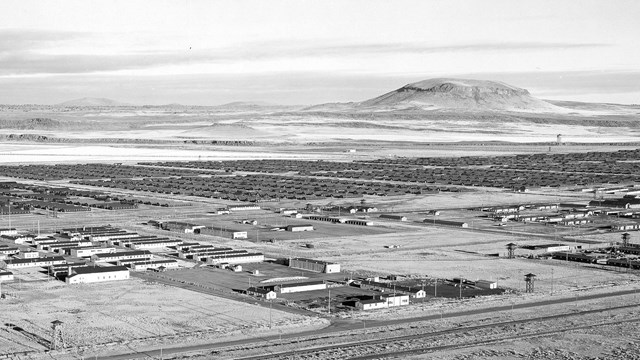
Tule Lake UnitBarracks at Tule Lake Segregation Center
view map
text size:largestlargernormal
printer friendly

Welcome to WWII Valor in the Pacific National Monument, Tule Lake Unit

Tule Lake became a monument along with other units in Hawaii and Alaska by Presidential Proclamation in December 2008. Tule Lake includes sites in the Tule Lake Basin where Japanese Americans were incarcerated during WWII.
 
exclusion order

Executive Order 9066

On February 19, 1942, Franklin D. Roosevelt signed Executive Order 9066 authorizing the U.S. military to incarcerate Japanese American families living on the West Coast, after Japan attacked Pearl Harbor. Without a hearing or due process, the U.S. government put into motion a mass incarceration program that targeted persons of Japanese ancestry based on the claim, later proven to be false, of military necessity.

Over 110,000 Japanese Americans were forcibly removed from their homes and communities and imprisoned in remote, military style camps, one of which was Tule Lake.  Stripped of their basic freedoms, families were forced to live in primitive, overcrowded conditions, impoverished, powerless and fearful of what the future would hold.

 
Girl being finger printed at Tule Lake Segregation Camp

Tule Lake Segregation Center

In 1943 the U.S. Government developed a loyalty questionnaire that contained two deeply-flawed questions. One concerned willingness to serve in the U.S. armed forces; the other was a disavowal of allegiance to the Japanese Emperor or other foreign government. Those who refused to answer “yes” to either of the two questions or gave qualifying statements such as “if my rights are restored” or “if my family is freed” were labeled “disloyal” and segregated to Tule Lake.

Converted to a high-security Segregation Center in 1943, Tule Lake became the largest of the 10 War Relocation Authority (WRA) camps, imprisoning 18,789 people.  It was also the last WRA camp to close remaining in operation seven months after World War II ended.

 
German Prisoners of War pose for a picture at Camp Tule Lake

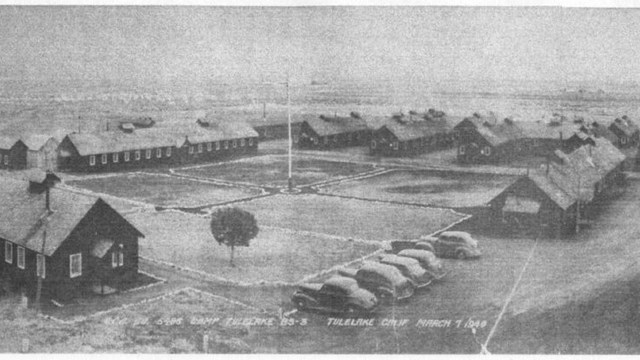
Camp Tulelake

Another section of Tule Lake monument is Camp Tulelake, a former Civilian Conservation Corps camp.  During WWII, after the CCC program ended, the camp was used before segregation to imprison several hundred Japanese American men who protested and refused to answer the loyalty questionnaire.  It was used again shortly after segregation to house Japanese American strikebreakers brought in from other WRA camps to harvest the crops that Tule Lake strikers were leveraging to demand better living and working conditions.  Between 1944 and 1946 the camp housed German and Italian Prisoners of War who worked for local farmers in the Klamath Basin.

 
Barracks at Tule Lake Segregation Camp with Castle Rock in the background

New Park will be Developed Over Next Few Years

These important historic sites will be developed over the next few years. Please help us by checking back here often to learn about the planning and public feedback process. As we move forward with development, there will be news about restoration of parts of the Tule Lake site and activities around the history of the wartime incarceration.  


Write to

Tule Lake Unit
P.O. Box 1240
Tulelake, CA 96134

E-mail Us

Phone

Visitor Information
(530) 260-0537

Climate

The weather in northeastern California is constantly changing. Visitors should be ready for all conditions throughout the year. Summers are generally sunny and warm. Winters are cold with below-freezing nights and occasional snow.
Skip to SearchSkip to NavigationSkip to BodySkip to Footer
Internees being processed at Tule Lake Segregation Center  

Did You Know?
The first group of Japanese Americans arrived on May 27, 1942. They were from Northern California, Washington and Oregon.

Last Updated: November 10, 2009 at 12:32 EST