An official website of the United States government
Here's how you know
Official websites use .gov A
.gov website belongs to an official government
organization in the United States.
Secure .gov websites use HTTPS A
lock (
) or https:// means you've safely connected to
the .gov website. Share sensitive information only on official,
secure websites.
Spring is here! Be prepared for warmer day and cool evenings. Some winter weather is still possible, so take time to check the weather before heading to the park. There is still some snow and ice on trails in areas above 9,500 feet in elevation.
This report is a general guide. By the time you start your hike, conditions on trails in RMNP could be the same, better, or worse than what is described below.
Before Your Next Hike, Be Prepared For the Unexpected:
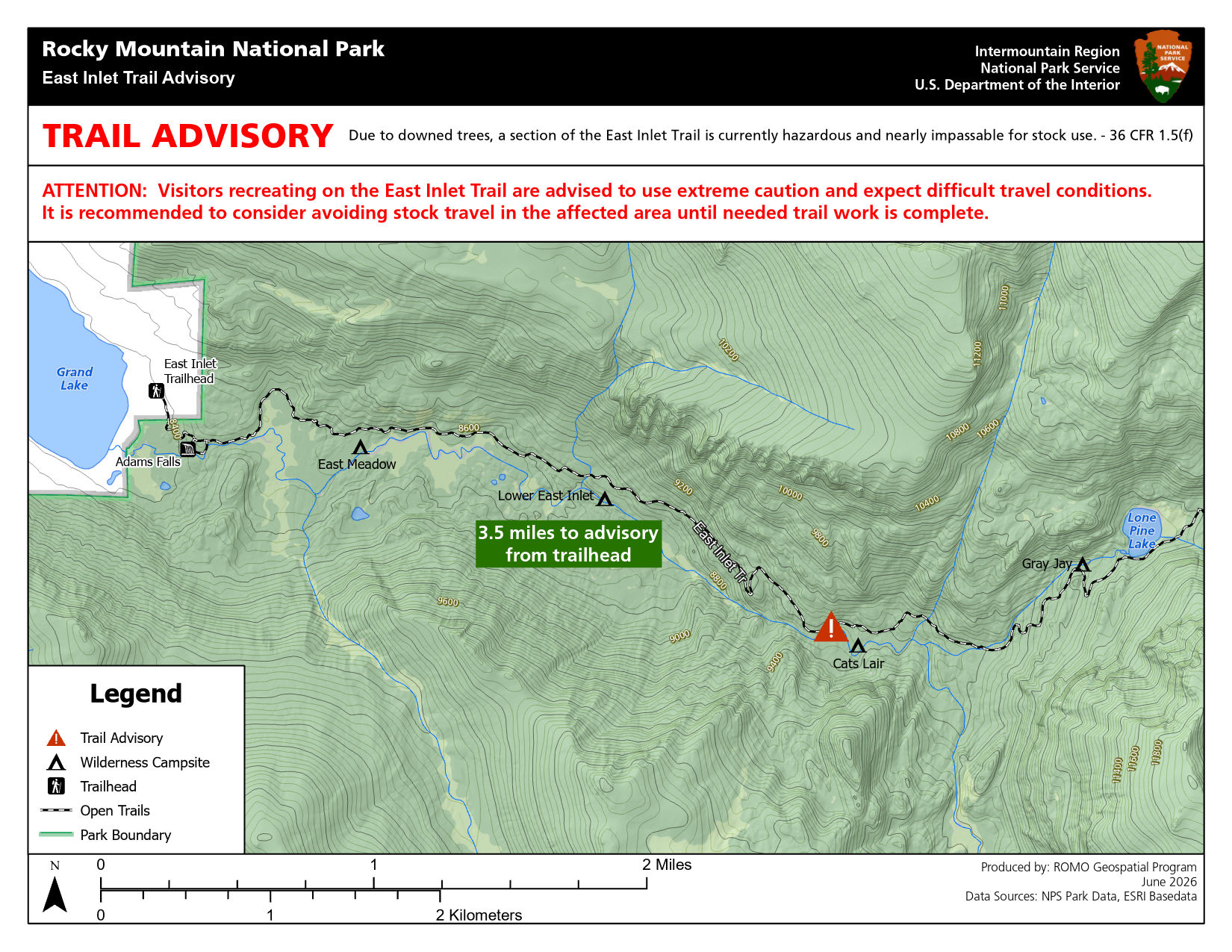
Trail Advisory for the East Inlet Trail Before Lone Pine Lake
A section of the East Inlet Trail, located on the west side of Rocky Mountain National Park, approximately 3.5 miles from the trailhead and before Lone Pine Lake is currently hazardous and nearly impassable for stock use due to downed trees.
RMNP Trail Crews are actively working to clear and restore the route.
Visitors recreating on the East Inlet Trail are advised to use extreme caution and expect difficult travel conditions. It is recommended to consider avoiding stock travel in the affected area until needed trail work is complete.
Heading to Adams Falls?
Adams Falls is located before the affected section of trail. Access from the East Inlet Trailhead to Adams Falls is not impacted.
Example of traction devices on the bottom of a boot
NPS Photo
Additional Safety Information
Be Weather Aware When Hiking in RMNP
For your comfort and safety, take time to check the weather before your next trip to Rocky Mountain National Park. Know that the weather can change rapidly. Be prepared to turn back if needed.
Know that:
Weather can change based on elevation and throughout the day. Expect to find snow on high elevation trails.
Wear warm layers of clothing that will help protect your skin from the cold.
Waterproof boots and warm wicking socks can help keep your feet dry
When Hiking on Icy Trails, Use Traction Devices
There are many different styles available to choose from. Traction devices usually slip on and attach to the bottom of your boots and help provide traction when walking on trails with hard-packed snow and ice. Traction devices are available for rent or purchase at outdoor recreation stores located in communities near RMNP.
Pay Attention to Trees and Tree Branches
When hiking in forest areas, pay attention to the trees near you. Know that falling trees and tree branches are an ever-present hazard year-round in RMNP. When hiking, take time to look up and be aware of your surroundings.
Trees and branches can fall without warning.
Rocky Mountain National Park Trail Conditions Report
Destination
Date
Description of Conditions Found
Reported By
General Conditions for All Trails in RMNP
June 4, 2026
Conditions vary on trails throughout Rocky Mountain National Park.
For lower elevation trails in areas below 9,000 feet, the trails are mostly dry. Areas could be wet or muddy.
For higher elevation trails in areas above 9,000 feet, continue to expect some snow and ice on trails. In areas above 11,000 feet, expect deeper snow. This time of the year, it is recommended to carry traction devices and be ready to use them in areas that are snowpacked and icy.
With warm daytime temperatures and freezing cold night, expect daily freeze/thaw cycles, which contribute to icy trails.
Postholing is possible in deep, soft snow.
June 1 marks the end of the Colorado Avalanche Information Center's daily avalanche forecasts for the 2025/2026 season. Throughout the summer, CAIC will continue to monitor conditions, review observations, and update forecast summaries when conditions change or new information becomes available. Avalanche season doesn’t end just because daily forecasts do. Avalanches remain possible anywhere snow exists, and if unusually dangerous conditions develop, updates will be shared. Learn more about spring and summer avalanche safety at https://avalanche.state.co.us/summer-avalanche-safety.
As always, conditions can change frequently and rapidly, so visitors may find conditions that are the same as, better, or worse than what is described in this report.
Park Ranger
East Inlet Trail
June 4, 2026
A section of the East Inlet Trail, located on the west side of RMNP approximately 3.5 miles from the trailhead and before Lone Pine Lake, is currently hazardous and nearly impassable for stock use due to downed trees.
RMNP Trail Crews are actively working to clear and restore the route.
Visitors recreating on the East Inlet Trail are advised to use extreme caution and expect difficult travel conditions. It is recommended to consider avoiding stock travel in the affected area until needed trail work is complete.
Adams Falls is located before the affected section of trail. Access from the East Inlet Trailhead to Adams Falls is not impacted.
Park Ranger
Bear Lake Nature Trail
June 4, 2026
Snow around the Bear Lake Nature Trail has melted. Expect some wet and muddy areas. There are areas with large puddles on the trail.
Park Ranger
Bear Lake to Nymph Lake
June 4, 2026
From Bear Lake Trailhead to Nymph Lake, the trail is mostly dry.
Park Ranger
Bear Lake to Sky Pond
June 2, 2026
From Bear Lake to just before The Loch, there was no snow on the trail. There is some snow near the Loch. Be prepared for solid snow on the trail from just above treeline to Timberline Falls. This area is very icy and traction devices are recommended. The scramble up the cliff and in the gully at Timberline Falls to ascend to Sky Pond was very challenging. The lower portion of the rock scramble in the gully was dry in places and muddy in other places. The upper 100 feet of the gully was filled with snow.
Once past the second scramble up a cliff next to Lake of Glass, the route was covered with snow to Sky Pond.
Many can enjoy a steller view of Timberline Falls and head back if the scramble up the cliff next to Timberline Falls is more then they want to do. Know your limits and make decisions right for you.
NPS Volunteer
From Nymph Lake to Dream and Emerald Lakes
May 29, 2026
As you continue up the trail beyond Nymph Lake, snow is beginning to melt. There are many areas between Nymph and Dream Lakes that are wet, have standing puddles, and are muddy. There is still a large section of snow and ice just before Dream Lake that is unavoidable and covers the trail. There is still snow near the Dream/Haiyaha trail junction. From Dream to Emerald, expect some snow on the trail with large sections that are wet and muddy. If planning to hike to above Dream to Emerald Lake, have traction devices and be ready to put them on.
NPS Volunteer
From Dream Lake to Lake Haiyaha
May 29, 2026
The trail from the Dream-Haiyaha Junction to Lake Haiyaha is still covered with icy, hard-packed snow, creating a steep incline. The steep section about 1/3 mile from the junction is very icy with a steep drop. This section is currently very difficult, even with traction devices and hiking poles.
NPS Volunteer
From Lake Haiyaha to the Loch/Mills Junction
May 29, 2026
Beginning at Lake Haiyaha and hiking down to the Loch/Mills trail junction, this section of trail is beginning to melt out. There are still several sections covered with snow and ice. Traction devices are recommended. Expect areas that are muddy and have standing puddles.
NPS Volunteer
From Loch/Mills Junction to Alberta Falls
May 29, 2026
Most of this section of trail, as you hike down from the Loch/Mills Junction to Alberta Falls and back to Bear Lake, was dry. Some snow still lines the edge of the trail. Some sections were wet and muddy.
NPS Volunteer
Longs Peak & Chasm Lake
May 22, 2026
Conditions are changing rapidly and frequently (daily & even hourly!) during this "shoulder season" time of the year, so conditions may be the same as, better, or worse than what is described below. Remember - Your safety is your responsibility.
There is snow and ice on the Longs Peak Trail to the Boulderfield. Any venture beyond the trailhead requires proper winter equipment, routefinding skills, and knowledge of winter travel. Travelers should expect to encounter snow and ice, extremely cold temperatures, avalanche hazards, and high winds.
It is not recommended to attempt the Keyhole Route without full crampons and an ice axe, and the knowledge, skills, and experience to use them safely.
Have you recently been out recreating on any trail inside Rocky Mountain National Park? Would you like to share with others what conditions on the trail was like?
☎️ Call Rocky Mountain National Park staff at 970-586-1206 and share a report over the phone.
🏫 Stop by a Rocky Mountain National Park visitor centers and fill out a report in person.
How Much Snow is in Rocky Mountain National Park?
Areas and trails inside Rocky Mountain National Park below 10,000 feet are currently snow free. Trails could be wet and muddy. Water could be flowing across sections of trails. Continue to expect snow and ice on trails located above 10,000 feet in elevation.
How do we know how much snow is in the park? There are several SNOTEL sites in and around Rocky Mountain National Park. These are monitored by the USDA Natural Resources Conservation Service and there is a website available where anyone can see current and past snow depth information specific to each location.
Lake Irene
(Site #565)
elevation 10,700’
0 inches snow
Phantom Valley
(Site #688)
elevation 9030’
0 inches snow
Willow Park
(Site #870)
elevation 10,700’
0 inches snow
Photos Showing Trail Conditions in Rocky Mountain National Park
Going up next to Timberline Falls to reach Lake of Glass -Taken June 2, 2026
NPS Photo/D.Turk
Dream-Haiyaha Junction, taken May 21, 2026
NPS Photo/P.Allison
A steep section between Dream and Emerald Lakes is covered with snow and ice, taken May 21, 2026
NPS Photo/P.Allison
Things to Know Before Your Next Hike:
Plan ahead and be prepared for varying weather and conditions. Remember - Your safety is in your hands! Weather and conditions can change quickly. In RMNP, you can experience all four seasons in one day!
Any Time of Year - Be prepared: Choose your hiking destination wisely. Know your personal limits and choose a trail that meets your goals within your limits. Be willing to turn back for any reason. Always tell someone where you are going, where you will be parked, what your intended route is, when you plan to be back home, and then let them know when you return.
Carry the 10 Essentials: Know the ten essentials and carry them with you when hiking.
Route-finding is important. During the winter, it can be easy to lose a trail. Trails in RMNP are not marked in winter and following tracks left by others is not advised, as you don’t know where they lead. Wind and blowing snow can cover up tracks. Always carry a map and compass and a GPS, and know how to use them.
Be Prepared for Conditions with Essentials. It is important to bring and use the right gear, especially suitable gear for the season.Plan that trails can be snowy much of the year. Depending on conditions and elevation, some trails can be icy and snowy September through midsummer.
Important questions to consider - Do you have the right gear and equipment for your hike? Do you know how to use it?
Food and water are essential no matter how long your hike.
Wear layers of wicking clothing and pack extra socks.
Bring waterproof outer layers (rain gear/snow gear/windproof jacket) and extra layers for warmth. During the summer season, be prepared for afternoon rain storms.
Pack a hat and gloves, sunglasses or goggles, and sunscreen any time of year. Sunlight can damage your eyes and skin, even on cloudy days. Protect your eyes from the sun and blowing snow.
It is advised to wear closed-toed footwear with a treaded sole when hiking. Slick-soled shoes without good traction, sandals, high-heeled shoes, flip flops, and/or clogs can all lead to cold toes, wet feet, and slips, trips and falls.
Roads can be icy and snowy, especially in shady areas. Be prepared and know how to drive in winter conditions. If the Colorado Vehicle Traction Law is in place in RMNP, for your safety and the safety of other motorists, all vehicles must have properly rated tires with a minimum of 3/16” tread or an approved traction control device.
Pets: Pets are prohibited on all trails, tundra, and meadows areas in Rocky Mountain National Park. For details, see RMNP's Pets Webpage.
Last updated: June 5, 2026
Park footer
Contact Info
Mailing Address:
1000 US Hwy 36
Estes Park,
CO
80517
Phone:
970 586-1206
The Information Office is open year-round: 8:00 a.m. - 4:00 p.m. daily in summer; 8:00 a.m. - 4:00 p.m. Mondays - Fridays and 8:00 a.m. - 12:00 p.m. Saturdays - Sundays in winter.
Recorded Trail Ridge Road status: (970) 586-1222.