
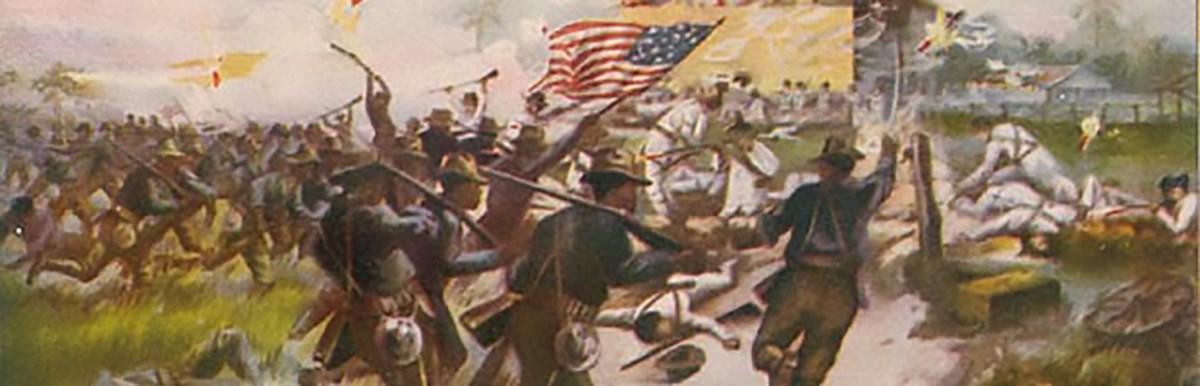
On February 15th, 1898, over 250 American sailors were killed when the battleship Maine blew up and sank in Havana harbor. The war with Spain began in April, 1898 when Major General William Shafter, a former commander of the 24th Infantry led an expeditionary force of over 17,000 men, including nearly 3,000 Black regulars, into Cuba. (11) Although the Spanish American War was ostensibly fought to liberate Caribbean and Philippine islanders from Spanish oppression, the participation of African American troops was very controversial in the African American community. Some troops and many citizens openly questioned whether African Americans should fight for the U.S. government that recognized them as citizens in name only. Despite emancipation nearly 40-year before, Blacks routinely were deprived of their rights by federal and state laws. Instituional discrimination was reinforced by savage murder and terror of African Americans primarily in the South. Articles in the Black press during the war showed a diversity of opinion in the African American community. The Army did not want Black officers during the war, creating a major contention with the African American community EDITORIALS AGAINST FIGHTING "If the Government Wants Our Services,
EDITORIALS FOR FIGHTING "What if War Comes"
"War Has Been Declared by the United States Against Spain"
In order to prepare for the invasion of Cuba, the Buffalo Soldiers were posted to the southeastern United States for the first time in their history. Originally billeted near Tampa, Florida, where overt racial discrimination was the norm, local white citizens refused "to make any distinction between the colored troops and the colored civilians" and tolerated no infractions of local discriminatory laws and racial customs. Despite this prejudice, the troops of the 9th and 10th Cavalry, and the 24th and 25th Infantry served with distinction on the battlefields of Las Guasimas, El Caney, and San Juan Hill. (12) The terrain and climate were challenging. Troops had to deal with heat, rainstorms, mud and yellow fever. When there was an outbreak of yellow fever in the army camps, Black 24th Infantry soldiers served as nurses and hospital orderlies for the stricken Caucasian troops, ordered to do so because of the stereotype that Blacks were physically better able to deal with tropical heat conditions. (13) 
In four months of fighting the Spanish under these adverse conditions, the Buffalo Soldiers were described as "most gallant and soldierly." (14) During one landing at Tayabacoa, Cuba, 10th Cavalry Privates William H. Thompkins, Fitz Lee, Dennis Bell, and George Wanton voluntarily went ashore in the face enemy fire to rescue wounded U.S. and Cuban comrades. After several failed attempts, they succeeded. Each were awarded the Medal of Honor. (15) A career soldier, Thompkins was eventually buried at the Presidio's San Francisco National Cemetery, along with another 450 Black veterans of the 9th and 10th Cavalry and the 24th and 25th Infantry. After the Battle of San Juan Hill, Rough Rider Frank Knox said, "I never saw braver men anywhere." Lieutenant John J. Pershing wrote, "They fought their way into the hearts of the American people." (17) Theodore Roosevelt commented "… no one can tell whether it was the Rough Riders or the men of the 9th who came forward with the greater courage to offer their lives in the service of their country." (18) Despite this praise, incredibly Colonel Roosevelt later wrote: "Negro troops were shirkers in their duties and would only go as far as they were led by white officers." Tenth Cavalry Trooper, Presley Holliday wrote in response, "His (Roosevelt's) statement was uncalled for and uncharitable, and considering the moral and physical effect the advance of the 10th Cavalry had in weakening the forces opposed to the Colonel's regiment, both at Las Guasima and San Juan Hill, altogether ungrateful and has done us an immeasurable lot of harm…not every troop or company of colored soldiers who took part in the assaults was led or urged forward by a white officer." (19) Many African Americans felt the deeds of the soldiers in the battles of Cuba, and later in the Philippines would perhaps lead to "a new era for the Negro race" in obtaining equal rights and privilege as Americans. They honored the soldiers' valor and service to the United States with books, pictures, orations, poems and editorials. One newspaper editor stated the general feeling of African Americans, "we are proud of our colored troops, the heroes of the day." (20) < Return to Buffalo Soldiers Home |
Last updated: February 9, 2022